
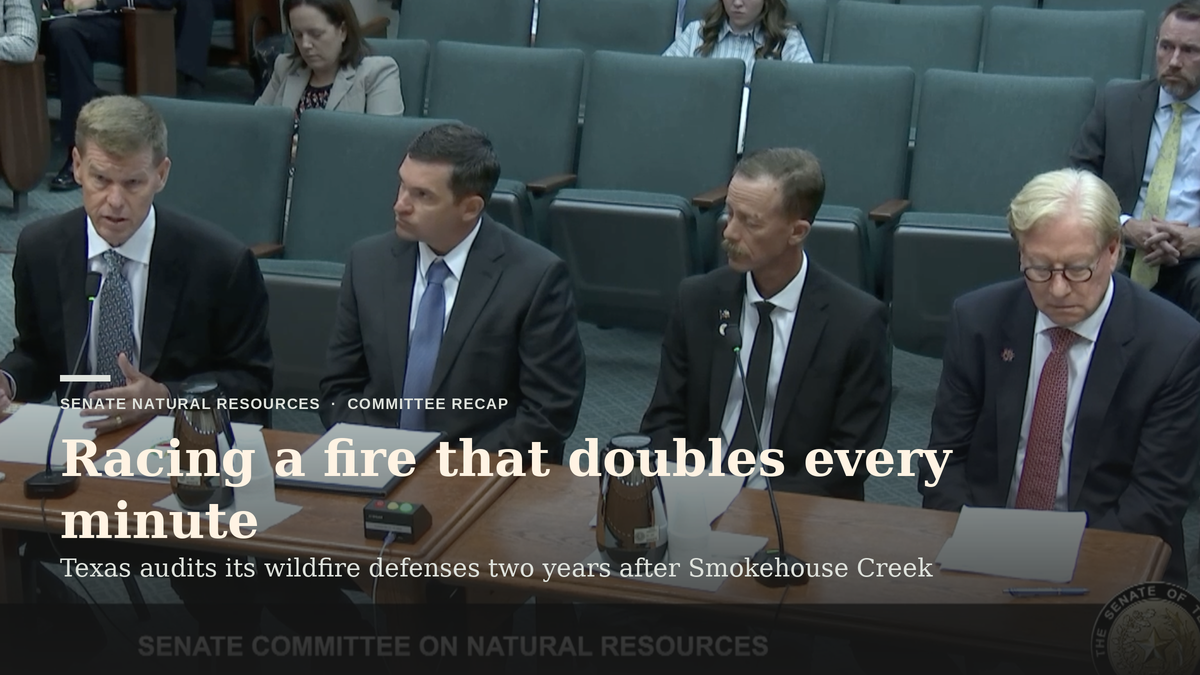
Two and a half years after a snapped utility pole ignited the largest wildfire in Texas history, the Senate Committee on Natural Resources spent more than three hours Tuesday auditing every layer of the state’s wildfire defenses — and heard that the machinery lawmakers built in 2025 is largely on schedule, but that the hardest questions, from powerline liability to who approves a utility’s mitigation plan, are already queued up for the next Legislature.
The wildfire charge consumed roughly 210 minutes of a nearly six-hour hearing, and as The Texas Dispatch previewed last week, it carried personal weight for Chairman Kevin Sparks, R-Midland, whose district includes much of the Panhandle range scarred by the 2024 Smokehouse Creek fire.
The most vivid case for speed came from Nim Kidd, chief of the Texas Division of Emergency Management. “We know that fire almost doubles in size every 60 seconds,” Kidd told the committee. “The faster I get on that fire, the faster I knock it down, the more damage I can limit… if I’m 200 miles away, that baby is growing. So the more that we can pre-position assets in areas where we know there’s an increased danger, the faster that response will be, the fewer acres” burned.
Sen. César Blanco, D-El Paso, pushed the state’s responders toward technology. “In the age of AI… are there technologies such as AI cameras, drones, things that can help mitigate these fires, to be able to get there faster, in these remote areas?” he asked Kidd, crediting TDEM’s response to fires near Presidio in his far-flung West Texas district, where “time is of the essence as it relates to mitigation.”
Vice Chair Judith Zaffirini, D-Laredo, worked the seams of the state’s response system, asking witnesses to “differentiate and identify the difference between the need for urban firefighting and wildfire fighting” and to walk through the factors that drive wildfire risk assessments — drawing an explanation of how wildland crews and structural departments mix resources through the Texas Interstate Fire Mutual Aid System on fires where the two worlds collide.
The charge instructs the committee to assess “the vulnerability of utility infrastructure in high-risk areas” — the phrase that points squarely at Smokehouse Creek, which a House investigative committee traced to a decayed utility pole, as The Texas Dispatch previously reported. Connie Corona, executive director of the Public Utility Commission, told senators the agency has “created new rules intended to identify risks, improve oversight of utility infrastructure, and help reduce utility-related wildfire ignitions,” implementing House Bill 144, House Bill 145 and Senate Bill 1789 — the 2025 suite covering risk assessment, pole inspection and wildfire mitigation planning.
A pro forma mitigation plan, she said, “helps promote consistent implementation across the utilities, and is particularly helpful to smaller utilities that have fewer resources.” House Bill 143, she added, codified a memorandum of understanding between the PUC and the Railroad Commission creating a process to de-energize dangerous private powerlines in the oil patch.
Mark Bell of the Association of Electric Companies of Texas warned members not to file wildfire away as a rural problem: “We often think of wildfires as affecting only rural communities, but with our population growth, we have to be sensitive to wildfires impacting larger population centers.” He described vegetation management in transmission rights-of-way and, “under the most extreme fire risk conditions, judicious use of the public safety power shutoff to de-energize specific circuits in order to minimize risk.”
But Zachary Stevenson of Texas Electric Cooperatives flagged the first statutory fix request of the afternoon: the PUC read the new law to require a “fully contested case” to approve a utility’s wildfire mitigation plan, a process he said co-ops “would like to see maybe reconsidered at the statutory level.” Sparks pressed Corona on how many utilities are tracking the pro forma plan, and she acknowledged that while most attestations have been filed, “the plans themselves have yet to be filed for a lot of folks.”
Erin O’Connor, mitigation and prevention department head at Texas A&M Forest Service, thanked the panel for “the historic investments you made in our agency” and reported that the statewide fuel study ordered by Senate Bill 34 — Sparks’ own wildfire-response law — is “on schedule to be completed this fall,” dividing the state into 16 regions by fuels, weather, topography and fire history.
The real-time statewide database of firefighting equipment required by Senate Bill 767, another Sparks bill, is also in development. Those deliverables land just as the committee drafts its recommendations: Sparks read the charge’s coordination-and-resiliency language back to witnesses and told them, “That is what we need to cover in our report. So we would like your input specifically regarding that section” — a clear signal of where the 90th Legislature’s wildfire agenda will start when it convenes in January 2027.
On fuel, the testimony converged on a blunt economic argument. Greg Creasy of the Texas Parks and Wildlife Department called prescribed fire “an essential tool in reducing hazardous fuel loads to better protect communities, private properties and natural areas,” and witnesses cited research finding that every dollar invested in fuel management saved $3.75 in suppression and recovery costs.
Chuck Linton, president of the Prescribed Burn Alliance of Texas, Sean Benedict of the Nature Conservancy in Texas, and Archie Stone, wildland coordinator for the Borger Fire Department, rounded out a panel arguing the state’s fuel problem is solvable with more burning, not less.
The afternoon’s rawest testimony came from the public rows. “I personally have been a victim of wildfire,” said Steven Smith, a Panhandle landowner. “I was burned in the Smokehouse Creek fire. I’ve lost animals, infrastructure and lots of grassland numerous times.”
Agricultural aviators told the committee several hundred privately owned aircraft — roughly a third of them based in the Panhandle and West Texas — stand ready to drop on fires if the state can figure out how to fold them into its response. Fred Richardson of the Austin Area Firewise Alliance, representing 45 neighborhoods in Travis County, urged members to seed similar community-level organizations statewide.
Because the committee met in the interim, it took no votes; the hearing ended with the panel in recess subject to the call of the chair.
Also heard: The hearing opened with roughly 53 minutes of oversight testimony from TCEQ, the Railroad Commission and the General Land Office, followed by an 85-minute deep dive into the rollout of the state’s new produced-water laws, SB 1145 and HB 49 — including a turf question the two agencies asked the Legislature to settle. That story is covered in the companion recap, “24 million barrels a day: Texas’ produced-water rollout advances as regulators ask lawmakers to draw the line between them.”
Hearing at a glance
Issue
Interim charge “Protecting Texas from Wildfires” (~210 minutes, ~60% of hearing)
What happened
TDEM, PUC, Texas A&M Forest Service, TCEQ, TPWD, utilities and prescribed-fire advocates reported on the 2025 wildfire-law rollout; co-ops asked lawmakers to revisit the contested-case requirement for mitigation plans; no vote (interim hearing)
When
Tuesday, August 11, 2026, 9:00 AM CT · run time ~5:48
Where
Room E1.012, Capitol Extension, Austin
Chair
Sen. Kevin Sparks, R-Midland (SD-31)
Key witnesses
Nim Kidd (TDEM chief); Connie Corona (PUC executive director); Erin O’Connor (Texas A&M Forest Service); Mark Bell (AECT); Zachary Stevenson (Texas Electric Cooperatives); Greg Creasy (TPWD); Chuck Linton (Prescribed Burn Alliance of Texas); Steven Smith (Panhandle landowner)
Archived video
senate.texas.gov, vid 22698