
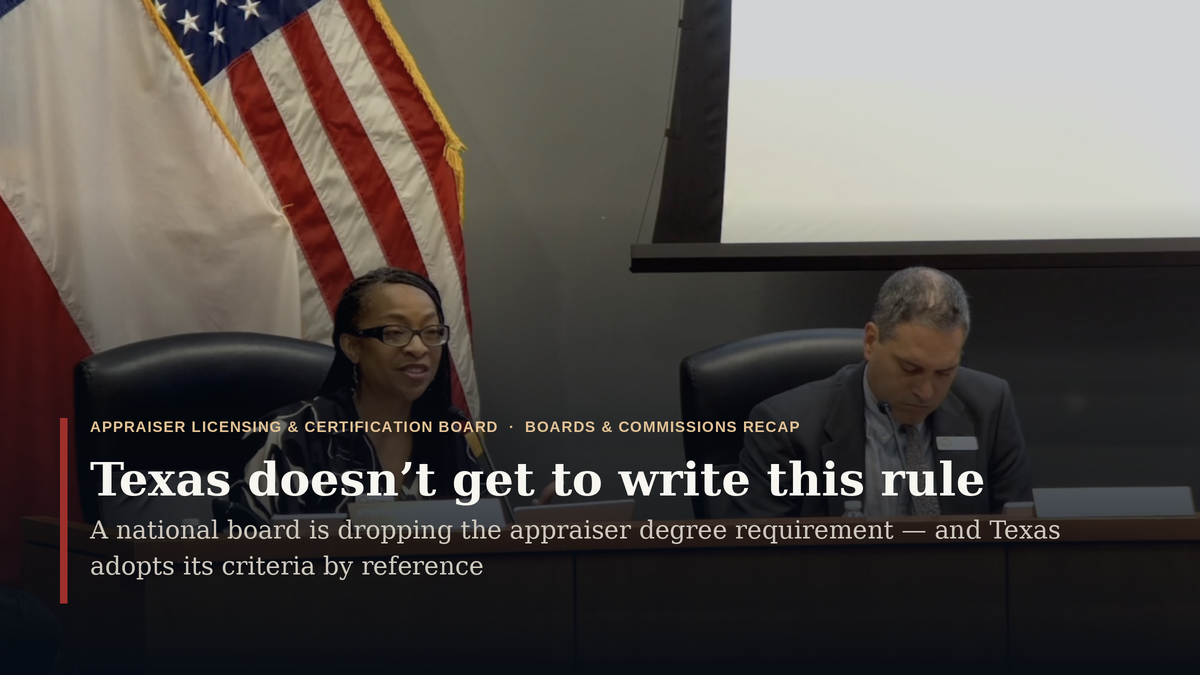
Two trustees of the Appraisal Foundation drove to Austin on Friday morning to tell the Texas Appraiser Licensing and Certification Board that the profession it regulates is running out of people. They got about ninety minutes, most of the meeting, and they left with the board’s chair on the record against the centrepiece of their proposal.
The reason the visit matters more in Texas than in most states is a piece of housekeeping the visitors themselves praised. “The state of Texas should be commended because basically you apply the [Appraiser Qualifications Board] criteria by almost by reference,” Pete Fontana told the board. “There’s only nine states that call that out in their statute that whatever the criteria is, that’s what they’re going to apply. They’re not going to have any overlays.”
That is accurate, and it is the whole story. Texas rule — 22 TAC §153.13 and §153.15 — says applicants “must meet all educational requirements established by the AQB” and “all experience requirements established by the AQB,” with no dated edition named. When the Appraiser Qualifications Board changes the national criteria, the Texas requirement moves with it, without TALCB rewriting either rule. The compliment Fontana paid the board is also a description of how little say it has.
Fontana — a Foundation trustee who chairs its State Harmonization Task Force, and who told the room he had just come off the board after “17 years of of that 12 years as the chair” and now considers himself “a recovering regulator” — framed the change as crisis management. Residential appraisers must move to the redesigned UAD 3.6 report on November 2, and he expects a share of them simply to quit rather than learn it: “we’re looking at a 15 to 20% reduction in people just retiring because they don’t want to use the new technology based.”
“In South Carolina, they lost 300 appraisers. The renewal ended July 31st. 300 appraisers didn’t renew,” he said. “They just retired because they weren’t going to do the new work with the new form. And so they lost 29% of their appraisers in one renewal cycle.” He put the average age of the profession at “almost 60 years old” and said the Federal Housing Administration, which collects birth dates for the roughly 30,000 appraisers on its roster, shows “their average age on the on the FHA roster 61.” In Alaska, he said, the Department of Veterans Affairs has “170 unassigned cases” nobody will take.
His diagnosis of why the pipeline is empty was blunter than anything the board said back to him. The bottleneck is finding a supervising appraiser willing to take a trainee. “We’ve got to get by this theory of protectionism in our business where the only way you can get into this profession is to know somebody,” he said. “If this was in a government agency, if we were a government agency, we would be engaging in nepotism because when you ask people how they got in the business, my dad was an appraiser, my mother was an appraiser, my sister, my brother. I’m guilty. My sister and my nephew are two of my employees.”
Later, arguing that boards should police bad work rather than police entry: “What we shouldn’t be doing is trying to keep people out of a profession uh through protectionism and through nepotism. That’s what we shouldn’t be doing because the industry is dying.”
The fix in the AQB’s second exposure draft has two halves, and the board objected to the second one.
The first is a “demonstration pathway” that replaces supervised experience hours outright — only at the entry-level Licensed Residential credential. As Fontana put it: “the proposal is to get into the license level that you would take the education, the exam, and then you would write three demonstration reports and that would be approved and then you would be licensed not certified only the license level to get you in the practice.”
Randy Flowers, the second trustee and the one the Foundation has assigned to Texas as its standing liaison, said his own programm already works that way in Missouri: candidates “can’t have someone else write their report. They have to write it themselves and then they have to defend that report to a board. So it’s very rigorous.”
The second is the elimination of the college-degree requirement for the two certified credentials. Flowers listed it alongside the rest — expanding PAREA to certified general, scrapping the six- and twelve-month time-in-grade minimums (“the time requirement doesn’t mean competence”), letting candidates sit the national exam straight after qualifying education instead of years later, and dropping continuing education for trainees.
Fontana’s case for cutting the degree was regional, and aimed squarely at a state with a lot of small towns in it. “We’ve got a lot of certified residential appraisers that are really well-qualified to do commercial work, especially in these rural states. We’re not talking about appraising, you know, like Churchill Downs or the MGM Grand. We’re talking about appraising six and 12 unit properties in rural states where you need a general certified appraiser to do it. But if they don’t have a college degree, they have no chance to move up.”
Chair R. Chance Bolton did not accept it. “We are traditionally certified general, have a college degree, the public knows that and there is some trust that comes from that. Taking that requirement away, how does that ensure the public trust? That’s our whole mission,” he said — and then, without waiting: “Well, it seems like it would erode the public trust from an education standpoint.”
A member on the board followed him with the question the whole draft turns on, and apologized for not having the vocabulary to ask it. “Who monitors the success or failure of the changes we’re making to reduce barriers?” she asked. “I’m all about reducing barriers in our industry, right? because I don’t want us to be underrepresented… But I want to make sure also that in that process of of reducing barriers and taking different things away, training, continuous education, that sort of thing, that we’re still protecting the consumer and having a high standard within our field.”
If there are not enough appraisers, Fontana argued, the mortgage market will value the house anyway — just not with a person. “If you can’t supply an appraiser to them to give them a valuation for that collateral risk, that to me is a violation of public trust,” he said. “Because what’s going to happen is the people with the big bag of money, particularly Fannie and Freddie, they will get these values, these collateral values one way or another through AVMs, through hybrid appraisals, through desktop appraisals, and then you can’t file a complaint against an AVM. So, if that loan defaults and they try to file a complaint against the appraiser because the appraiser was bad, you can hold that appraiser accountable. Well, you can’t hold an AVM accountable. They’re going to get these values one way or another.”
A board member said the automated future was closer than that. “At some point the banks are going to be confident in the AI models to say, I can just push a button. I can get a number instantly. I don’t need an appraiser. And I think that’s coming,” he said, and then, of the draft’s safeguards: “we’re going to see a significant reduction whatever standards are in place as a result of that.”
Flowers, who told the board he holds a doctorate in education and was previously a college dean, agreed the banks were already there — “there are banks that are already moving into that and they’ve they’ve accepted that risk as a bank” — and defended the degree change as a swap rather than a subtraction: a bachelor’s in “art history, you know, how does that apply to appraising?” against new required coursework in statistics and analysis.
One board member said during the exchange that he was writing to the AQB himself — “I’m planning on it. I’m actually drafting it now” — after Fontana noted that one comment already filed would keep the degree requirement for certified general and drop it only for residential. Whether TALCB will comment as a board was never put to a vote. The comment period closes August 30.
The board took no action on any of it. It could not have: none of this is Texas’s to decide. That is the point Fontana was complimenting them for.
Meeting at a glance
When
Friday, August 7, 2026. The date was fixed a meeting in advance — the November 14, 2025 minutes record future dates “February 20, 2026, May 15, 2026, August 7, 2026, and November 6, 2026.”
Governing body
Texas Appraiser Licensing and Certification Board — an independent subdivision of the Texas Real Estate Commission. Nine members: four appraiser, four public, one ex officio. Chair R. Chance Bolton (Bee Cave, appraiser member, chair since May 19, 2025); Vice Chair Martha Gayle Reid Lynch (El Paso); Rolando F. Castro; Tony “Mark” Luna, Jr. (Lubbock); Clayton Ripley (Austin, public); Stephanie L. Robinson, Ph.D. (McKinney, public); John H. Eichelberger III (Houston, public); Paola Escalante-Castillo (Weslaco, public); Mark McAnally, ex officio for the Veterans Land Board. Executive Director Chelsea Buchholtz; General Counsel Kathleen Santos; CFO Ranada Williams.
Archived video“Texas Appraiser Licensing and Certification Board (TALCB) Meeting 08.07.2026” (2:09:56), TREC and TALCB YouTube channel, posted August 10, 2026. Auto-generated captions only. The same meeting is archived without captions on AdminMonitor.