
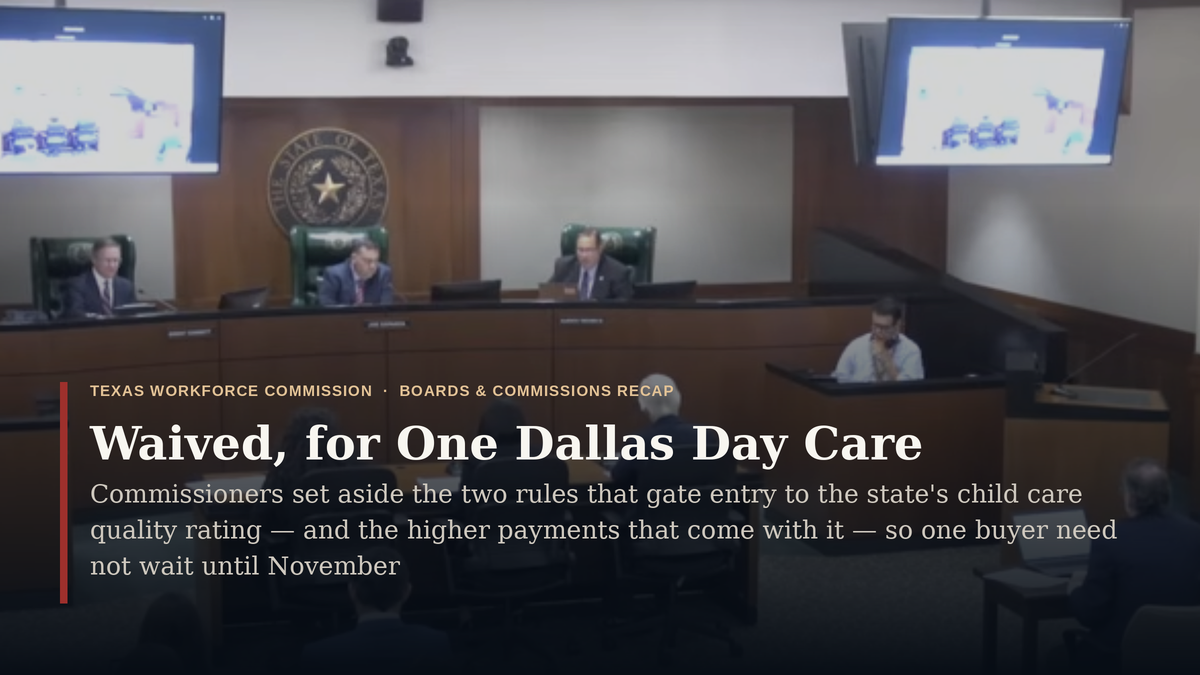
A Dallas child care center that recently changed hands can start chasing higher state payments almost two months earlier than the rules allow, after Texas workforce commissioners voted Sept. 8 to set aside two of their own eligibility requirements for its new owner.
What the owner gets is a shot at Texas Rising Star, the state’s quality rating for day cares that accept publicly subsidized children. The stars are worth money. A rated provider must be paid at least 5 percent more per subsidized child than an unrated one at two stars, 7 percent at three and 9 percent at four, and the regional workforce boards that write the checks are free to pay above those floors. A provider without a rating collects none of it. Texas paid for care for an average of 149,268 children a day in fiscal 2024, at roughly $705 a child a month.
The catch is that a rating does not come with the building. Someone who buys an existing center is issued a fresh license in their own name, which leaves the buyer holding neither of the two things the state demands before it will send an assessor: a permanent, nonexpiring license, and a year of licensing history. The seller’s stars stay with the seller. Until the clock runs out, the new owner is paid the base rate for every subsidized child in the building.
Commissioners have already decided to fix that. The rewrite of the state’s child care rules they adopted a week earlier, on Sept. 1 — the package The Texas Dispatch reported on before that vote — adds a grid covering what happens to a rating when a center is sold, moved, split, expanded or changes type, and it treats the permanent-license and one-year-history requirements as met when a facility changes hands. Staff told commissioners that piece does not take effect until Nov. 1.
Reagan Miller, who directs the agency’s Child Care and Early Learning Division, brought the request to the dais. She identified the applicant only as a Dallas-area provider seeking an assessment for “the program that they recently purchased.”

A commissioner asked what happens to the next buyer caught in the same gap. Each one would have to come to the commission individually, Miller said — “if we have any more, we would have to bring those forward to you for your consideration” — and she added that “with any luck, we won’t have many more of these since the rules will be effective very, very soon.” The agency has not said how many buyers are sitting in that gap right now. The motion passed without dissent.
Commissioners hold standing authority to waive their own child care rules when doing so benefits a parent, contractor or provider, and they use it roughly once or twice a year; they waived this same permanent-license requirement in November 2023 for home day cares switching permit types. What is different is the reason. This waiver is not patching a flaw somebody found in the rule. It bridges a gap the commission opened itself, by adopting relief in September that does not arrive until November. The Dispatch previewed the vote on Sept. 7.
Nobody outside the agency has said anything about the rewrite driving all this. No child care trade group or advocacy organization filed public comment on it or has taken a public position, and the previous version of the same chapter drew zero comments. Those groups were loud about the law behind it: arguing in 2025 for the bill that lets boards pay rated providers the full state rate, Children at Risk told senators that paying providers only what local parents can afford “creates Child Care Deserts in the very communities where they are already a problem.”
The Nov. 1 date rests on what staff said aloud. The adoption has not yet appeared in the Texas Register, and until it does — and the new grid with it — any other Texan who buys a day care and wants the state to come rate it has to ask three commissioners in person.