
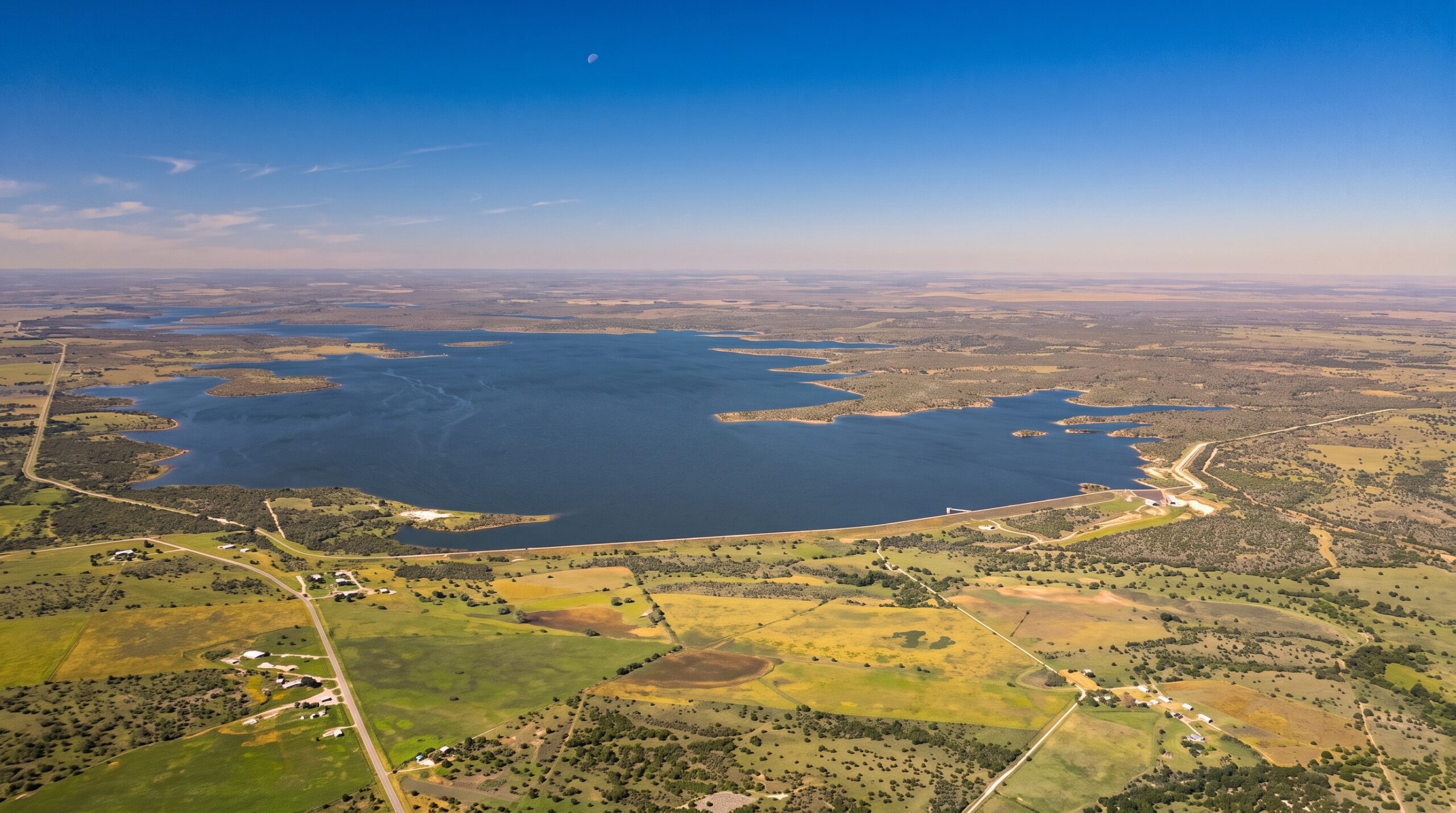
The Texas Commission on Environmental Quality’s executive director signed an emergency order on Aug. 25 letting Corpus Christi stop sending fresh water downstream to Nueces Bay. Among the findings supporting it was that the city “is currently in Stage 2 of its DCP” — the second tier of its drought contingency plan. Two days later, on Aug. 27, City Manager Peter Zanoni announced Corpus Christi was dropping to Stage 1.
The three commissioners take up the order at 9:30 a.m. Sept. 9, and they can affirm it, change it or throw it out. That hearing is not discretionary: state law requires one within 15 days of an emergency suspension, and Sept. 9 is the fifteenth day.
What the order suspends is an arrangement more than two decades old. Corpus Christi’s water right requires it to pass fresh water downstream into the Nueces Delta and Nueces Bay on a sliding scale tied to how full its reservoirs are. Fresh water pushes back against salt water in the shallow upper end of the estuary, where fish, shrimp and crabs spend their early lives. A 2001 agreed order sets the monthly targets, and when combined storage in Choke Canyon Reservoir and Lake Corpus Christi falls below 30 percent the releases stop automatically. They had been off for well over a year until summer rains lifted the system back above the line.
The emergency order raises that shut-off point to 50 percent, which in practice means the releases stay off. It runs 120 days, to Dec. 23, and renews itself automatically for another 60 days — to Feb. 21, 2027 — if storage is still below half full. By the executive director’s own arithmetic, “approximately 36,500 acre-feet of inflows would need to be passed through” over that term absent the suspension. An acre-foot is about 326,000 gallons. September and October carry the heaviest targets on the schedule, 11,500 and 9,000 acre-feet at the current storage tier.
The city’s case is that it is still in a drought worse than any on record. Its application, filed Aug. 11 with the Nueces River Authority and the city of Three Rivers, says reservoir levels “have hovered at historic lows” and that the water is “critical to meeting regional water supply needs.” Corpus Christi supplies close to 80 percent of the water demand across an eleven-county region. The order records that the city spent 596 days in the most severe stage of its drought plan before emergency curtailment, that combined storage hit an all-time low of 7.7 percent in May, and that new groundwater supplies will not deliver treated water until February 2027 at the earliest. As of Sept. 9 the system was about 41 percent full — but that average conceals a split: Choke Canyon is under a quarter full while Lake Corpus Christi is nearly brimming.
No one asked the commission to set the order aside. Three groups asked it to be narrowed. The National Wildlife Federation and Gulf Trust, represented by attorney Myron Hess, want the automatic renewal removed — “Providing for an automatic renewal is simply another form of issuing the Emergency Order for a term of 180 days” — and want the smallest monthly target, 1,200 acre-feet, kept in place, which they calculate would still give the city about 90 percent of what it asked for. They also asked the commission to correct the Stage 2 finding, quoting the city’s own site: “Stage 1 indicates a mild water shortage.” The Coastal Bend Bays & Estuaries Program disputes the order’s finding that no harm has been shown. Executive Director Kiersten Stanzel wrote that salinity in Nueces Bay, which normally averages 22 to 26 parts per thousand, “reached 40 ppt prior to spring rains,” and that the delta, “which should be the freshest area with salinities in the teens, reached salinities greater than 55 ppt.” Because the state sets no numerical salinity standard for Texas bays, she wrote, “the absence of such complaints does not establish that elevated salinity has had no effect on the estuary.” Ray Allen, writing for the Coalition About the Restoration of Estuaries and a former executive director of the bays program, asked that three acre-feet a day still reach Rincon Bayou.
The Texas Parks and Wildlife Department took no side. Executive Director David Yoskowitz wrote that the agency “neither supports nor opposes the Application,” but recommended the order be limited to 120 days and that the commission “reassess the conditions existing at that time.” The Office of Public Interest Counsel supported it in full. Four residents of one Corpus Christi street filed identical notes backing it: “As a resident impacted by water restrictions, I 100% support suspending water releases.”
The Dispatch previewed the vote Sept. 8. Whatever the commissioners decide, the order as written carries the city into next spring without a further vote.