
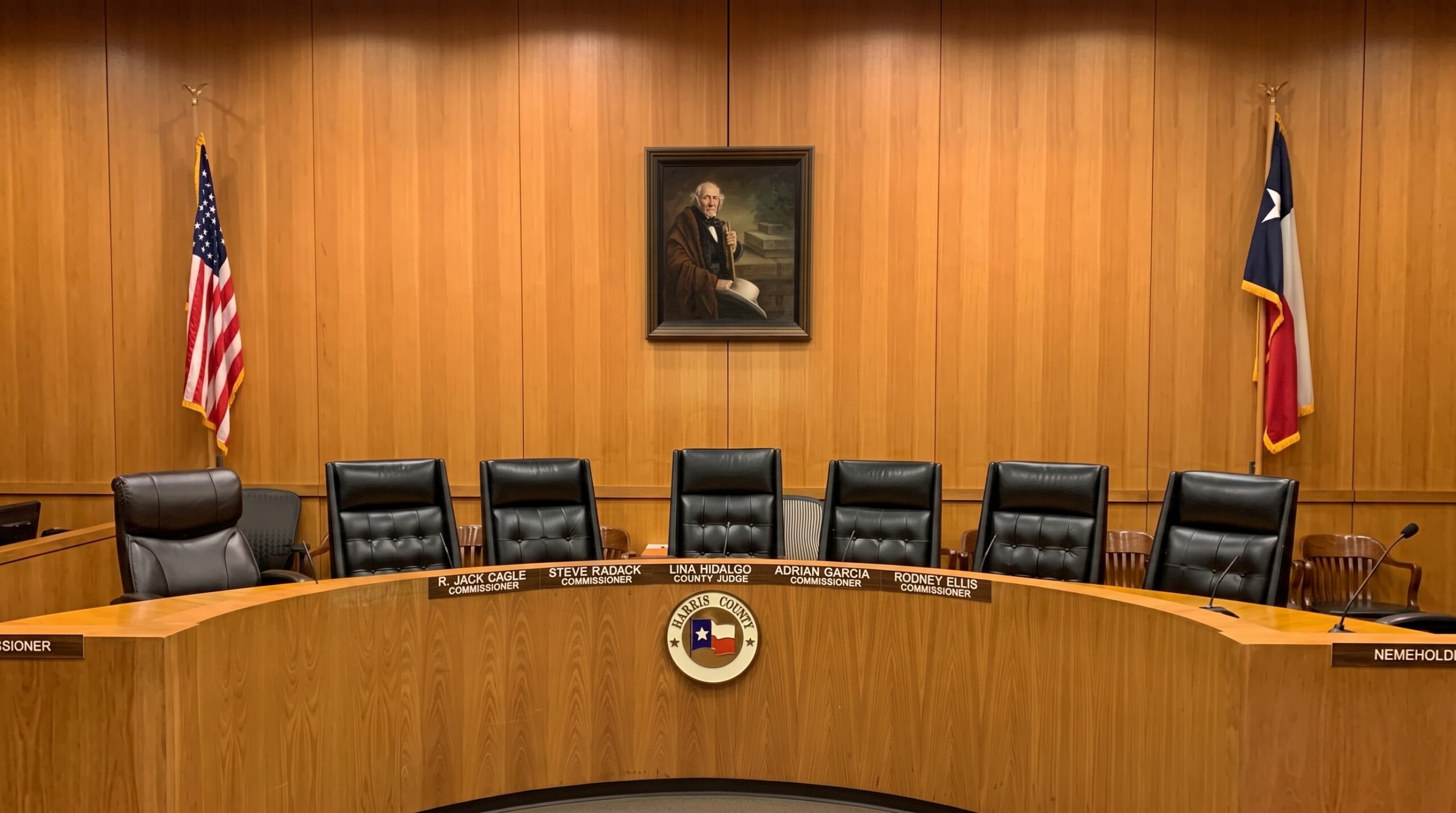
Harris County commissioners voted Sept. 8 to advance a property tax rate for the coming year that sits at the exact ceiling state law allows them to set without holding an election, and the county’s own notice says the owner of a median-valued home would pay $86 more because of it.
The rate is not final. The court set a maximum and called the public hearing that has to come before adoption, which is scheduled for Sept. 17 at 9 a.m. Commissioners can still come down from the number they advertised. They cannot go above it without starting the notice process over.
For a household, the arithmetic is short. The county’s public notice for the Sept. 8 meeting states that the proposed rate “would increase the tax on the median-valued homestead property by $86 compared to the current year (from $891 in tax year 2025 to $977 in tax year 2026).” Had the court instead adopted the rate that would raise the same amount of money from the same properties as last year, the notice says, the bill would have gone up $14.
What makes this year’s number unusual is where it lands. Every Texas taxing unit calculates a voter-approval rate — the ceiling above which it must ask residents to approve the increase at an election. The budget office recommended a county rate of 41.750 cents per $100 of taxable value. The worksheet certified by Tax Assessor-Collector Annette Ramirez on Sept. 3 puts the county’s voter-approval rate at 41.750 cents. They match to the ten-thousandth of a cent. The same is true of the Harris County Flood Control District, recommended at 5.266 cents against a voter-approval rate of 5.266 cents, and of the Port of Houston Authority at 0.603 cents against 0.603 cents. Three of the four entities the court sets rates for are proposed at the highest figure that avoids an election.
The fourth is not. Harris Health System, the county’s public hospital district, is proposed at 19.528 cents against a voter-approval rate of 23.917 cents.
The document behind the vote is the budget office’s “OMB Recommended Tax Rates for Tax Year 2026,” attached to the court’s agenda. It shows the county rate rising from 38.096 cents to 41.750 cents, an increase of 9.6 percent, with the debt-service portion up 21.7 percent. Across all four entities the combined rate would go from 62.413 cents to 67.147 cents, up 7.6 percent, and the hospital district’s debt-service rate would rise 62.9 percent.
The alternative was set out at the meeting. Commissioner Tom Ramsey pushed to hold the county at last year’s 38.096 cents; officials said that option could require roughly $243 million in budget cuts, Fox 26 Houston reported. According to that account, the county rate advanced on a 3-2 vote, with Ramsey and County Judge Lina Hidalgo opposed, while the Harris Health rate advanced 4-1. Hidalgo, who supported the hospital district and flood control increases, said afterward that the county budget was still not fixed: “We are patching the bullet hole with a Band-Aid for one more year.” Harris Health chief executive Dr. Esmaeil Porsa said the rate “allows us to continue the path that we’ve been on for the last six or seven years.” Harris County has not published minutes of the Sept. 8 meeting, and no vote tally appears in its public records system.
Harris is not the only large county setting rates this month, and the others are going in different directions. Bexar County has proposed 29.9999 cents, which is below its no-new-revenue rate of 30.9043 cents; its notice states plainly that “BEXAR COUNTY is not proposing to increase property taxes for the 2026 tax year.” Bexar votes Sept. 15. Fort Bend County takes its record vote Sept. 10 on a total rate of 41.2 cents, four ten-thousandths of a cent above its own voter-approval rate of 41.156 cents. And Dallas County chose the one path Harris did not: it adopted a rate of 24.865 cents, above its 22.465-cent voter-approval rate, and ordered an election for Nov. 3 to let voters approve or reject it. If they reject it, the order says, “the tax rate of the County of Dallas will be the voter-approval tax rate.”
The Dispatch reported last week on the first round of those rate-setting decisions. Harris County’s budget must be settled before its fiscal year begins Oct. 1, which leaves the Sept. 17 hearing as the last scheduled chance for residents to speak before the rate is locked in.