
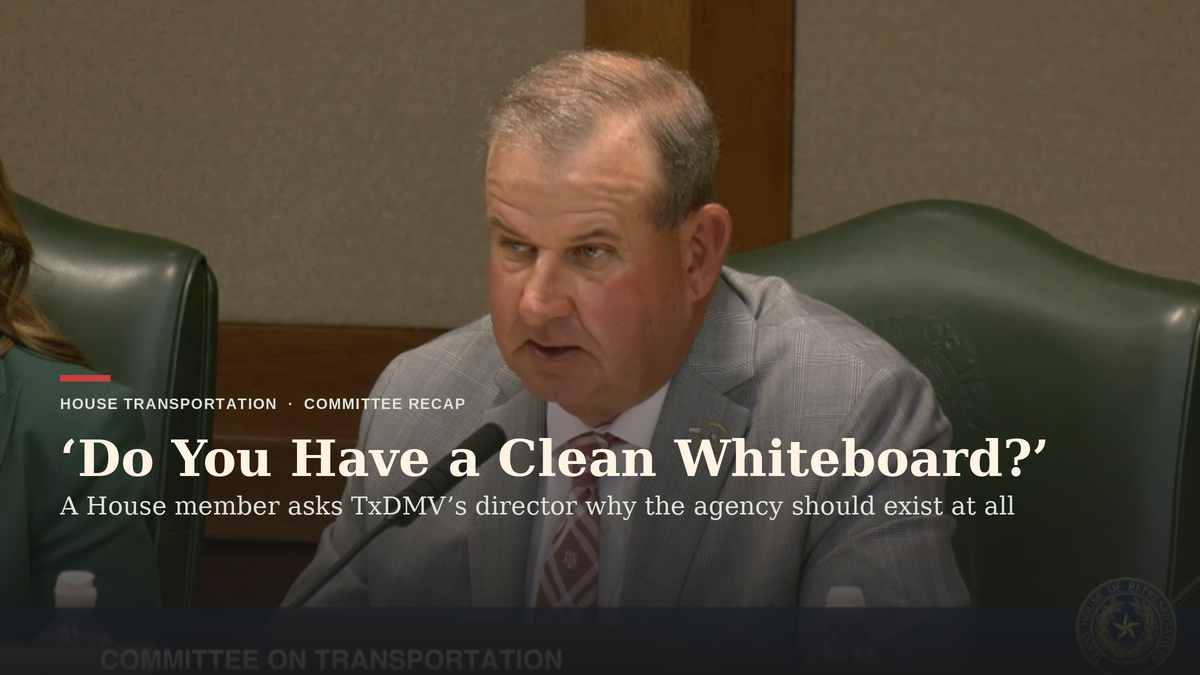
Rep. Pat Curry spent much of the House Transportation Committee’s Aug. 17 interim hearing asking a question that no state agency wants asked out loud: why does the Texas Department of Motor Vehicles exist? “So I’m trying to figure out exactly what. Why DMV exists. I want to understand why we need separate agencies to do some of these things,” Curry told Executive Director Daniel Avitia. “It was reformed in 2009, correct?”
The exchange ran through a 79-minute review of the department’s statutory duties, the second-longest charge on an eight-charge agenda, and it ended with Curry handing Avitia a hypothetical. “If we could redesign the agency today?” he asked. “Do you have a whiteboard? Do you have a clean whiteboard? What would you do?” Avitia declined to answer on the spot: “I can’t answer that question right now without giving it some thought.” Curry pressed again — “I’m asking for now. Knowing what you know now, what would you do to make this highly efficient for the state of Texas and its taxpayers?” — and Avitia allowed only that the question was fair.
What Avitia did concede is that the work is far from finished. “Are we perfect? Absolutely not. Do we still have a lot of work to do? Absolutely. I’ll be the first one to say that there’s probably another six years worth of work, at least to further streamline and modernize this agency,” he said. He dated the turnaround to his own arrival in the top job: “We have taken the DMV from four years ago, we almost forgot that we were a customer service agency. I will say that. So I have had to retool this agency starting four years ago.”
The department Avitia described is large and cash-heavy. TxDMV handles “registration of 27 million vehicles, titling of 7.7 million vehicles” and permitting for oversize and overweight loads, he said, and “these operations collectively result in an estimated $4.5 billion in annual revenue collections for the state. The majority of collections are deposited into the State Highway Fund.”
Two capital projects are running at once. Curry turned to the registration and title system rewrite: “So in the 89th, there was 125 million appropriated to that. Tell us about that, the revamp of that project. How’s that going?” Avitia was unusually blunt about what the state has been running on. “When I saw the usage of this system, it was terrible. It was awful. In fact, it was the worst system I think I have ever seen,” he said. “I would like to wake up one morning and not worry about this system turning on in the morning and working. It often crashes because it’s 30 years old.”
He said the rebuild is “on time and on budget,” but would not promise the appropriation would cover it: “My hope is that I don’t have to come back and ask for more money… I want to be very careful not to disclose dollar amounts about anything at this point.” Separately, he said, “aside from this $125 million modernization project, we also have $143 million headquarters project where we are currently living kind of in a house of rubble, if you will.”
Rep. Marc LaHood asked how much of the technology money is going to defense: “How much of the money that’s being spent was spent on cyber security or shoring up any of the security on the back end?” Avitia deferred the specifics to a private briefing — “of course, security being a very private thing, we don’t want to talk about that very openly” — but said the agency has “begun the process of implementing identity and access management already.”
Curry also demanded a paper trail on the metal-plate conversion the legislature ordered in House Bill 718, which replaced paper temporary buyer tags after criminals exploited them. Avitia said the program had “original budget for that program was $35 million” and that “to date, the agency has spent $27.8 million implementing that bill,” coming in roughly $7.2 million under. Curry wanted more than a number. “So I’d like the details on that, please, if you don’t mind getting those in my office. And I’d like to see the contracts as well,” he said. “A real accounting of what we’re talking about here.” Avitia offered to bring the agency’s chief financial officer.
The dealer community backed the crackdown while indicting the department’s customer service. Bentley Durant, legislative chair of the Texas Automobile Dealers Association, told members the tag fraud “began as an administrative problem became an organized crime problem and a threat to law enforcement officers across Texas,” and that dealers stayed at the table through a rocky rollout: “The system was clunky, errors occurred, and plates were misdelivered. But we stayed at the table.”
His complaint was licensing. “When I applied for an independent dealer, license, communication was poor. Questions went unanswered, clarification requests were ignored and the process dragged on for months,” Durant said. “We say Texas is open for business. Long licensing delays and poor communication are the opposite of that.” He set a benchmark for the 90th Legislature: “A complete dealer license should be decided in 15 days or less.”
Durant also objected to how the department writes rules — “Massive document dumps, such as the ones we experienced back in 2024, shortly before meetings do not allow us to meaningfully participate in the process” — a theme Curry picked up with the agency’s general counsel. He noted the department rewrote its rules extensively in 2024 and did “a total makeover again of the rules” in 2026, leaving regulated businesses chasing a moving target.
General Counsel Laura Moriarty attributed the second pass to a state efficiency review that told the agency to strip language that “was unenforceable, where it was not supported by statute, where it was redundant with statute.” Curry’s follow-up was the practical one: “So should we expect another big rule set of rule changes in 2028.” Moriarty said stakeholders should expect changes “as we space out our rule reviews over four years.”
Caroline Love of the Texas Association of Counties supplied the institutional history Curry was reaching for, and a caution. She worked at TxDOT during the 2009 sunset review that created the department, she said, and the original design also contemplated moving driver licensing out of the Department of Public Safety — a transfer that never happened. Whatever lawmakers do next, she said, the department does not operate alone: “When DMV says that they register 27 million vehicles and titles over 7 million vehicles each year, what they really mean is DMV and its county partners administer those 27 million vehicles and 7 million titles together.”
No votes were taken because the hearing was an interim proceeding. Curry’s closing formulation — “I think that’s part of our job is to figure out where we’ve been, what we’ve done with what we’ve gotten and where we’re going” — reads as groundwork for a structural bill in the 90th Legislature, which convenes in January 2027.
Also heard
The committee’s largest topic block by time was ports: back-to-back panels on the ship channel improvement revolving fund created by Senate Bill 1939 and on the economic weight of Texas seaports ran roughly 93 minutes combined, with Texas Ports Association President Larry Kelly warning that TxDOT’s own budget request for the 90th Legislature would eliminate both the revolving fund and the state’s maritime infrastructure program. Members also spent 54 minutes on nondomiciled commercial driver licenses and federal English-proficiency rules, 37 minutes on how TxDOT communicates roadway closures, 31 minutes on automated speed enforcement in work and school zones, and 25 minutes on whether legislators should direct TxDOT’s local project selection.
Fact box
Issue
Interim charge reviewing the statutory duties of the Texas Department of Motor Vehicles and legislative oversight of TxDMV, TxDOT and the Texas Transportation Commission (~79 minutes, ~18% of hearing)
What happened
Rep. Pat Curry questioned whether TxDMV should remain a stand-alone agency and demanded contracts and a full accounting of the $27.8 million metal-plate program; Executive Director Daniel Avitia said the 30-year-old registration and title system was “the worst system I think I have ever seen” and that modernization needs “another six years worth of work”; dealers asked for a 15-day licensing standard; no vote (interim hearing)
When
Monday, Aug. 17, 2026, 9:30 AM CT
WhereRoom E2.012, Capitol Extension, Austin
Chair
Rep. Tom Craddick, R–Midland (HD-82)
Archived video
house.texas.gov, video 22755