
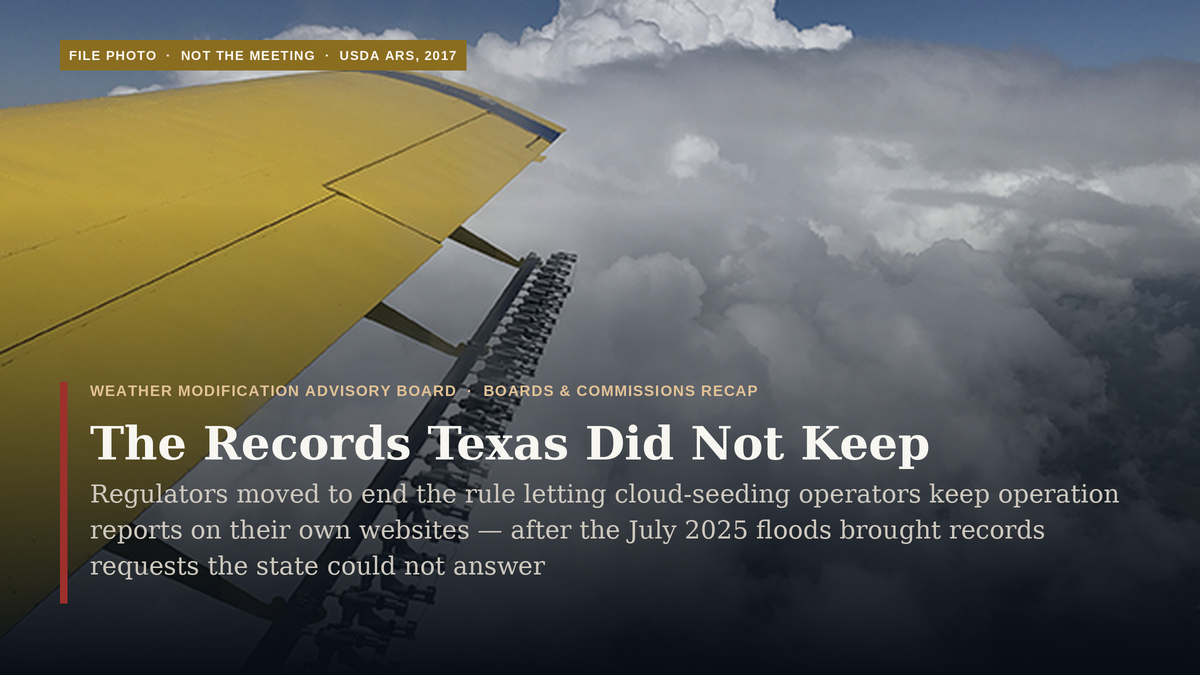
When the public went looking for Texas cloud-seeding records after the July 2025 floods, the state agency that licenses cloud seeding did not have them.
On Aug. 27 the Weather Modification Advisory Board voted to propose fixing that. The rule it advanced would end an arrangement, seven years old, under which licensed weather modification operators may satisfy their reporting duty by posting operation reports on their own websites instead of filing them with the Texas Department of Licensing and Regulation.
Assistant General Counsel Steven Leary put the origin of the change plainly. “So last summer in response to the flooding that occurred, there were a whole lot of inquiries and open record requests and so forth about the operation reports,” he told the board.
The existing rule is 16 TAC §79.33, and the load-bearing word in it is or. Operators must report “in writing to the department, or on a publicly-accessible website.” As Leary described it, “the license holders are allowed to furnish those reports on their own website instead of sending them into TDLR.”
That has left the agency answering records requests for documents it never received. “What staff has found is that that that method is getting in our way,” Leary said. “We don’t control those operations websites and sometimes those reports are hard for the public to access on those websites.” And: “we’re having to tell people we don’t have those reports and that they need to go to the operation website.”
He noted the statute points the other way from the practice: “The statute itself requires that we make those reports available to the public.”
The proposed change is modest in text and consequential in effect. Operators would keep posting to their own sites but would also “send TDLR a copy of those reports on a quarterly basis,” and a new subsection would put the obligation on the agency: “The department’s going to make sure that those records are open for public inspection either by posting on our website or providing a good link for the public to click on and access those reports.”
One correction, and it matters because it assigns responsibility for the gap. Leary told the board the website option “was a change that was made a number of years ago at a state auditor’s suggestion to kind of reduce paperwork on the department side.”
The amendment took effect Feb. 15, 2019, and the rulemaking preamble attributes it to a recommendation from the department’s own internal auditor — TDLR’s in-house audit function, not the independent state agency that audits Texas government. The Dispatch found no State Auditor’s Office report on TDLR weather modification.
The flood that drove all this did not, on the evidence, have anything to do with cloud seeding. The July 4, 2025 Central Texas floods killed at least 135 people, including 119 in Kerr County. Viral claims blamed a cloud-seeding flight, and TDLR investigated: the seeding at issue happened the afternoon of July 2 over Karnes County near Runge, roughly 130 miles southeast of Kerr County, on two small clouds that dissipated the same afternoon — more than a day before the storm complex that caused the flooding.
TDLR concluded the operation “did not contribute in any way” to the rainfall. Independent atmospheric scientists have been uniform that seeding cannot produce a flood on that scale; the University of Colorado’s Katja Friedrich has noted that seeding material typically remains in the atmosphere only two to four hours. What the episode did produce was a wave of public suspicion — and a demand for records the state could not hand over.
The volume of that demand is Leary’s account, not a documented figure. TDLR has published no count of cloud-seeding records requests, and the Dispatch could not independently confirm a surge.
Leary was careful about what the Legislature actually did. Senate Bill 2075 of the 89th Legislature standardized TDLR’s three dozen advisory bodies, which had been variously called boards, committees and councils. “For this program, the only major change it made is it renamed the advisory board,” he said. The rest is delegated: the bill “authorized the commission by rule to set the composition number of members and terms for all of our program advisory boards uh that don’t have those things specified in statute.”
Weather modification is such a program. Agriculture Code ch. 301 lets TDLR create an advisory board and says nothing about how many people sit on it. “So right now just by tradition you’re a five member board,” Leary said, “and we just have a sort of a variety of people on it just based on what the commission feels is best but it’s not really set in rule.”
The draft would set it in rule: seven members — two meteorological or other scientific experts, two farmers or ranchers, one pilot or aeronautic expert, and two members of the public — on six-year staggered terms. The scientific seats have a specific rationale. “we don’t really have any meteorologists on staff,” Leary said; the agency employs hydrologists and leans on the board for atmospheric expertise. By his count it currently has one such member.
The pilot seat drew the meeting’s only real dissent, from the member who would seem likeliest to welcome it. James P. Nance, who holds the board’s atmospheric scientist seat, argued the aviation slot should go to someone still doing the work. “I am a pilot and I guess I could call myself an aeronautical expert, but I would suggest that you get a pilot that is doing the work,” he said. “I’m a retired Air Force helicopter pilot and I have flown with those folks down in in South Texas, but it’s been a long time.” He recommended the agency find someone “a little more current in that” — and then declined to offer a formal amendment. The board proposed the package as drafted.
Two cautions on where this stands. Nothing here is law, or even a formally proposed rule yet. No amendment to 16 TAC ch. 79 had been published in the Texas Register as of Aug. 28; the chapter contains no §79.70, the new advisory-board rule the draft would create. Leary told the board the package still faces review, a 30-day comment period after publication, a likely second board meeting and a six-month adoption deadline. And the rules have not caught up with the statute in the meantime: §79.13 and §79.17 still say “Weather Modification Advisory Committee,” a body that by statute no longer exists under that name.
Which leaves the practical question the floods raised. For at least the next several months, if a Texan wants to know what a licensed operator flew over their county and when, the state that issued the license still has to send them somewhere else to find out.