
Correction, Sept. 11, 2026. An earlier version of this story said no record of the Sept. 3 vote had been posted. TDHCA says the board approved the draft that day and posted the outcome to its social media accounts. The story also omitted that the plan keeps a general waiver rule under which an applicant may ask the board to excuse any requirement, including this one. Both points have been added.
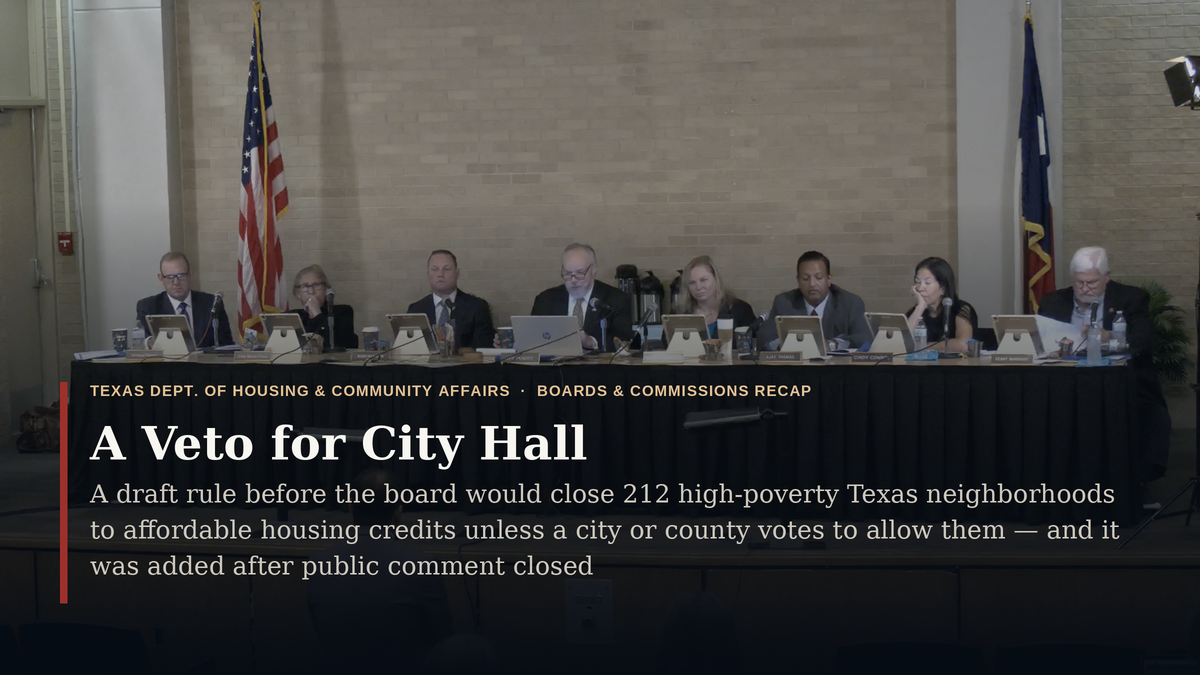
Texas would bar new subsidized apartments from its poorest neighborhoods unless the city council or county commissioners vote to let them in, under a draft rule put before the state housing board Sept. 3.
The neighborhoods are census tracts where more than 40 percent of residents live below the poverty line — 55 percent in the border regions from Del Rio to Brownsville and around El Paso. A Texas Dispatch analysis of current census estimates finds 212 tracts that would trip the line, home to roughly 666,000 people; Harris County alone has 68.
Under the rules now, that poverty rate is a flag, not a wall. A developer can answer it by showing the neighborhood is improving, or that the project is needed to keep the state in compliance with fair-housing law or a court order. The draft strikes those answers, leaving a resolution from the city or the county as the only route named. One general escape valve survives: under a separate rule an applicant may ask the board to waive any requirement, though the request must show the need is “not within the Applicant’s control or is due to an overwhelming need,” and competitive applicants cannot file one between applying and the award.
Nobody commented on the change, because it was not there to comment on. The July 14 staff draft still treated a high poverty rate as something a developer could mitigate; the version that reached the board Aug. 31 had moved it into the list of conditions that make a development flatly ineligible. The developers’ trade group filed a 14-point comment letter Aug. 14 that never mentions it.
The part that hands the decision to city hall is the part federal tax authorities have told states to avoid. The IRS, in a 2016 ruling written against a fact pattern resembling the Texas program of that era, said the tax code

The argument for steering credits away from the poorest neighborhoods comes from tenant advocates, not developers. But the Texas group most identified with it does not make it as bluntly as the draft does. Texas Housers wrote in April 2025 that “the research is clear that high-poverty, low-opportunity neighborhoods are harmful to tenant well-being” — while noting in the same passage that building subsidized housing in “high poverty, distressed neighborhoods can increase the property values and decrease the crime rates of surrounding areas,” Its recommendation was to weight opportunity scoring more heavily, not to close neighborhoods off.
The same group is on record that local approval is what keeps affordable housing out of the areas it wants to reach, calling it “a barrier due to pressure that local decision makers receive from residents who oppose affordable housing.” The draft does both things at once — it pushes development out of poor neighborhoods and makes a local vote the only exception. No Texas advocacy group has taken a public position on that combination, and none should be described as supporting or opposing the draft.
This agency has been to the Supreme Court over where it puts these apartments. Inclusive Communities, the 2015 decision establishing disparate-impact claims under the Fair Housing Act, began as a suit over TDHCA granting too many credits in poor Black neighborhoods and too few in white suburbs. The agency won on remand.
What it has not done is explain itself. No rationale appears in the 243-page draft, in either preamble, or in the write-up staff gave the board, which describes the addition in one sentence and never mentions that three existing provisions were struck to make room for it. Nor has it published how many tracts the line would close, or which year’s census data it would use — a live question, because a 40 percent cutoff sweeps in college neighborhoods where students count as poor. Brazos County, home to Texas A&M, has more qualifying tracts than Dallas.
The board approved the draft Sept. 3, the agency says, posting the outcome to social media; the minutes remain in draft and no tally has been published. What the board changed from the floor is not yet public. Comment runs Sept. 18 through Oct. 9, final board action Nov. 5, the governor’s decision due by Dec. 1.