
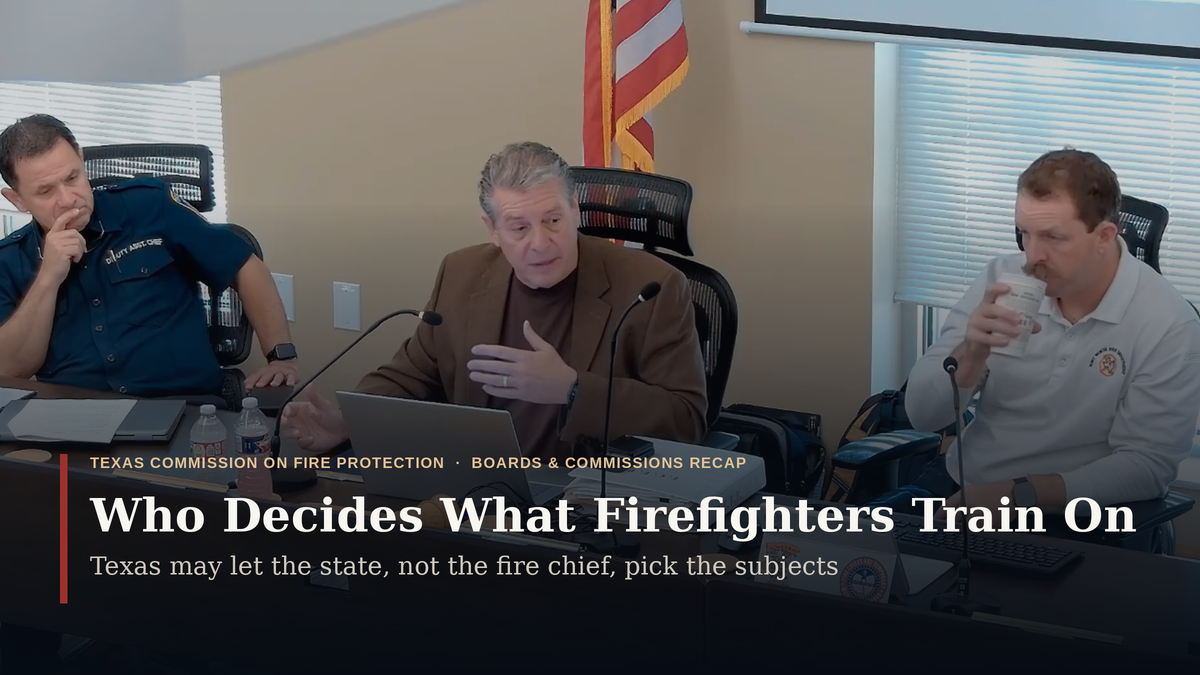
The state could start telling Texas firefighters what to study each year, taking a choice that has belonged to their fire chiefs since at least the early 1990s, under rule language three committees of the state fire commission agreed Oct. 7 to send forward.
About 42,900 people work at the 884 fire departments the Texas Commission on Fire Protection regulates, and the certified ones among them owe the state 18 hours of continuing education a year to keep a card that is good in Laredo, Lubbock or anywhere between. Who picks the subject of those hours comes down to one sentence of state rule: the head of a fire department “may select subject matter for continuing education appropriate for a particular discipline” (§441.5(g)). Two of the 18 hours are already spoken for — every firefighter has to read the commission’s annual injury report. The chief chooses the other 16.
At a joint workshop of the commission’s firefighter advisory, health and wellness, and curriculum and testing committees — the first time the three had met together — members worked toward adding a clause letting the agency assign topics too. As read back near the end of the morning, the chief would keep his authority “unless the topics have otherwise been recommended or assigned by the commission”. No text has been drafted, and the member reading it called it an approximation.
A second change would loosen the two locked hours. Chris Watson, an Austin battalion chief on the curriculum and testing committee, proposed that they cover the injury report “or other current relevant topic” named by the agency — letting it substitute cancer, sleep or mental health in a given year.
What drives all of it is a suspicion that the 18 hours are not buying much. A staff member put the population at 41,000 and described the only routine check: at renewal a department administrator ticks a box saying everyone finished, and compliance officers audit some records afterward. Members said the predictable result is training picked for being easy to document. Asked whether the commission even had the authority to dictate subjects, a senior staff member was blunt. “You have the latitude. That’s why we’re here,” he said.
Not everyone wants it used. Robert Louis Havens, the deputy fire chief in Port Arthur, said he did not “think it’s a good idea for the commission to say that we need more of this specific training”, because the hazards of one Texas town are not those of the next; his own department carries hazardous-materials crews, a 40-member rescue team and a dive team. Adam Story, Cedar Park’s fire marshal, made a narrower point: because the rule says a chief “may” choose, it burdens no one as written. A staff member warned that proposing to strip the choice outright would “fill this room up”.
The sharpest moment came from a chief who had walked in on the other side. He now runs a small department, he said, where “I’m not only creating the lesson plan, often I’m the guy delivering the training” — and the morning had turned him around.
“An hour ago I was like, no, like the the department should maintain those 18 hours. And where I’m at now is like I’d say take them all.” He wanted the state to own the hours tied to the certificate and leave departments those tied to the job.
The commission has already done a narrower version of this. On May 14 it adopted a standard requiring every regulated firefighter to retake the National Fallen Firefighters Foundation’s Courage to Be Safe course at least every five years, worth four hours of credit. Announcing it then, Agency Chief Mike Wisko said the commission wanted training that is “relevant, practical and grounded in the realities of the job”. He was speaking in May about that standard, and took no position on who should choose subjects. A member told the workshop that when the commission made the course recurring, “nobody pushed back”.
Nothing was decided. There was no vote and no formal consensus, and no one outside the room has taken a public position, because Chapter 441 has not been published for comment and no comment docket exists. The language goes first to the firefighter advisory committee, which may rewrite or reject it, and reaches the commissioners in February at the earliest. It will not travel alone: Wisko told the room the governor’s new regulatory efficiency office is working through the agency’s 278 rules hunting for cuts, and that its edits will be merged with the committees’ before anything reaches a commission agenda. “They think we have too many words.”
The hands-on training mandate came back. The same workshop took up the proposal the Dispatch reported Sept. 25, to require documented hands-on drilling rather than online modules. Bill Crews, a Garland captain, said the demand comes from below: firefighters tell the commission “our chiefs are not giving us hands-on time”. Chiefs pushed back on what “hands-on” means for an administrator, and Sam Baucom, the assistant fire marshal in Kyle, suggested capping computer-based hours instead of defining the alternative. Teaching hours. Holden Wenger, the commission’s certification chief, said TCFP “do not currently accept teaching hours” toward renewal. A senior voice said from the dais that this is a staff interpretation with no rule behind it and will be revisited. A new certificate. Vince Abrigo of McAllen asked the three committees to begin work on a health and wellness officer certification; staff said it is already on the agency’s radar.