
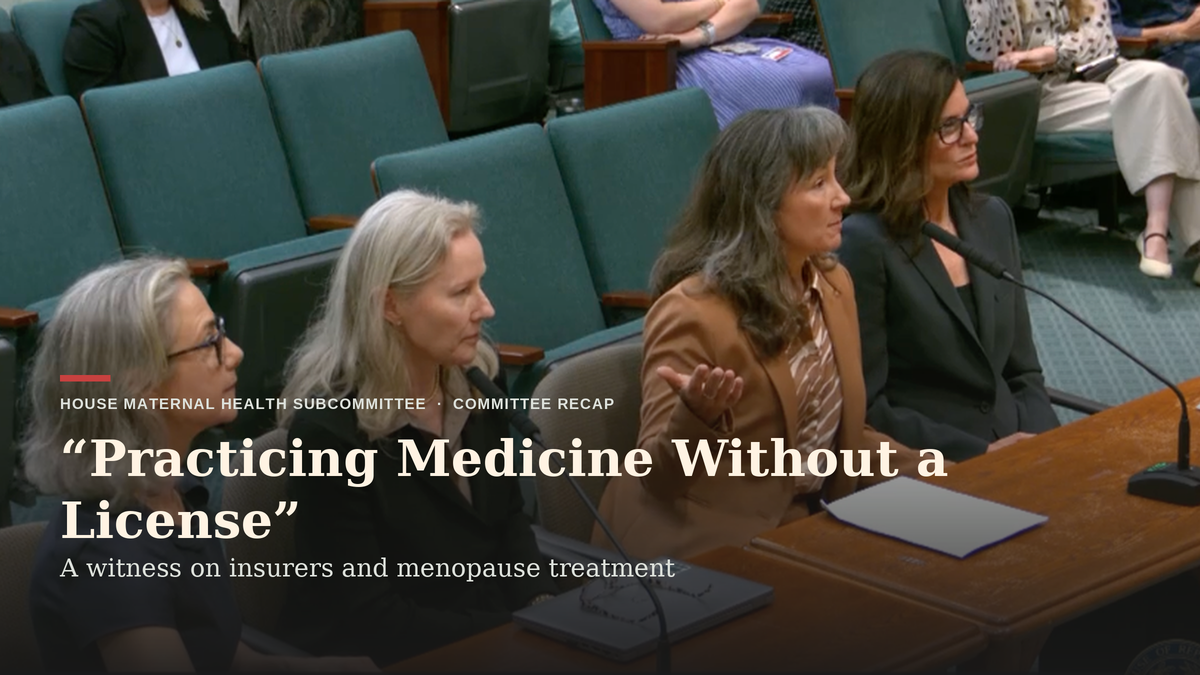
Doctors told a House subcommittee Oct. 5 that insurer rules, thin physician training and Medicaid gaps keep Texas women from menopause care. The health plans’ lobbyist said coverage is not the barrier, and pointed to a surge in claims.
Chair Katrina Pierson, R-Rockwall, framed the hearing around who decides. “The best course of care is a decision between her doctor and herself, not an insurance company or a pharmacy,” she said. Pierson is also behind the women’s health initiative The Texas Dispatch previously reported, which includes a menopause treatment coverage act.
Dr. Mary Claire Haver, an ob-gyn and certified menopause specialist, warned that a coverage bill tied to a menopause diagnosis could shut women out. “If a bill ties coverage to diagnosis of menopause, a woman may have to go a full year without a period before she qualifies. And some women will never be able to prove it at all,” she said. The FDA began removing the black box warning from hormone therapy labels in February, she said, but “changing a label doesn’t retrain a workforce.”
Dr. Jennifer Friedman of the Texas A&M College of Medicine put numbers on the training gap. She said 93% of ob-gyn residency program directors want a standardized menopause curriculum, yet only 31% have one. Dr. Heidi Russell, a pediatrician who directs the Center for Health Policy at Rice’s Baker Institute, went after the plans. “Insurance corporations practicing medicine without a license,” she said. She urged lawmakers to bar step therapy that forces patients onto riskier drugs: “insurance mandated step therapy protocols that require patients to take medications with higher clinical risk profiles, such as oral estrogen over transdermal options, should be prohibited by state and federal law.”
Rural and public-hospital clinicians described the cost to patients and practices. Sheila Larson, a women’s health nurse practitioner at a county hospital, said Texas Medicaid “does not cover any … menopause, perimenopause or menopause medication,” even though a generic regimen can cost “not even $20 a month.” She said she saved one patient from a hip fracture that way. A prior authorization for a newer drug took eight weeks, she said, and ended in a decision that took seconds. Dr. Brian Glymph, an ob-gyn in Nacogdoches, said a month of a newer menopause drug costs $2,100 out of pocket. “Anybody that tells you the insurance companies don’t practice medicine is fooling themselves,” he said. “I will stand by that 100%.”
Jamie Dutton Singh of the Texas Association of Health Plans gave the other side. “Most HRT has no PA or step therapy associated with,” she said, adding that only 4% of drugs carry such rules. Texas law, she said, requires a step-therapy decision within 72 hours. “Really what we’re seeing around trends on this is that the main barrier is not coverage. Since the black box warning has been removed. We have huge claims in our system. We’ve had an 86% increase in claims around this,” she said.
Rep. Joanne Shofner, R-Nacogdoches, pressed the contradiction. “Now, we’ve heard from six other panelists and doctors, etc., who tell kind of a different story than what you have said that the insurance companies are doing the deny, deny, deny,” she said. Dutton Singh could not give an overturn rate for denials, she acknowledged. A member then asked whether TDI should be required by statute to collect prior authorization data. “I don’t think it would hurt anything,” Dutton Singh said. “I have no problem with that.”
Rep. Liz Campos, D-San Antonio, said she wants to move on coverage. She said she is “moving forward with legislation, putting in as much as we can to make sure all of this is covered.” Larson floated another idea for 2027: continuing education on menopause for nurse practitioners, modeled on existing training requirements. Pharmacist Steve Hoffert, who owns Magnolia Pharmacy, asked lawmakers to preserve a woman’s ability to choose treatment “including access to appropriately compounded therapy when commercially available options don’t meet our needs.”
No vote was taken, and no bill number was cited. The presiding lawmaker said, in a summary of the debate, that the issues of “coverage denials, prior authorizations, networks, access, accountability, liability” will carry into the 90th Legislature in January 2027. The Dispatch previewed the hearing and earlier covered the subcommittee’s Sept. 15 hearing.
The panel also took testimony on baseline reproductive hormone testing, about 75 minutes of the hearing. Witnesses split on whether a single early test means anything; see the companion recap, “Doctors Doubt a Single Hormone Test, but Witnesses Urge Texas to Study Baselines.”
Fact box
- Issue
- Hormone replacement therapy for perimenopause and menopause: coverage, access, training and risk (approx. 185 minutes, about 70 percent of the hearing)
- What happened
- Physicians and nurse practitioners described prior authorization, step therapy, training and Medicaid gaps; the health plans association said coverage is not the barrier. Members asked about collecting prior authorization data. No vote — interim hearing.
- When
- Monday, Oct. 5, 2026 · run time 4:22:43
- Where
- Room E2.030, Capitol Extension, Austin
- Chair
- Rep. Katrina Pierson, R–Rockwall (HD-33); members Rep. Liz Campos, D–San Antonio (HD-119) and Rep. Joanne Shofner, R–Nacogdoches (HD-11)
- Key witnesses
- Dr. Mary Claire Haver; Dr. Jennifer Friedman, Texas A&M; Dr. Heidi Russell, Baker Institute; Sheila Larson, nurse practitioner; Dr. Brian Glymph; Jamie Dutton Singh, Texas Association of Health Plans; Steve Hoffert, Magnolia Pharmacy
- Archived video
- house.texas.gov video 22877