
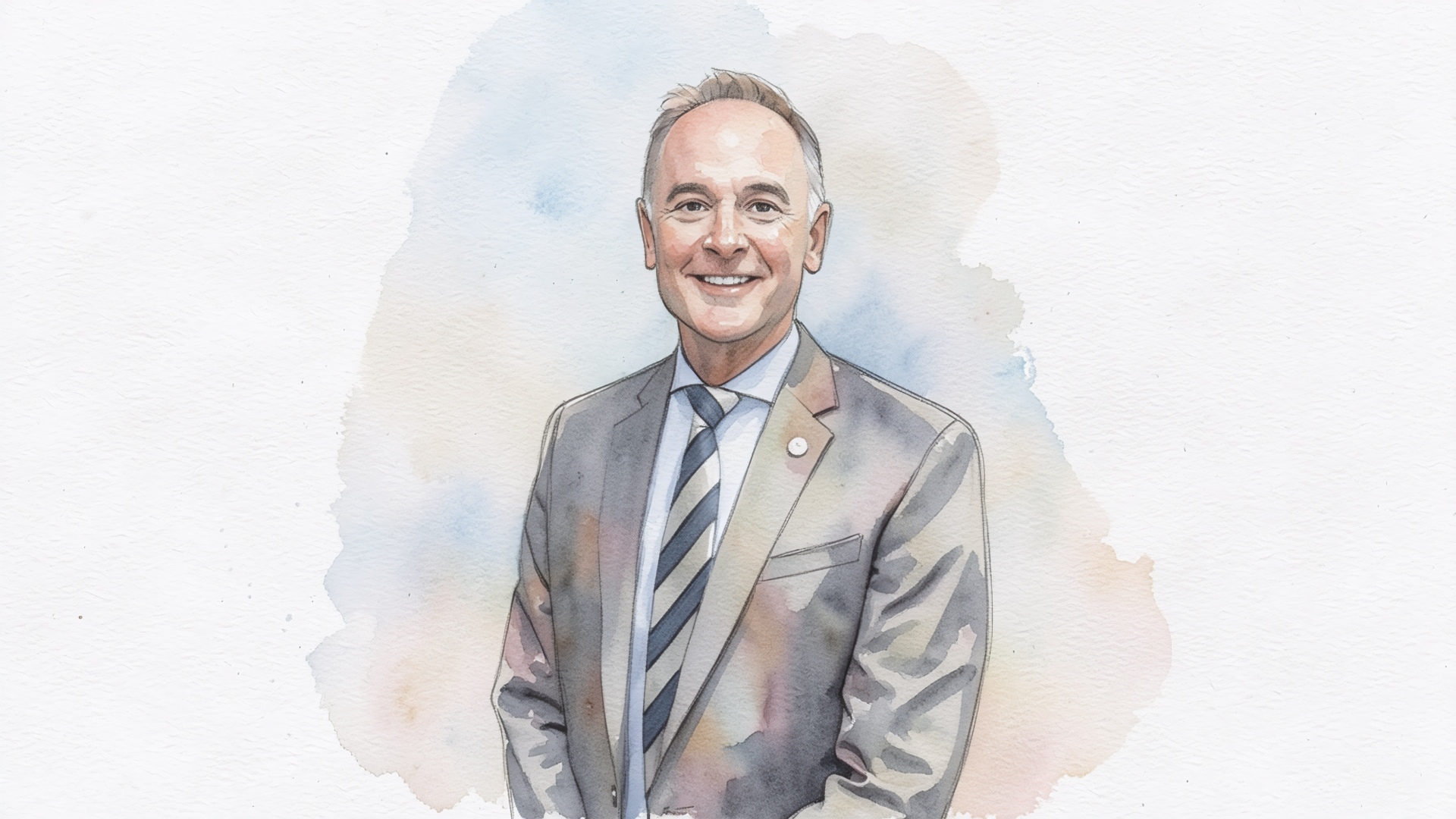
Allen Harrison becomes chairman of the Texas Hospital Association’s board on Jan. 1. The Legislature convenes twelve days later.
Asked whether he’s annoyed at the timing, Harrison — president of Medical City Healthcare, HCA Healthcare’s 22-hospital North Texas division — passes on the joke and answers the real question.
“It’s a privilege and an honor,” he says. “But I recognize it’s a steep hill to climb. There’s a significant challenge in front of Texas hospitals for the next legislature.”
The challenge is that affordability is widely expected to dominate the session, and hospitals are increasingly being named as a reason health care costs what it does.
“There’s a lot of chatter about how large of a contributing factor are hospitals to the issues around affordability,” Harrison says. His conclusion is that the industry has been too quiet. “I think we probably need to elevate our messaging and probably need to be more assertive and more visible in how we present our side of that story.”
This is that story, and the argument he intends to make.
The September that nearly happened
Harrison spoke four days after an episode that gave Texas hospitals a concrete sense of what loss looks like.
On Sept. 1 — the start of the state’s fiscal year — the federal government stopped approving Texas’s supplemental Medicaid payments, the first such interruption since the funding stream began in 2014. The money flows mainly through the Comprehensive Hospital Increase Reimbursement Program, or CHIRP, in which local governmental entities levy roughly $4 billion a year in taxes on hospitals themselves and the federal government matches it, closing part of the gap between what Medicaid pays and what care costs.
By the Texas Hospital Association’s accounting, hospitals were losing $27 million a day.
On Sept. 18, after months of negotiation involving the Governor’s office and the Health and Human Services Commission, the Centers for Medicare & Medicaid Services released nearly $12 billion covering hospitals, physicians, rural clinics, nursing facilities and behavioral health providers.
Harrison’s gratitude is pointed, and so is the ask it sets up.
“We are incredibly grateful to Governor Abbott and to the Health and Human Services Commission, because they held the line for us,” he says. “That for us is just job one. We’re not asking for a lot. We just don’t want to lose what we currently have.”
The arithmetic hospitals want lawmakers to see
Harrison’s case rests on payer mix, and he walks through it quickly.
Hospitals lose money treating Medicaid patients. They lose money treating Medicare patients. And they absorb a growing population of uninsured patients who pay nothing. Together, he says, those three categories typically account for about 70 percent of a hospital’s patients, varying by geography.
That leaves 30 percent with commercial insurance — and here is the line he wants legislators to sit with.
“Commercially insured patients represent more than 100 percent of all the earnings of a hospital,” he says. “And you may think, well, how is that possible? Well, what that means is without them, we’re losing money. Whatever we make comes from filling up the shortfall, and then whatever is left over, that’s our profit.”
Because commercial coverage is bought by employers, that structure puts hospitals and Texas businesses on opposite ends of the same rope. “That’s what creates this friction now between employers and hospitals,” he says. “We’re stuck in the middle of a system that can be frustrating on both sides.”
The statewide Medicaid shortfall at $9 billion in uncovered costs. That figure runs well above the $2.7 billion annual shortfall the hospital association has published in its own materials, which also reports that most Texas hospitals are reimbursed around 73 percent of audited allowable costs — though it tracks closely with the roughly $9.1 billion in CHIRP payments that had been frozen when he spoke.
As for insurers who have taken up the affordability cause, Harrison is unsparing.
“If you’re in the provider space and you hear insurance companies talking about affordability — like, dude, the call is coming from inside the house.”
A hospital is where his father was
Harrison has spent his career in and around hospitals, and he traces it to two months he spent in one.
His father had type 1 diabetes — “kind of when you lose the genetic lottery,” Harrison says. “It’s not a lifestyle issue.” He was diagnosed on returning for the Korean War, having already served in World War II, and was honorably discharged. He was sick for the whole of his son’s childhood. His first major eye operation came when Harrison was four.
“I never had the experience of playing catch with my dad,” he says. “He was just never healthy enough to do that.”
By the time Harrison was in college, his father was on peritoneal dialysis — a shunt into the abdomen, a bag of electrolytes doing the work of failed kidneys. He did an exchange in the morning. Harrison’s mother drove him to work, came back at lunch for another exchange, returned to collect him in the evening for a third. They did that for three years.
Then came a kidney transplant. By then the vasculature around the organ site had atrophied so badly that his father’s body couldn’t sustain the new kidney. He never left the hospital. He was there two months, during Harrison’s senior year of college, and Harrison was there some part of nearly every day.
What he describes next is notable for what it isn’t.
“I didn’t have some conversation with a heroic nurse and an emotional moment,” he says. “I didn’t have a doctor put his arm around me and speak words of wisdom. None of that really happened. But what did happen is, over the course of a couple of months, when you’re there over and over and over again, you start to really understand important things happen in hospitals. Life-changing things happen in hospitals.”
He got comfortable in them. He never left.
He is careful not to turn his father into a cautionary tale. “It wouldn’t be accurate to say that you can’t live a rich and fulfilling life if you don’t have your health,” he says. “We take care of thousands of people who are not healthy, and they are living rich and fulfilling lives. But you pay a price.” His father never complained. “Mad respect for my dad, the way he lived his life.”
Charges are not prices
The most clarifying thing Harrison says has nothing to do with blame.
“Hospitals — we don’t really have prices,” he says. “We have charges. But we don’t ever determine how much somebody is going to pay us unilaterally.”
Medicare pays its rate regardless of what a hospital charges. Medicaid pays off a fee schedule. Commercial insurers negotiate case rates. Only rarely does payment attach to charges at all.
“What is the last time a hospital had a sale?” he asks. “We don’t do sales.”
He concedes the obvious consequence: “It’s not an intuitive economic system.”
That distinction cuts both ways, and it is worth holding onto when he reports that his own system will write off more than $1 billion this year — a figure he states, accurately, in charges rather than in payments it could realistically have collected.
Where the argument is disputed
Harrison’s accounting of losses on public payers is not seriously contested; that Medicaid and Medicare reimburse below cost is well established, and Texas’s uninsured population — roughly five million people, the largest share of any state — is a documented burden on hospital finances.
What is contested is the causal step: whether those shortfalls are what set commercial prices.
That proposition, known as cost-shifting, is rejected by most health economists who have studied it. Work from the RAND Corporation, the National Bureau of Economic Research, the Congressional Budget Office and others points instead to market power and hospital consolidation as the primary determinants of what employers get charged. Several studies have found that lower Medicare rates are associated with lower commercial rates — the opposite of what cost-shifting predicts. Commercial prices in some states run above 300 percent of Medicare.
“Commercial prices are purely based on elasticity of demand in the local market,” University of Southern California health economist Glenn Melnick has argued. “It’s not driven by what they’re being paid by the other guys.”
Harrison, for his part, does not claim hospitals are the engine of health care inflation. He divides spending roughly into thirds — hospitals, pharmaceuticals and physicians — says hospital increases run in the mid-single digits where hospitals have any say at all, and argues that puts the sector near general inflation. “I don’t know what everybody else’s contribution to health care inflation is,” he says. “I would argue ours is pretty modest.”
The forecast they got wrong
Harrison is unusually candid about a bet his industry lost.
When Congress declined to extend the Affordable Care Act’s enhanced premium tax credits, hospitals expected roughly 15 percent of the people who had been using those subsidies to move onto employer-sponsored plans — a shift that would have moved patients from a thin-margin category into the profitable one.
“We were wrong,” he says. “Basically everybody who lost their insurance through the exchanges is uninsured.”
The available evidence supports him. Premiums for the average marketplace enrollee more than doubled for 2026; a KFF survey found about 9 percent of prior-year enrollees had become uninsured, with another 17 percent at risk of dropping coverage. Congressional Budget Office and Urban Institute projections put the national coverage losses in the millions. The attrition was driven by unaffordability, not by migration to employer plans.
He sees a parallel shift inside commercial coverage. Employer insurance, he argues, has functioned for decades as prepaid health care; insurers are now pushing it back toward something closer to catastrophic coverage, with deductibles of $3,000 or $5,000 before the plan pays anything.
“They push that risk onto the patients, the patients can’t bear it, and we write it off,” he says. Texas hospitals collect roughly 40 percent of the patient-responsibility portion, by his estimate. “That’s not the system anybody grew up with. No one has adapted to that.”
Where the workforce stands
One problem has eased. Hospitals can hire new nurses again — at least in a metro the size of Dallas-Fort Worth, where Medical City employs about 20,000 people across 22 hospitals, some 75 urgent care centers, a dozen ambulatory surgery centers and a dozen freestanding emergency departments.
What changed is tenure. “Coming out of COVID, our workforce on the nursing side has just gotten a lot younger,” Harrison says. Physicians who practiced before the pandemic were used to teams they’d worked with for a decade or more. “Most of those nurses have left the workforce. We’ve got enough people, but they don’t have as much experience as they used to.”
The acute shortages have migrated to technical roles: imaging technologists who run CT and MRI machines, and respiratory therapists. “As technology advances, you need more and more sophisticated technicians, and that takes training and that takes time.”
It is, he notes, a solvable problem and a good pitch — virtuous work, good pay, flexible schedules, tuition and loan assistance, sign-on bonuses — and one where community colleges and high school programs are already moving.
What patients would say
Asked what the patients he never meets would tell him, Harrison doesn’t reach for anything flattering.
“If they were really honest, what they’d tell you is: I’m scared,” he says. Even hospital employees feel it going in for a procedure. “If you’re on the other side of that bed sheet, you feel vulnerable.” What patients need, he says, is to be listened to — “I know I don’t always make sense with how I’m asking my questions. It’s because I’m scared.”
And afterward?
“Your finances don’t make any sense at all to me,” he says, speaking for them. “Why is it that the billing part of health care can often be as stressful as the actual provision of care itself?”
Those inside the system know the explanation of benefits is not the bill, that the number will be discounted, that it will probably be fine. Patients don’t.
“That’s how we do business,” Harrison says. “And I think our patients would say, well, it sure would be nice if your billing practices were a better reflection of how much I actually owe.”
It is a striking thing for an incoming hospital association chairman to concede heading into a session about cost — that the part of his industry patients find most punishing is the paperwork, and that they are not wrong.