
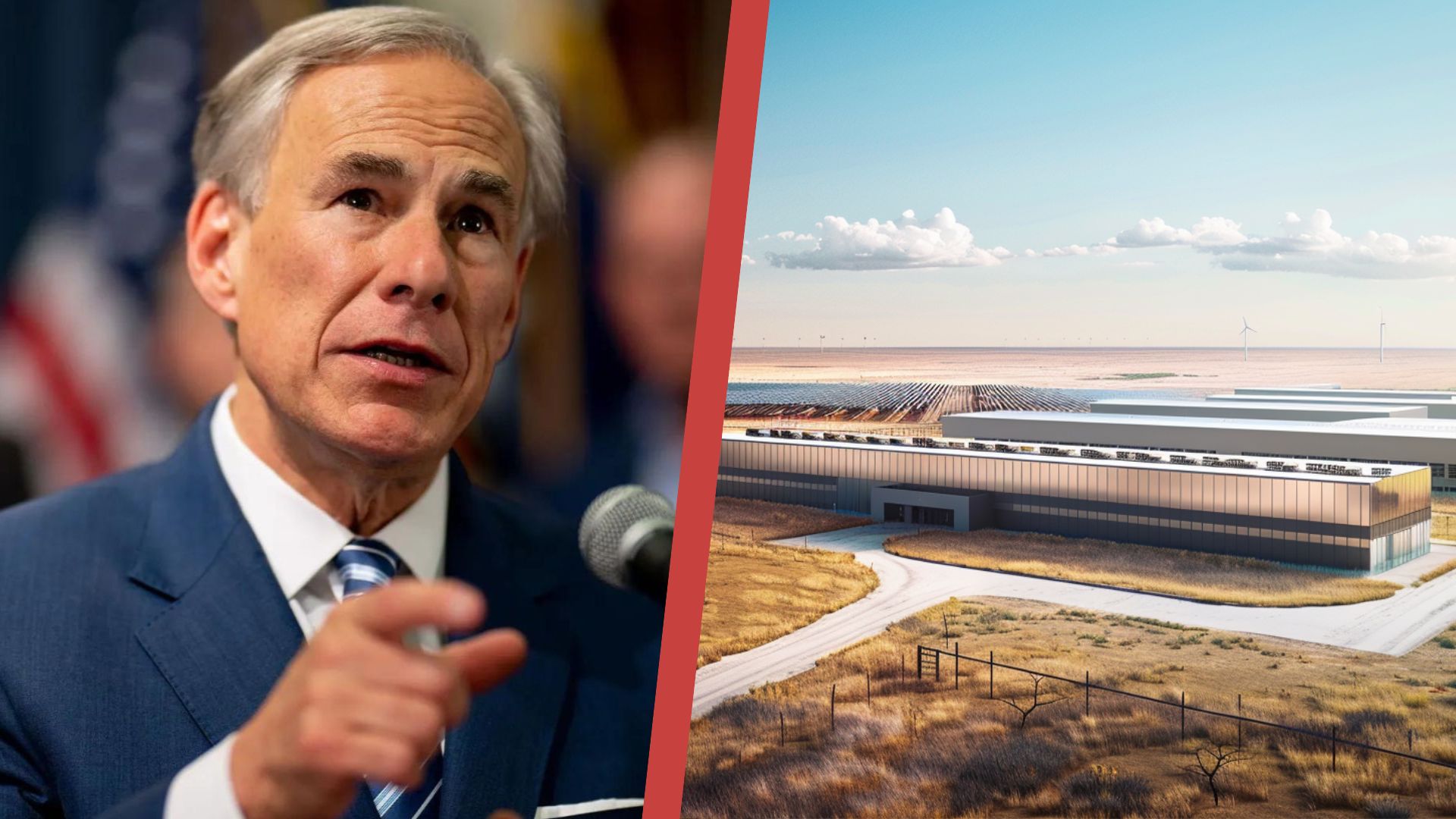
Gov. Greg Abbott on Monday ordered the Public Utility Commission of Texas and the Electric Reliability Council of Texas to conduct a comprehensive verification and audit of every data center advancing through ERCOT’s interconnection process — and to finish the audit before any additional data center is approved to move forward.
Any project that fails to comply with state requirements “must be denied connection to the Texas grid,” the governor wrote in an Aug. 3 letter to PUC Chairman Thomas Gleeson and ERCOT President and CEO Pablo Vegas.
The order amounts to a compliance checkpoint for the largest interconnection queue in the country. ERCOT is currently weighing approximately 474 gigawatts of requests to connect to the Texas grid — more than five times the record peak electricity demand ERCOT has ever served — and roughly 90 percent of the new power requests are data centers, according to the letter. “That unprecedented load growth could endanger the reliability and stability of the Texas electric grid,” Abbott wrote.
The governor said the audit was made necessary by the failure of some data centers to comply with a PUC survey measuring water and power usage required under the General Appropriations Act. “Failure to fully comply with that law hinders your ability to make fully informed decisions,” he told the two officials.
Under the directive, the PUC and ERCOT must collect five categories of information from each project: the extent to which data centers are paying their own way or depending on state and local tax incentives, grants, abatements or other public assistance; projected annual and peak electricity consumption, along with any progress toward on-site generation or other measures to reduce demand on the ERCOT grid; projected annual and peak water consumption, anticipated water sources and the cooling technology to be used, including whether a facility will employ air-cooled, closed-loop or another water-efficient system; measures to reduce impacts on neighboring property owners and communities, including noise mitigation, light controls, setbacks, traffic improvements and emergency response coordination; and the ownership and controlling interests in each project.
That last demand tracks a request the regulators made themselves in response to a previous Abbott letter. In a July 17 memorandum to the governor, reported by The Texas Dispatch, Gleeson asked lawmakers, among other regulatory authorities, to extend the Lone Star Infrastructure Protection Act — the 2021 law barring companies owned or controlled by China, Russia, Iran or North Korea from access to critical Texas infrastructure — to the owners of data centers, warning that “foreign state actors could also maliciously use large computational load facilities to negatively impact the ERCOT grid.”
The data center industry’s chief trade group responded with cautious optimism. “The Data Center Coalition and its members strive to be good actors where we operate, which is why we are hopeful this directive from the Governor will help separate those who are responsible water and energy stewards from those who are not,” said Dan Diorio, the coalition’s executive vice president of state policy and government affairs, in a statement. With “billions of dollars in investment and hundreds of thousands of jobs on the line,” Diorio said, the group urges the PUCT and ERCOT “to move swiftly in order to distinguish between speculative projects and serious, committed investors and community partners.”
“Done correctly, this review can showcase the good actors in the data center industry rather than delaying them unnecessarily, ensuring Texas will continue to be the national leader in economic development,” Diorio said.
Monday’s letter builds on Abbott’s June 10 directive, which ordered the agencies to make data centers fully fund the power lines and substations built to serve them and to report back on further ratepayer protections — a deadline the agencies met with the July 17 memo, as The Texas Dispatch previously reported. The governor has already shown he is willing to enforce those expectations project by project: in July, Diode withdrew a proposed data center near Cedar Creek Lake in Henderson County after Abbott said it failed to meet his standards for grid, water and community protections. “Data centers that want to do business in Texas must meet a clear standard. This project did not,” Abbott said at the time.
The audit also lands amid an intensifying legislative examination of the industry. Senate Finance opened its interim agenda July 27 by scrutinizing the data center sales tax exemption, whose cost is projected to reach $3.3 billion, and two days later ERCOT told the Senate Business and Commerce Committee that data center growth is pushing demand toward 175 gigawatts. Lawmakers cannot act until the Legislature convenes in January 2027 — a sequencing problem The Texas Dispatch has examined in depth, because ERCOT’s “Batch Zero” interconnection review is expected to clear its first wave of projects around April 2027, potentially before any new statute takes effect.
In the meantime, the audit gives the state a lever that requires no new legislation. “Any data center project that fails to comply with the verification and audit process to protect the reliability and resilience of the Texas electric grid must be denied,” Abbott wrote. “Simply put, Texans must come first.”