
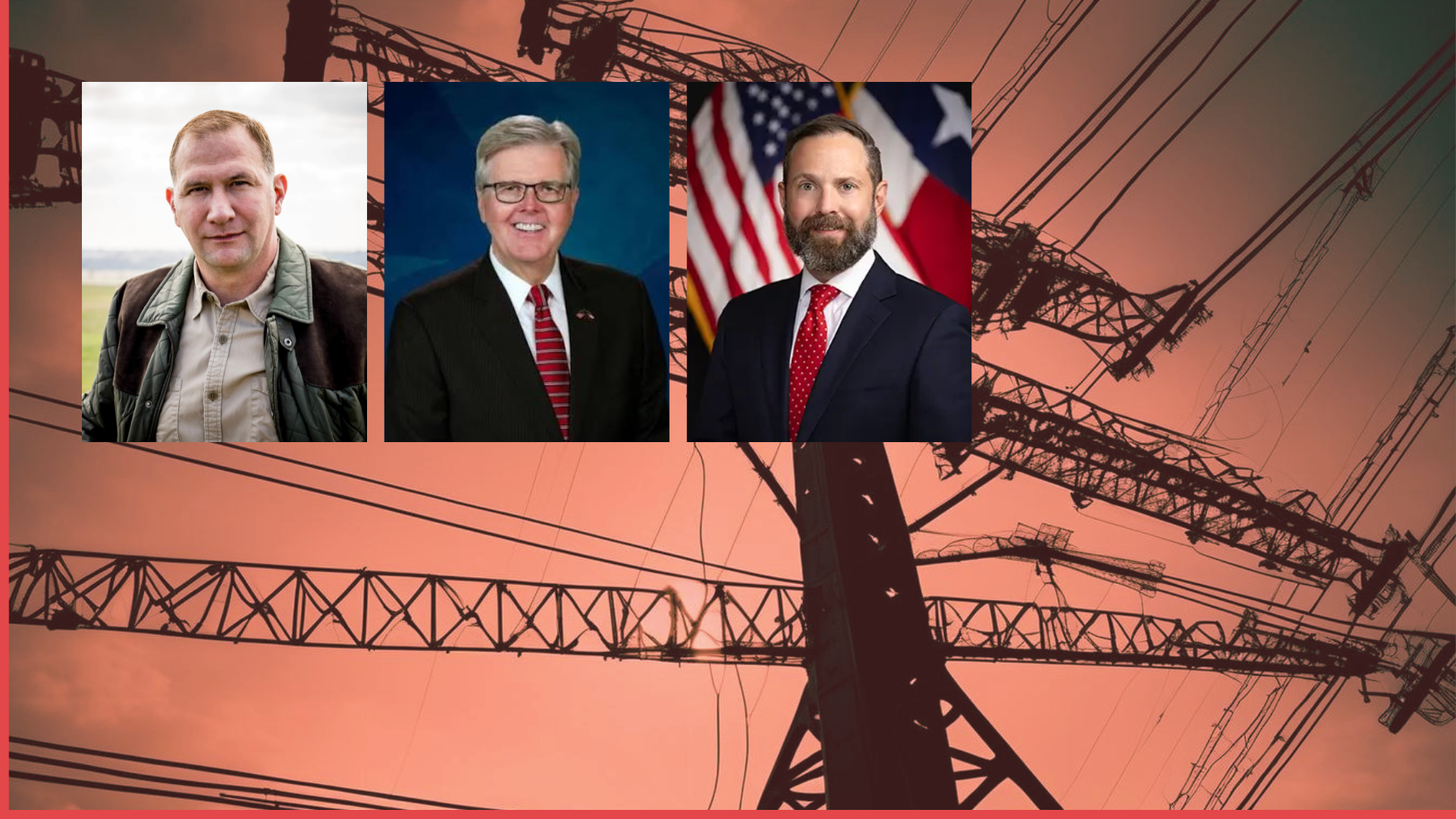
Texas’ two top presiding officers have lined up behind a Senate committee chairman’s call for state regulators to reject pending applications for the first 765-kilovolt transmission lines ever proposed in Texas, and the House will take up the issue at its own hearing in three weeks — a rapid escalation that leaves one of the largest infrastructure projects in state history facing resistance from multiple corners of the Capitol.
The sequence began July 31, when Sen. Charles Schwertner, R-Georgetown, who chairs the Senate Committee on Business and Commerce, issued a statement calling on the Public Utility Commission to deny the pending certificate of convenience and necessity (CCN) applications for the lines.
Testimony at his committee’s hearing two days earlier, Schwertner said, highlighted significant concerns about the CCN process, including a lack of proper notice, shortened timelines for commission proceedings, and due process at the State Office of Administrative Hearings. Those concerns, he said, “demonstrate the need for a complete overhaul of the CCN process before these applications can advance.”
Lt. Gov. Dan Patrick endorsed that call the same day and went a step further. In a statement posted to X, Patrick said he agreed with Schwertner in urging the commission to deny the pending applications “and not consider re-applications, until the transmission companies can address the serious concerns raised by landowners at Wednesday’s hearing.”
Patrick said the Electric Reliability Council of Texas and the Public Utility Commission had studied the state’s current and future power needs for years, and that the 765-kV lines are part of their plan — but that neither agency “followed through with a plan that is supported by the vast majority of Texas landowners.”
Both, he said, acknowledged as much during the hearing. “Hour after hour, witness after witness testified they did not have adequate notice and have no idea where the lines are going because of constant route changes,” Patrick said, adding that witnesses accused ERCOT, the commission and the companies of rushing a process that could significantly affect the use of their land. The overwhelming number of rural witnesses, he said, want the process paused, and “some want it stopped entirely.”
The lieutenant governor was careful to separate the need from the method. “Everyone agrees Texas needs the transmission necessary to meet the growing needs of the state,” Patrick said. “However, support for ERCOT’s 765-kV transmission plan should not come at the expense of private property rights.” The current process, he said, “is broken and must be reformed,” and if the lines are built — “which many believe must be built” — the commission’s approval process must both strengthen the grid and protect landowners and communities. Patrick said the Senate will prioritize the issue during the 90th Legislative Session, which convenes in January 2027.
Hours later, Speaker Dustin Burrows announced that the House Committee on State Affairs will hold an interim hearing Aug. 19 on the proposed 765-kV lines. “The Texas House remains committed to policies that support the responsible planning and development of our rapidly growing state,” Burrows said in a statement, adding that the hearing is intended “to help ensure Texans have a meaningful voice in the planning of this project.” He thanked State Affairs Chairman Ken King “for his leadership and his work with members of the committee and stakeholders on this important matter.”
A group of attorneys who have represented hundreds of landowners in transmission cases before the commission responded with a joint statement of their own July 31, arguing that a denial by itself would not fix the process. “Denial alone is a reset, not a repair,” they wrote, warning that applications refiled under existing rules would reproduce “the same notice gaps, the same 180-day clock, the same inability to develop a record at SOAH.”
The attorneys, who submitted joint written testimony to the committee July 29 and said they offered ten recommendations, also urged the Legislature and the commission to create a way to reimburse landowners for documented participation costs, noting that utilities recover theirs through rates while “landowners have no comparable mechanism.” They added that they “do not speak with one voice on the fate of the pending applications,” since some clients want a rehearing and others “would prefer finality to another round of litigation.”
The statements follow a long day of testimony on July 29. The Senate committee heard from 156 witnesses on the transmission charge — three times the 51 who testified on a companion charge about the grid and data centers — before Schwertner recessed the panel roughly 15 hours after it convened. Opening the hearing, he framed the task as managing load growth while working to “encourage new technologies and respect homeowners, businesses and landowners all at the same time.”
Much of the testimony was personal. Janice Douglas, who owns a tract in Salado just north of Schwertner’s district, described months of contradictory answers about routing near her property and said she had only belatedly learned a nearby 138-kV line was being tied into the 765-kV system. “I have been round and round with at least this many people,” she told members, gesturing to the crowd, “and every one of them tell me the wrong story.” Others testified for organized groups, including Ann Tarrillion for the Medina County Pearson Community Intervenors and Amanda Short of Corpus Christi, founder of the Texas Infrastructure Stewardship Initiative.
Industry witnesses used the same hearing to argue that delay carries its own risk. Mark Bell of the Association of Electric Companies of Texas told the panel the build-out is unavoidable, noting Texas electricity demand has grown “two and a half times the rate of the rest of the nation” over five years as the state adds more than a thousand residents a day. He said the commission approved the plan using 2024 peak-demand estimates that “didn’t account for the extraordinary growth we’re seeing among large load customers,” and argued transmission and generation are complements rather than rivals, because a stronger grid ensures “power is not trapped behind transmission constraints.” His warning was blunt: “The greatest risk to the ERCOT system today is inaction.”
Todd Staples, president of the Texas Oil and Gas Association, described West Texas families and business owners being told they may wait five years for power “or you may not get power at all,” and said ERCOT had documented the region’s transmission shortfall in public studies since 2019, followed by years of workshops and meetings. Staples told the committee he would not “interject myself on the CCN process,” calling it outside his expertise, but said the underlying need was long settled and delay the real danger.
A third invited witness, Brent Bennett of the Texas Public Policy Foundation, challenged the premise, arguing that building “more energy dense, reliable generation, close to demand centers” would eliminate the need for cross-state lines, and urging lawmakers to slow a plan carrying “generational, irreversible impacts.”
The committee’s vice chair delivered the sharpest assessment. Sen. Phil King, R-Weatherford, said he was “very disappointed that ERCOT is not here” for the transmission charge, calling the absence “discourteous” to the Legislature and to witnesses. The utilities “are good companies and they’re not out to offend property owners,” King said, “but the process did not work.” He called the notice failures “particularly problematic,” said knocking landowners out of a case on technicalities when some 800 people are swept into one routing dispute “is just putting form over substance,” and noted the 180-day procedural window was written before anyone anticipated “the giant route that’s about to go all around Texas.”
At stake is the first phase of the Permian Basin Reliability Plan. The Public Utility Commission approved the plan in October 2024 and signed off on the higher-voltage import paths in April 2025, choosing a 765-kV design estimated at roughly $13.8 billion over a comparable 345-kV network, according to regulatory filings and ERCOT planning documents.
The lines are intended to relieve severe transmission constraints in the Permian Basin, where oil-and-gas electrification and surging demand have outpaced the grid. The first major case to reach the commission, a joint AEP Texas and CPS Energy application filed in March 2026 for the roughly 370-mile Howard-Solstice line, drew more than 600 intervenors, and state administrative law judges recently recommended a route as the docket heads to the Public Utility Commission.
The commission has not ruled on the pending applications, and it is not bound by the statements from Schwertner, Patrick or Burrows. But the political pressure now runs in one direction, and the calendar has tightened: the House State Affairs Committee meets Aug. 19, and both chambers have signaled that CCN reform will be on the agenda when the 90th Legislature convenes in January 2027.
Related coverage: Grid urgency meets landowner backlash as Senate committee weighs Texas 765-kV plan