
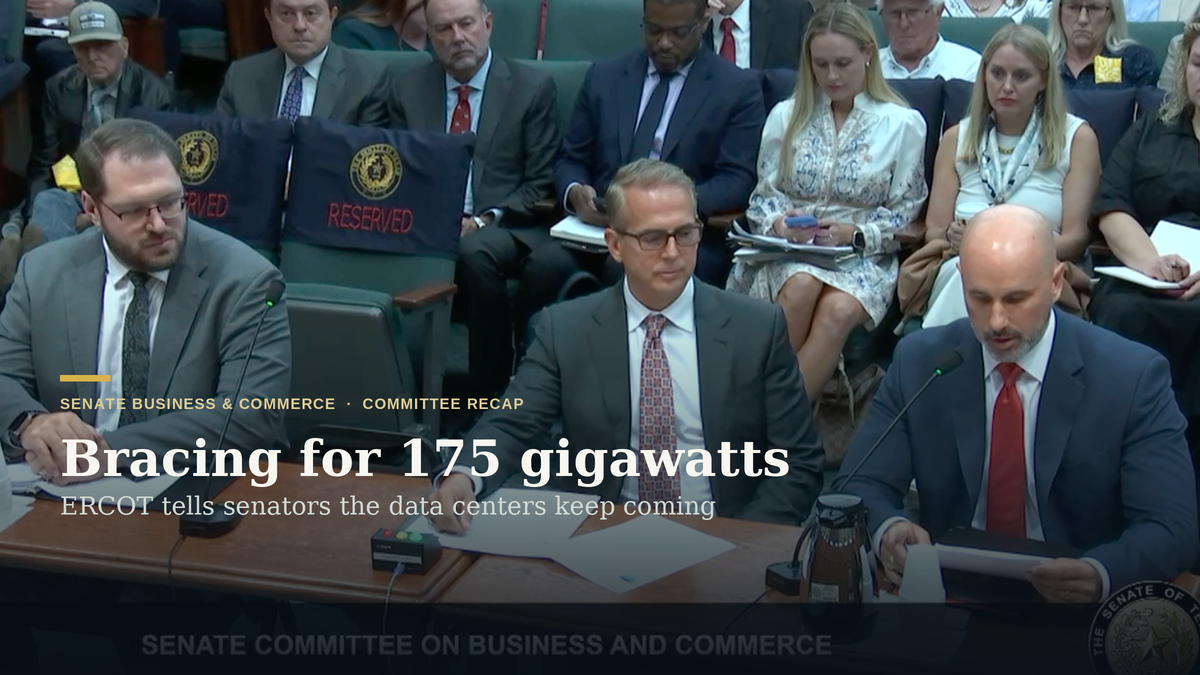
The state agencies that keep the lights on told a Senate panel Wednesday that Texas is planning for a grid nearly double the size of today’s — and that the surge is being driven by an unfamiliar customer: the data center.
Opening the Senate Committee on Business and Commerce’s third interim hearing, Chair Charles Schwertner, R-Georgetown, framed the challenge as a good problem to have. “Today we should recognize that Texas is winning,” he said. “The challenges we will discuss in this committee are challenges of a vibrant, thriving and dynamic economy and state. And electricity is more and more powering this economy.”
The numbers behind that optimism are staggering. ERCOT President and CEO Pablo Vegas, appearing alongside Public Utility Commission Chairman Thomas Gleeson, walked members through a demand forecast that has been rewritten by the arrival of very large loads.
A roughly 65-gigawatt block of new large-load interconnection requests, layered on top of “the organic growth of Texas” that alone “was getting us to about 110 gigawatts by 2032,” pushes the combined forecast, Vegas said, “somewhere in that 175” gigawatts. For context, that is well beyond the record demand the grid has ever actually served.
Vegas credited the tools lawmakers handed the grid operator in Senate Bill 6, the 2025 law that set interconnection standards for loads of at least 75 megawatts and gave ERCOT new visibility into how those loads behave. He told members the co-location provisions in the law — which govern large customers that plug in beside a power plant — have already let “several projects move through” in a way that “gives us the most flexibility.”
He also cautioned that reliability is no longer just an afternoon problem, noting that on a recent night “closer to 90 percent” of supply came “from dispatchable resources,” and that meeting demand overnight “is just as important” as meeting the late-afternoon peak.
Schwertner returned to SB 6 repeatedly, at one point telling colleagues the bill had proved its worth. “If we didn’t have the provisions in Senate Bill 6 regarding visibility and load and management of load, it would be very difficult at this time,” he said, thanking members for the “team effort working that last session.” The remark doubled as a signal that the committee sees the 2025 framework as a foundation to build on, not revisit, when the 90th Legislature convenes.
Where senators pushed hardest was on who is actually behind the demand. Chris Matos, who leads Google’s energy market development in Texas, drew a distinction members returned to: some data-center load comes from “the actual owners and operators, like the big brands — Meta, Google, Amazon,” while other requests come from developers who “get a project that has the electrical ability to support them, and then they go and sell it.”
That gap between firm and speculative demand is precisely what SB 6’s screening rules — including a transmission study fee of at least $100,000 — were written to filter, and members probed how well the forecast separates the two.
The reliability debate also reached into the oil patch. In an exchange touching the Permian Basin, members and witnesses discussed how oilfield operations increasingly draw grid power rather than running “off of diesel” and natural gas as they did “before ESG,” a shift that adds still more load in the very region the state is racing to connect. Todd Staples, president of the Texas Oil and Gas Association, was among the invited witnesses, as were Walt Baum of Powering Texans and the Texas Competitive Power Advocates and Mark Bell of the Association of Electric Companies of Texas.
As The Texas Dispatch previously reported, the same large-load boom is generating friction well beyond the grid — a Hill Country water district this year asked lawmakers to curb data-center permitting over water-supply concerns. Wednesday’s testimony underscored the throughline: the load growth that has ERCOT planning for 175 gigawatts is also driving the transmission build-out that brought scores of landowners to the same hearing room.
Because the committee met in the interim, it took no vote. The reliability testimony will inform recommendations to the 90th Legislature, where members signaled the work will be less about rewriting SB 6 than about pressure-testing whether its forecasts, fees and interconnection rules can keep pace with a grid the state is trying to build faster than it ever has.
Also heard
The committee’s second charge — the 765-kilovolt transmission expansion tied to the Permian Basin Reliability Plan — drew 156 witnesses and dominated the marathon hearing, as affected landowners faulted the state’s notice-and-routing process. That testimony is the subject of the companion story.
The hearing at a glance
Issue
State of the electric grid and rulemaking under Senate Bill 6 (large-load interconnection), including data-center demand and dispatchable generation. The first of the day’s two charges, drawing 51 witnesses.
What happened
An invited panel led by ERCOT CEO Pablo Vegas and PUC Chairman Thomas Gleeson briefed members on a combined ~175 GW demand forecast and SB 6 implementation, followed by industry and public witnesses. Interim hearing — no vote.
When
9:00 AM CT, Wednesday, July 29, 2026 · hearing ran roughly 15 hours (both charges) before recess
Where
Room E1.012 (Hearing Room), Capitol Extension, AustinChairSen. Charles Schwertner, R–Georgetown (SD-5)
Archived video
senate.texas.gov · vid 22667