
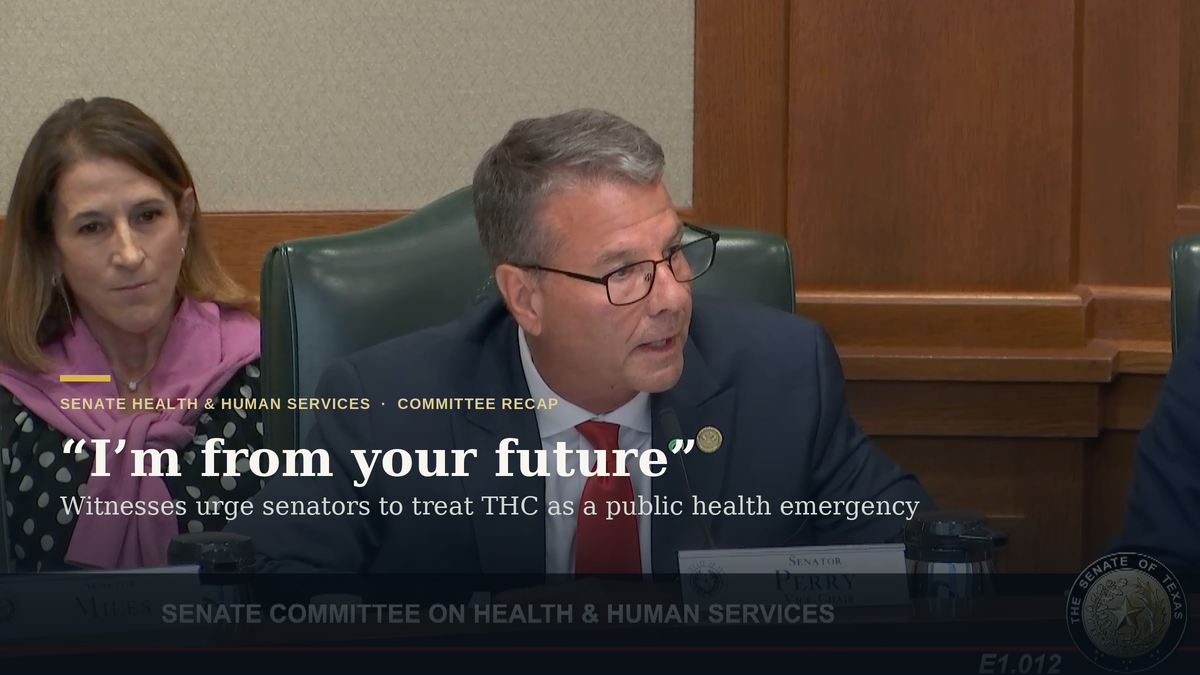
A year after Gov. Greg Abbott vetoed the Legislature’s THC ban, the Texas Senate’s health committee spent Tuesday morning assembling the public health case for trying again. Over two and a half hours, the Senate Committee on Health and Human Services heard physicians, police and researchers describe rising newborn exposures, flooded emergency rooms and a retail market of nearly 9,000 largely unregulated stores.
Chair Lois Kolkhorst, R-Brenham, opened with the state’s own numbers. Citing Department of Family and Protective Services data, she said 1,559 children tested positive for THC at birth in fiscal 2024, rising to 1,896 in 2025. The Teaching Hospitals of Texas, she added, reported “36,983 emergency detentions” across 17 member hospitals in 2025, “up from 35,995 in 2024.”
Later, quoting a San Diego emergency physician’s warning that high-potency THC “is attacking young brains,” she asked her witnesses directly whether they agreed. “Absolutely. That’s the reason I’m here today, ma’am,” came the reply from the panel.
The morning’s most arresting testimony came from Aubree Adams, director of Citizens for a Safe and Healthy Texas, who moved from Pueblo, Colorado. “They call fentanyl a weapon of mass destruction. I disagree,” she began. “I’m from your future.” Adams described her hometown’s transformation after legalization into “the Napa Valley of Marijuana,” and told senators a man was murdered “over a sale of legally homegrown marijuana. His body was found laying feet from my parents’ garage.”
Allen Police Chief Steve Dye, testifying for the nearly 1,700 members of the Texas Police Chiefs Association — and, he said, for the Sheriffs’ Association of Texas as well — catalogued the enforcement problem: “almost 9,000 retail locations” at last count, labels that “do not reflect the level of actual amount of THC inside the package,” police canines that “cannot distinguish between THC consumables and hemp,” and lab-testing costs “most cities cannot afford.”
Departments that do file charges, he said, “are often sued by the hemp industry.” Of his own city’s enforcement sweeps, Dye said: “In the nine stores that we hit, we found 7 to 78% THC concentrations.”
The Texas Medical Association sent Dr. Dominic Lucia, a pediatric emergency physician, who recounted a toddler he called Rhett arriving nearly unconscious after eating THC gummies from a nightstand — “25 to 50 milligrams each on a tiny little body” — and spending two days in a pediatric ICU.
Poison center calls related to THC, he testified, climbed from just under 700 in 2018 to more than 2,600 in 2025, over half involving children four and younger. Dr. Amanda Hall, deputy commissioner and chief medical executive at the Department of State Health Services, layered on state data from the Texas Poison Center Network, EMS records, hospital discharges and vital statistics, telling members THC-linked deaths of Texas residents fell heaviest among 18-to-44-year-olds.
Matthew Rossheim, an associate professor at the University of North Texas Health Science Center who said he has published more than 100 peer-reviewed studies on intoxicating substances, told the committee his 50-state survey found 74% of vape shops selling intoxicating THC products. “Retail availability is not just merely a convenience issue, it’s one of the strongest determinants of use,” he said. “Availability drives use and use drives harm.”
Kolkhorst also called up Dr. Tim Stevenson of DSHS’s consumer protection division for a legal update, and his answer underscored why regulators have struggled. The department was “immediately embroiled in a lawsuit” when it tried to treat Delta-8 as a controlled substance, Stevenson said, and could not act until the Texas Supreme Court resolved the case on June 5 of this year. Asked by Kolkhorst what the court decided, he said: “They determined that Delta-8 could and should be a controlled substance.”
Vice Chair Charles Perry, R-Lubbock — who carried the vetoed ban and has been the Senate’s point man on hemp since the 2019 law that legalized it — pushed back on the federal government’s recent move toward rescheduling cannabis, calling the research rationale “the industry narrative that he has adopted, right, wrong or indifferent, time will tell.” Of claimed medical benefits, Perry said: “There’s already people coming out and saying they’re going to hit a brick wall because there’s really none.”
No votes were taken at the interim hearing, but the through-line was unmistakable: with Abbott’s veto forcing regulation over prohibition, the committee is building the evidentiary record — health costs, detention counts, court rulings — for another run at restricting consumable THC in 2027, as The Texas Dispatch previewed ahead of the hearing.
Also at the hearing
The committee devoted its longest block — about four and a half hours — to mental illness, homelessness and the forensic-bed waitlist, where sheriffs and prosecutors pressed for state help. A closing 20-minute panel monitored the Texas Child Mental Health Care Consortium, including TCHATT school telehealth and the wind-down of federal ARPA funding at the end of this fiscal year.