
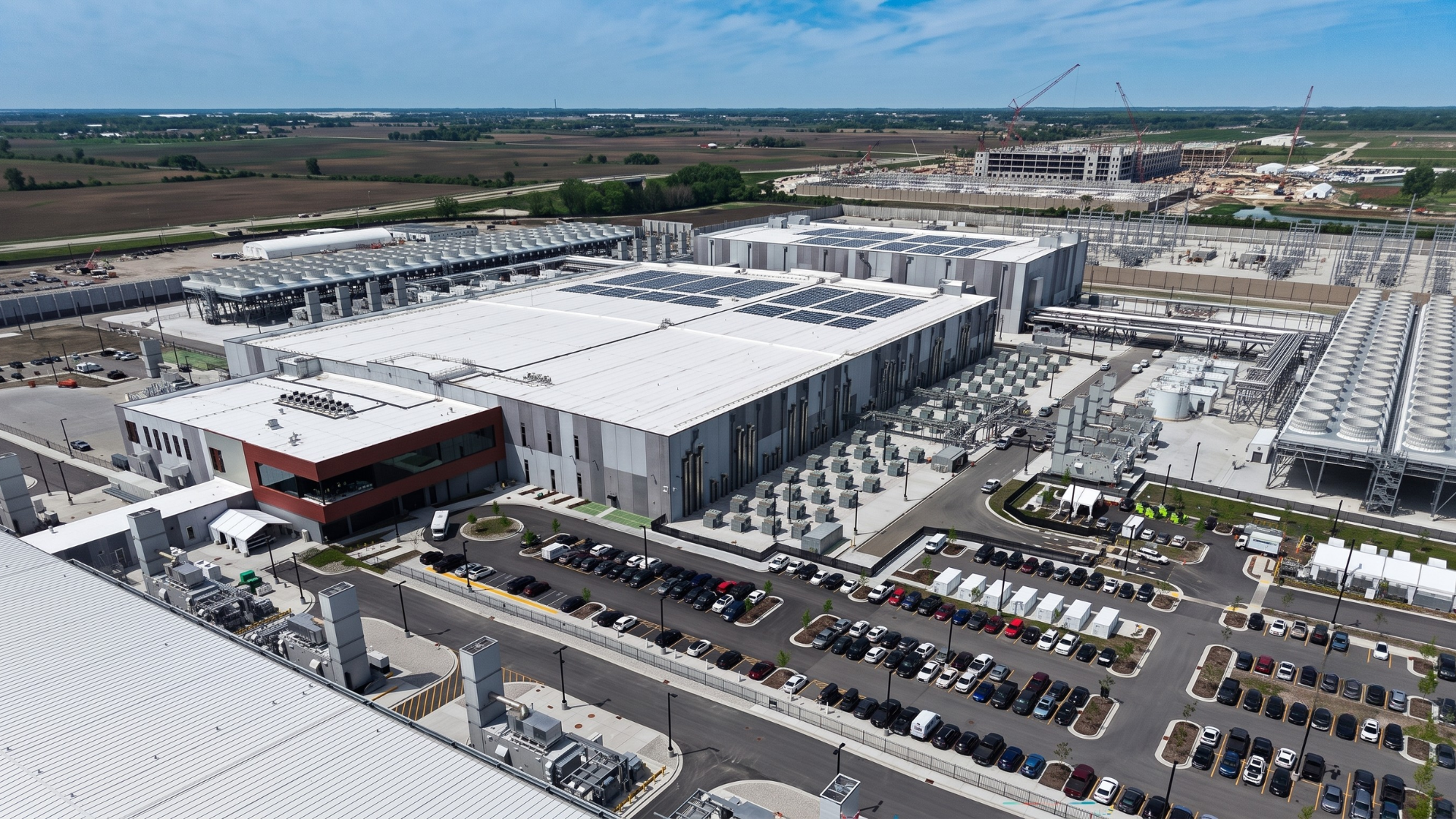
One of the largest single data-center projects yet planned in Texas is approaching an operational milestone in a rural county west of Fort Worth. Vantage Data Centers’ “Frontier” campus in Shackelford County, developed as part of the Stargate initiative led by OpenAI and Oracle, is on a schedule that would bring its first facility online in the second half of 2026, according to the company and to reporting by Data Center Dynamics.
Vantage describes Frontier as its largest project to date. The company says the campus spans roughly 1,200 acres and will eventually hold 10 single-story data-center buildings totaling about 3.7 million square feet, with a combined capacity of 1.4 gigawatts and an investment the company puts at more than $25 billion.
Vantage says the project will employ more than 5,000 people across construction and operations. Data Center Dynamics reported that the air- and liquid-cooled site is designed to support rack densities above 250 kilowatts and that the campus, like the nearby Stargate Abilene development, is set up to run on an on-site natural-gas microgrid rather than drawing its full load from the grid at the outset.
That self-supplied power model places Frontier squarely within the central tension Texas regulators are trying to manage. The Electric Reliability Council of Texas is tracking more than 438 gigawatts of large-load interconnection requests, nearly 90 percent of them from data centers.
By generating its own electricity behind the meter, a campus like Frontier can sidestep parts of that congested queue, an approach supporters say also responds to the cost concern at the center of Senate Bill 6 and Governor Greg Abbott’s June 10 directive that the infrastructure costs of serving data centers not be shifted onto residential and small-business ratepayers.
Supporters of the build-out, including Abbott, have cast Texas as the national center of AI infrastructure, pointing to the jobs, capital investment, and tax base that projects of Frontier’s scale bring to rural counties. Vantage has framed the campus as a driver of “significant regional economic growth” in an area near Abilene that has become a hub for hyperscale development. The behind-the-meter design, its backers argue, lets that growth proceed without forcing other customers to pay for new transmission to serve it.
Critics of the development, however, have focused on water and local control. State lawmakers pressed regulators on data-center water use at a June 23 Texas House Natural Resources Committee hearing, where, as KWTX reported, members heard that the number of data centers surveyed by the Texas Water Development Board had grown from 22 to 341 but that only about 17 percent had returned the legally required questionnaire.
Water researchers and rural advocates quoted by the Texas Observer and Inside Climate News have warned that the concentration of large campuses in dry West Texas counties could strain local groundwater, while industry representatives such as the Data Center Coalition’s Dan Diorio have said operators take water-use efficiency and conservation seriously and do not treat water as an endless resource.
The friction has already produced local fights elsewhere in the region. In Tom Green County, commissioners voted June 2 to reject a proposed 12-month moratorium on data-center development in one precinct, a decision that followed an April protest in which hundreds of residents turned out against a separate project.
For Shackelford County, the near-term marker is operational rather than regulatory: whether Frontier’s first building energizes on schedule later this year, and how its gas-fired microgrid and water sourcing perform as the campus scales toward its full 1.4 gigawatts.