
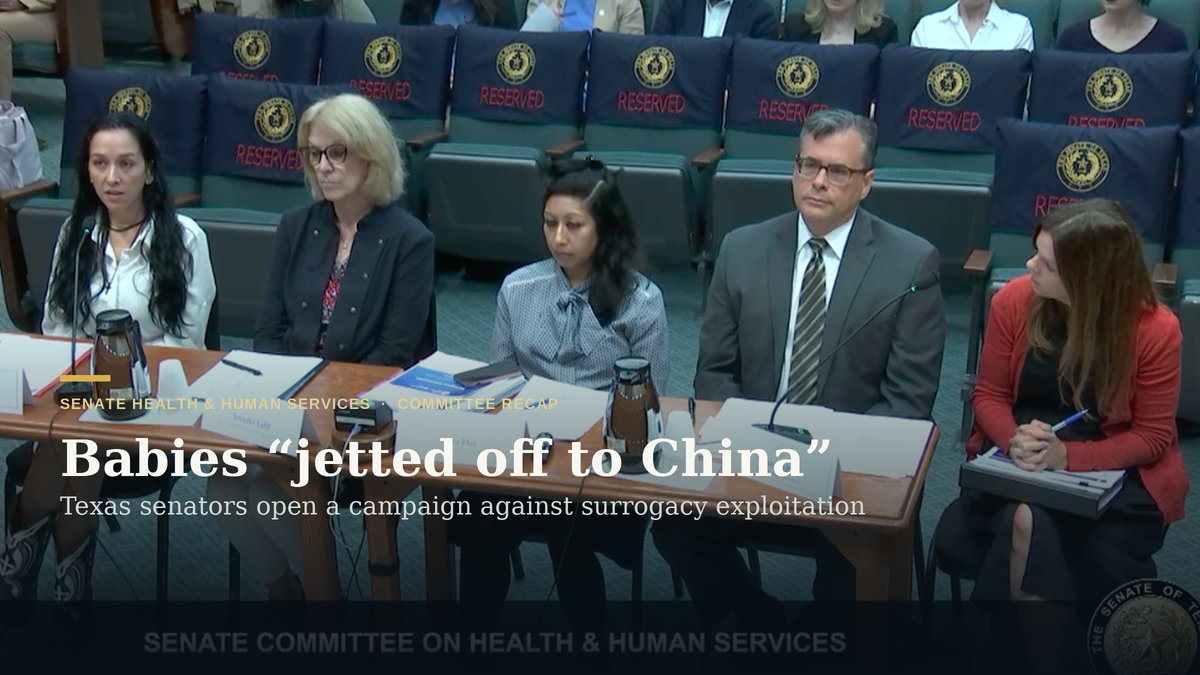
Texas has some of the most permissive surrogacy laws in the country, and on Wednesday the Texas Senate’s health panel spent more than two hours of invited testimony — and much of a long public-comment line — building the case that foreign nationals and commercial agencies are exploiting them.
“Today we tackle an issue that appears ripped from the headlines,” Chair Lois Kolkhorst, R-Brenham, said as she gaveled in the Senate Committee on Health and Human Services, thanking Lt. Gov. Dan Patrick for an interim charge she said she requested “long before the Supreme Court’s ruling on birthright citizenship, which I think was about ten days ago.”
Kolkhorst described a pipeline she wants closed: “In some cases, the babies are picked up from the hospital after a pre-birth agreement is presented and the baby is immediately jetted off to China. Who are we as Texans if we do not address this issue?”
The chair said the committee would examine “the practice potentially of commercial surrogacy,” asking: “What happens when we allow a payment to women for engaging in surrogacy, or placing their own child up for adoption? When does a reimbursement payment blur the lines into becoming an incentive?” She also invoked the state’s waiting children: “We have thousands of children in our foster care system each year who would love to have a forever home… do not forget them in the quest for parenthood.”
The morning’s centerpiece was Christian Ross, a former surrogate who traveled from out of state to describe how a match arranged by “a larger surrogacy agency based in California” left her “embroiled in an international custody battle.” Ross told senators she knew the intended parents were foreign — “I had been told that they had one child and wanted to expand their” family, she said under questioning, adding, “I had known about the one child rule in China.”
Her verdict on the industry was unsparing: “If I could go back and redo this all over again, I never would have done this. It ruined my life and likely that baby’s life as well.” She urged the committee to act first: “I know you guys are the Lone Star State, but let’s make it all 50 states and let’s start the movement here.”
Jennifer Lahl, a registered nurse and founder of the Center for Bioethics and Culture Network who said she testified at the United Nations in Geneva the previous week, pressed the health argument. Gestational surrogate pregnancies are “medically high risk,” she testified, listing “gestational hypertension, pre-eclampsia, placenta previa, C-sections, and long term health consequences from the powerful hormones from IVF drugs.”
“Surrogate mothers have died in the United States because of these high risk pregnancies,” Lahl said. “The babies they’ve carried have died.” She held up French law, which she said “effectively treats surrogacy as a form of prohibited commodification, akin to exploitation or slavery like practices.”
The state’s own paper trail came from Dr. Tara Das, state registrar for vital statistics at the Department of State Health Services, who told the committee Texas registers about 400,000 births a year and that “the responsibility for gestational agreements is at the hospital level.”
Asked by Sen. Molly Cook, D-Houston, how long the state has tracked surrogate births, Das said the electronic records began capturing surrogacy record types in part of 2015, “with 2016 being the first full year.” Steve Wohleb, general counsel of the Texas Hospital Association, described a small set of recent hospital cases involving disputed pre-birth agreements: in two of the three, he testified, “the intended parents were foreign nationals who did not reside in the United States.”
Democrats on the panel probed where a crackdown might overreach. Sen. César Blanco, D-El Paso, raised constituents with dual citizenship: “My district shares a border with Mexico… They’ve got mixed nationalities, or mixed immigration status. And some of those families might need to utilize surrogacy if they want to grow their families. A ban on allowing international surrogacy would directly harm them.”
Lahl’s answer conceded nothing: “I don’t care if you’re gay or straight or single or mixed or whatever — my point is, you don’t risk another woman’s health because you want to grow your family.” A resource witness pointed Blanco to Section 160.756 of the Family Code, the provision spelling out the findings a court must make before validating a gestational agreement.
Cook, an emergency-room nurse, warned the committee about the framing: “You can get into a very, just anti-immigration space with some of this conversation. And I’m just so thankful that we’re here in the Health and Human Services Committee to talk about health.” She thanked Ross directly: “I think we can all agree that shouldn’t have happened to you.”
Sen. Bryan Hughes, R-Mineola, steered witnesses toward informal arrangements outside agency contracts, and Kolkhorst closed the loop on public dollars, drawing from Lahl that a surrogate already on state assistance can carry a commercial pregnancy at taxpayer expense — “that is awfully attractive to the agencies and the intended parents,” Lahl said, “because it’s one less thing that they have to cover.”
Public testimony ran deep into the afternoon and cut both ways. Ashley Sosa, communications director of Texas Alliance for Life, and a string of anti-abortion and child-welfare advocates urged restrictions on what one witness called a “largely unregulated” industry.
But Whitney Scheibner, a two-time independent surrogate carrying for a second family, asked senators not to sweep her arrangement in with the abuses: “As you consider recommendations, I encourage you to clearly distinguish unethical practices from ethical fertility care.”
The committee must deliver recommendations before the 90th Legislature convenes in January 2027, and Kolkhorst’s framing — commercial payments, foreign intended parents, hospital handoffs and birth-certificate mechanics — sketched the likely contours of legislation to come, a fight the Texas Tribune reports is already entangled with the national battle over birthright citizenship. No votes were taken at the interim hearing.
Also at the hearing
After roughly two hours and 16 minutes on surrogacy, the committee turned to its monitoring charge: implementation of the DFPS abuse-and-neglect central registry, the post-flood Senate Bill 1 youth-camp safety law one year after the Kerr County disaster, and House Bill 3595 assisted-living emergency standards.