
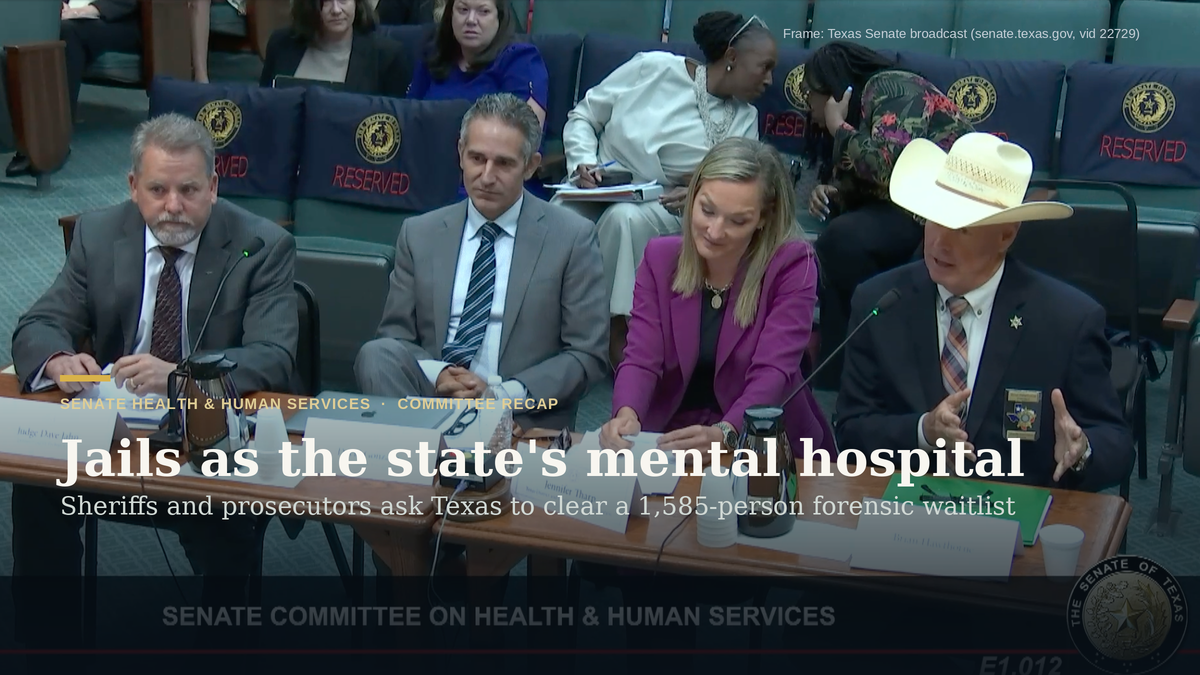
A sheriff, a prosecutor, a defense lawyer and a probate judge sat at the same witness table Tuesday and told the Texas Senate Committee on Health and Human Services the same thing: county jails have become the state’s default mental hospital, and the counties are paying for it.
The panel spent roughly four and a half hours — the bulk of a 7.5-hour interim hearing — on the tangle of mental illness, addiction and homelessness that is crowding jails, emergency rooms and a state forensic waitlist that still holds nearly 1,600 people.”Law enforcement effectively has become the front door in confronting mental health crisis,” said Chambers County Sheriff Brian Hawthorne, president of the Sheriffs’ Association of Texas.
“Deputies are called to address situations that are fundamentally health and social issues.” Hawthorne told senators his county has found one tool that works — long-acting antipsychotic injections for inmates — and that most counties cannot afford it. “Probably the least expensive one is $2,000 an injection and they last about 30 days. But that’s the best $2,000 my commissioners court has agreed to spend,” he said, asking whether “there’s any way the state could help with those long term injectables.”
Comal County District Attorney Jennifer Tharp, who said she is starting her fifth term, testified that defendants with mental illness, substance use disorder and homelessness “have a greater representation in our criminal justice system now than … I’ve ever seen in the last 22 years as a prosecutor.” The choke point, she said, is competency restoration: “The state’s waitlist is still an issue. I have nine individuals right now in the state’s waitlist, one of which is for a very violent offense.”
The state’s own numbers backed her up. Jordan Dixon, chief behavioral health, disability and aging services officer at the Health and Human Services Commission, told the committee about 1,585 people are waiting for a state hospital competency-restoration bed — down from roughly 2,600 at the peak in fiscal 2022 — and that average waits have fallen from 209 days in fiscal 2025 to 189 days so far this year. “I’m not bragging about that. We don’t want people waiting six months, but we’re headed in the right direction,” Dixon said, adding that new beds funded by the Legislature will come online “between now and spring, summer of 2028.”
Chair Lois Kolkhorst, R-Brenham, framed the day as a test of whether Texas can avoid other states’ mistakes. “The state of California famously spent $24 billion to tackle their homeless problem over the past five years, yet last year found they have essentially the same level of homelessness as when they began,” she said in her opening remarks, promising that “in Texas, we are setting a much higher standard.”
Sen. Molly Cook, D-Houston, an emergency room nurse, seized on Hawthorne’s call to revive House Bill 305, last session’s measure to require a pretrial hearing within 14 days after a defendant returns from competency restoration. “Sheriff Hawthorne, I just wanted to thank you so much for spotlighting House Bill 305. I was really, really proud to carry that with Representative Hayes,” Cook said. “I’m just really grateful that you’re calling for it to be an emergency item.”
Hawthorne answered: “We hope you’ll bring it back to the surface because it … is an important issue for the sheriffs and the prosecutors.” Cook added that diversion only works if there is a destination: “If we divert folks, then they’ve got to have somewhere to go. And I feel that deeply as somebody who discharges people from the emergency department.”
Vice Chair Charles Perry, R-Lubbock, put a pointed legal question to the lawyers on the panel: “Is it legal for a hospital to be able to just ignore a court order?” A panelist responded that the issue had surfaced in his county and been set for an emergency hearing — one of several moments when witnesses described commitment orders colliding with bed shortages. Senators also walked through what supervision looks like after a not-guilty-by-reason-of-insanity finding, terrain The Texas Dispatch examined this month in its report on how the state releases insanity acquittees.
Austin defense attorney David Gonzalez, whose practice pairs lawyers with social workers, urged the committee to think like a business. “Much like the E.R. system — what’s the root cause?” he asked, offering “three business principles” starting with the 80/20 rule: concentrate resources on the small share of people who cycle through the system most.
Denton County Probate Judge Dave Jahn, a member of the Texas Judicial Commission on Mental Health since 2018, walked members through the civil commitment machinery, and witnesses noted state hospital beds are now so dominated by forensic commitments that civil patients depend on locally purchased beds.
Afternoon panels widened the lens to providers. Lee Johnson of the Texas Council of Community Centers, Susan Somers of Perimeter Behavioral Hospital, and Rhonda Mundhenk, president and CEO of San Antonio’s Haven for Hope, testified on the homelessness side of the charge.
Mundhenk told Sen. Borris Miles, D-Houston, that behavioral health conditions are “disproportionately prevalent amongst individuals and families experiencing homelessness,” and traced three pathways: conditions that precede homelessness, conditions created by it, and conditions it makes worse.
Because this was an interim hearing, the committee took no votes. But the direction of travel was unmistakable: members and witnesses alike pointed to the 90th Legislature, which convenes in January 2027, for a renewed push on HB 305-style competency deadlines, state help with jail-based medication, and commitment-law cleanup — the recommendations the lieutenant governor’s charge directs the panel to deliver.
Also at the hearing
The committee spent its first two and a half hours building a public-health case against consumable THC — newborn exposure numbers, emergency detentions and a Texas Supreme Court ruling on Delta-8. A final 20-minute panel took monitoring testimony on the Texas Child Mental Health Care Consortium.