
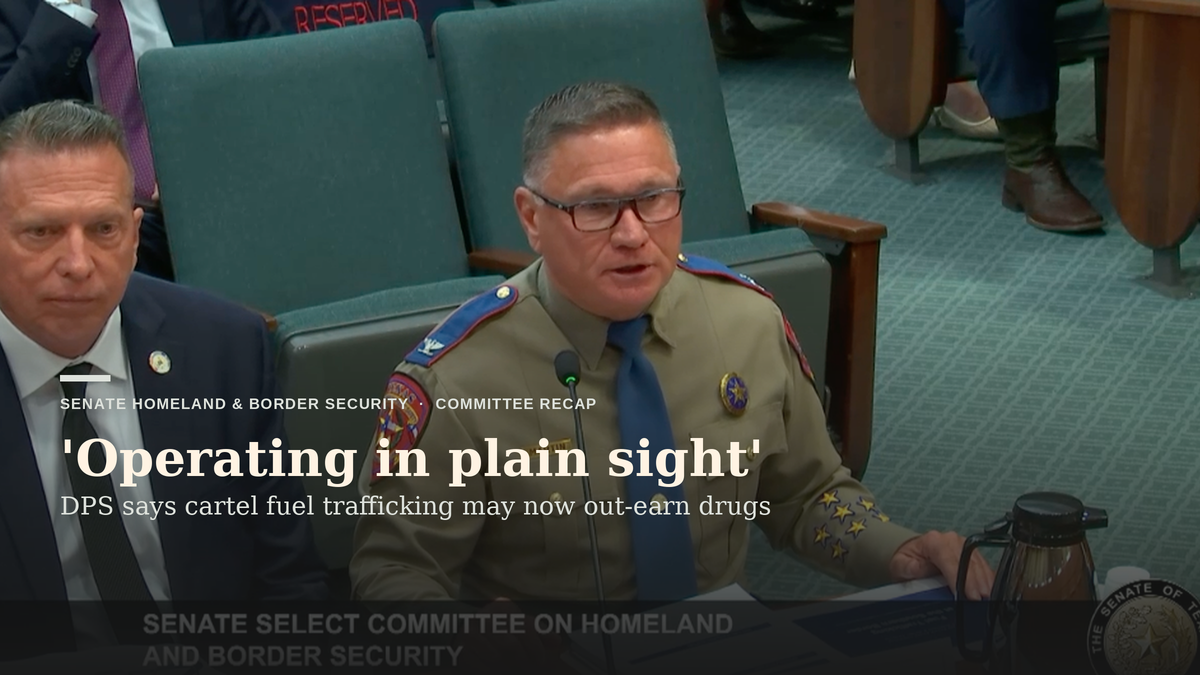
Cartel fuel trafficking generates an estimated $12 billion to $21 billion a year — and some federal investigators now believe it has passed narcotics as the cartels’ top revenue stream, the head of the Texas Department of Public Safety told the Senate Select Committee on Homeland and Border Security Thursday. “Fuel trafficking is a threat that’s operating in plain sight,” DPS Director Col. Freeman Martin said, repeating the dollar range when Chairman Phil King, R-Weatherford, asked him to say it again. “Rather than loading drugs into produce and furniture and auto parts… and smuggling it north, they’re loading in fuel trucks or in trucks or propane trucks or any container that you can think of and hauling it south.”
The committee spent roughly two and a half of its four-plus hours — the bulk of a hearing that consolidated three fuel-related interim charges into one arc — on how stolen, adulterated and untaxed fuel moves from Texas terminals to Mexico, and on the unlicensed “clandestine fuel sites” where loads are altered and stored along the way.
King opened by cataloging the methods: “overloading fuel tankers beyond permitted weight limits, fabricating saddle tanks onto trucks to deceive law enforcement, or transporting fuel in industrial water containers using cargo trucks.” The sites at the center of the trade, he said, “are unlicensed and unregulated” and “often appear overnight, frequently near neighborhoods, churches and community centers.”
The scale has a federal paper trail: the DPS presentation cited FinCEN data showing U.S. banks flagged more than $7 billion in suspicious cartel-related fuel transactions over a 14-month period, and the Treasury Department has sanctioned facilitators of cartel fuel-smuggling networks moving stolen Mexican crude into Texas.
Major Tim Murphy of the DPS Criminal Investigation Division told senators the state’s target is the organization, not the driver. “This is organized criminal activity is what this is. This isn’t the one off driver,” Murphy said, comparing the structure to oilfield theft rings: “It’s not the guy stealing the oil that we want to get to. It’s the guy that’s puppeting that person.”
The obstacle, he said, is access. “We can’t just go on a private property. We’re law enforcement. We have to have probable cause,” Murphy said, adding that investigators are seeking regulatory pathways onto sites that, in DPS’s words, serve “no lawful purpose.” The presentation also described a two-cartel toll system at the crossings: a truck can pay $5,000 to cross near Pharr, senators were told, or $10,000 in the Brownsville-Harlingen area, where the pricier cartel offers protection.
Vice Chair Juan “Chuy” Hinojosa, D-McAllen, pushed the panel toward the remedy he carried last session — Senate Bill 2949, a licensing-and-penalties bill that “passed unanimously here in the Senate, but never got out of the House.” His question cut to the simplest fix: “This fuel depots are really illegal and unlawful. So why can’t we just pass legislation that prohibits or does away with them completely makes them illegal along the border?”
DPS witnesses agreed lawmakers could, while noting last session’s bill collided with arguments about trade, commerce and lawful exports. Hinojosa returned to the point later: the “more direct way would be, number one, to make those fuel depots illegal, period.” King made the same case from the chair. Pressing Murphy on his analogy between clandestine fuel sites and drug labs, he concluded: “So their sole purpose is to conduct an illegal activity… To Senator Hinojosa’s point of why don’t we just outlaw those completely?”
Sen. Bob Hall, R-Edgewood, asked witnesses to draw the legal seam in a cross-border crime: “We’ve got crimes being committed against Mexico and we have crimes being committed against the U.S. and help me understand where the line is drawn,” noting Mexican consumers end up with contaminated fuel in their vehicles.
A second panel put enforcement numbers on the table. A lieutenant with the Texas Comptroller’s Criminal Investigation Division — an agency force he said has just 50 peace officers — described a December 2025 operation in Eagle Pass, El Paso and Pharr that produced three felony arrests for operating without shipping documents, and a subsequent case filed against a company owner, “not just the driver,” for false reports.
Sen. Kevin Sparks, R-Midland, who said he has worked with Murphy on Permian Basin oilfield theft for about a year, told the panel industry often already knows the culprits: “The oilfield kind of knows a lot of the bad actors. I mean, I started meeting with just… people in the reclamation business and they go, oh, we know who will take this stolen stuff.”
Sparks then walked David Ramirez, the Texas Commission on Environmental Quality’s border and Permian Basin area director, through the agency’s narrow hook into the problem: stationary tanks above 1,100 gallons must register as aboveground storage tanks, giving TCEQ site access — but the agency does not regulate mobile tankers, and it acts on complaints rather than patrols. “Our staff are not driving around the countryside,” Ramirez said; when DPS or the comptroller flags a site, TCEQ opens a complaint investigation and can escalate to a notice of enforcement if operators fail to register within 30 days.
Because the committee met in the interim, no votes were taken — but King closed with an unusually direct solicitation for bills ahead of the 90th Legislature, which convenes in January 2027. “If you see any changes in statute that… will help you prosecute the fuel trafficking and all the things surrounding it… please bring them to the committee so that we can go ahead and start getting bills ready,” he told witnesses. “I would like to see us… be able to shut down those clandestine fuel sites completely… My hope is we’ll shut them down, but even after we shut them down, they’re going to pop back up. We just want to make sure that you can prosecute them in whatever form they’re in as easily as possible.”
Also heard
A separate panel of the Texas Department of Transportation, the Texas Department of Motor Vehicles and the Texas Trucking Association examined the legislatively authorized overweight corridors — and the permits that currently place no limit on what commodity moves under them. The committee also took its fourth charge, on public corruption tied to fuel crimes, hearing from 452nd Judicial District DA Tonya Spaeth Ahlswede, chair of the Border Prosecution Unit board, on whether the unit should be added to the state’s public-integrity statute. No public testimony was offered.
Fact box
Issue
Consolidated interim charges on cartel fuel trafficking — “Shoring Up the Integrity of Export Fuel” and clandestine fuel sites (~154 minutes, ~59% of hearing)
What happened
DPS leadership put a $12–21 billion annual figure on cartel fuel trafficking and said it may now out-earn drugs; the comptroller’s office and TCEQ detailed enforcement gaps at clandestine fuel sites; Hinojosa and King signaled a renewed push to outlaw unlicensed fuel depots in 2027; no vote (interim hearing)
When
Thursday, August 13, 2026, 9:00 AM CT · run time ~4:20
Where
Room E1.016 (Hearing Room), Capitol Extension, Austin
Chair
Sen. Phil King, R-Weatherford (SD-10)
Archived video
senate.texas.gov, vid 22734