
The longest single stretch of Monday’s House committee hearing was not about a law already on the books. It was about one that failed, according to witnesses.
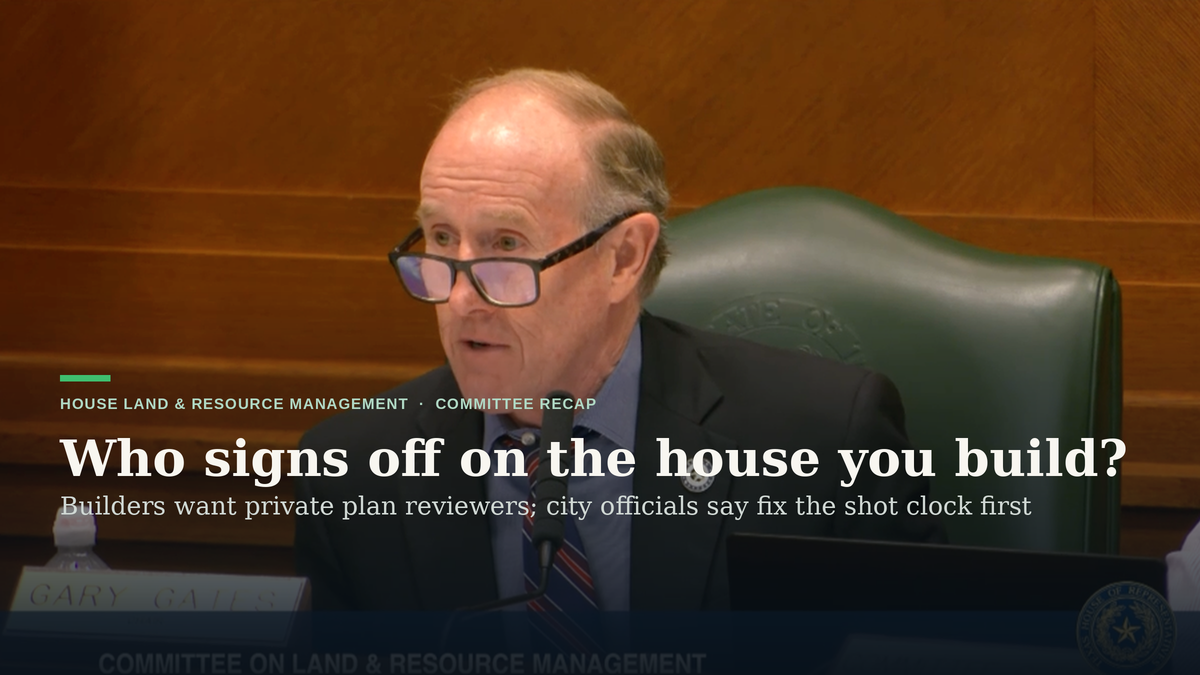
For roughly two hours — the biggest block of a seven-hour day — the House Committee on Land & Resource Management took testimony on whether Texas should let private professionals review plats and building plans that city staff review today. Chairman Gary Gates, R–Richmond, told members plainly this was not a monitoring exercise.
“These are new bills that we’re looking at for the next coming session,” Gates said. “I want to thank my staff especially. We’ve spent a lot of time on Zoom calls and meeting with people from all across the state, trying to hear from stakeholders from both sides of the issue.”
The idea already has a legislative history. House Bill 23, which would have given applicants the right to obtain third-party review of plats, development plans and permits, went through this same committee in 2025 and did not become law. JD Hale of the Texas Association of Builders raised it directly. “There was also House Bill 23. Don’t want to relitigate that bill, but also that would have allowed for third party inspections,” he said.
City building officials opened by arguing the Legislature should finish the job it started before handing plan review to the private market. Joshua Doyle, chief building official for the City of Sugar Land, told the panel Texas already has a permitting deadline law on the books — the “shot clock” — and has never gone back to see whether it works.
“You have a shot clock law that’s on the books,” Doyle said. “And then since then there hasn’t been any more talks about how do we” improve it. His recommendation was to exhaust that route first: “before we just jump to saying, you know what, shot clock law is not working, let’s just go straight to third party.”
Doyle, a licensed Texas master electrician with 12 years in Sugar Land’s building inspections division, offered the committee a different sequence. “Where I would start would be looking at the shot clock law, licensing at the state level and adopted codes at the state level,” he said.
Adam Haynes of the Conference of Urban Counties said the deadline law is already doing work in counties, precisely because missing it has consequences. The statute has “a provision that says at the end of that 30 days, if we don’t have our work done, you build,” Haynes said. The result, he told members: “We’re going to meet the shot clock law 100% of the time.”
Keith Mars, director at Austin Development Services, also testified on the invited panel.
The builders’ answer was that third-party review already works in Texas — where cities let it work. One witness walked the committee through Fort Worth, where the industry went to city hall two decades ago and asked for the option. “They went to the mayor, went to the city council, and they requested that third party inspections be allowed by right,” said Johnathan Killebrew, President of Metro Code, LLC. “And the city in their amazing wisdom passed an ordinance to make this program run. Now, over the past 20 years, of course, they’ve modified it.”
Then came the distinction the witness said matters most — and it was not about public versus private at all. It was about how many private firms a city admits.
“The difference between what the city of Fort Worth did that made it successful and what the City of Sugar Land, for example, that made it unsuccessful, was that the city of Fort Worth opened the competition,” Killebrew said. “They allowed all third parties to come in that were qualified. Whereas most cities in the state of Texas currently will allow one third party to come in. Well, if you’ve got one third party, it’s the same as having a building department. There’s no competition. So quality doesn’t increase.”
Hale made a related point about the shortage that drives the demand in the first place. Small Texas cities cannot justify a full-time inspector, he said, so inspectors from bigger cities moonlight across jurisdictions. He addressed two committee members by name to make it concrete, noting that Tyler’s building inspection department services surrounding cities “like Troup and Whitehouse and Lindale and other surrounding areas where there is not as much building” — a reference to the district of Rep. Daniel Alders, R–Tyler — and telling Rep. Todd Hunter, R–Corpus Christi, “I believe the same thing is happening with your folks.”
Hale also nodded to ongoing conversations with Rep. Matt Morgan, R–Richmond, saying he “and our association have had many discussions about what the minimum building codes possibly should be” — a signal that code floors, not just who enforces them, are in play for 2027.
The debate is not settled inside local government either. One witness told the committee that San Antonio officials were meeting as the hearing went on, and that “one of their tasks is to adopt a more formal position on the third party inspections” — a remark directed at Rep. Ray Lopez, D–San Antonio.
Design and real estate groups filled out the afternoon. Stephi Motal, testifying for the Texas Society of Architects, told members she represents “the nearly 8000 members who live and work across Texas” and has spent 30 years as a managing partner at an Austin firm. Alina Carnahan appeared for the Real Estate Council of Austin and David Billings, the former mayor of Fate, also testified.
The block wandered at the end. Late in the third-party testimony, members detoured into water authorities and lake levels — one member pressing on who a landowner appeals to when reservoir levels shift the ground under adjacent property. “Where do you go and complain? And who do you appeal to is the question that I would have,” the member said. “People come to me and say, I’ve got a problem.”
No vote was taken; the committee is meeting in the interim. What members signaled instead was direction. Gates framed third-party review as a bill being built for the 90th Legislature, which convenes in January 2027, and the testimony sketched its likely fault line: whether a new law simply permits third-party review, or requires cities that allow it to open the work to every qualified firm rather than a single contractor.
Also heard: Before this charge, the committee spent about three hours monitoring the four housing laws it passed in 2025 — HB 24, SB 15, SB 840 and SB 1567 — with mayors and city officials from Garland, Plano, Arlington and Grand Prairie defending local rules that housing witnesses called an end run around the by-right apartment law. That fight is covered in the companion story. Afterward, members took roughly an hour on local government fees — impact fees, utility connection charges, permit and drainage fees — and closed with about 50 minutes on pre-approving standard house plans for repeated use, a practice witnesses said El Paso and Houston already run in some form.
The hearing at a glance
Issue
Third-party review of plats, development plans and permits — the largest single charge, about 2 hours or roughly 29% of the hearing.
What happened
Invited and public testimony on whether to let private firms perform plan review and inspections now done by city staff. City building officials urged the Legislature to strengthen the existing permitting “shot clock” and state-level licensing first; builders pointed to Fort Worth’s open-competition model as proof the approach works, and argued single-provider arrangements defeat the purpose. Interim hearing — no vote taken.
When
9:00 AM CT, Monday, July 20, 2026 · ran 7 hours, 0 minutes
Where
Room E2.026, Capitol Extension, Austin
Chair
Rep. Gary Gates, R–Richmond (HD-28)
Archived video
house.texas.gov/videos/22720