
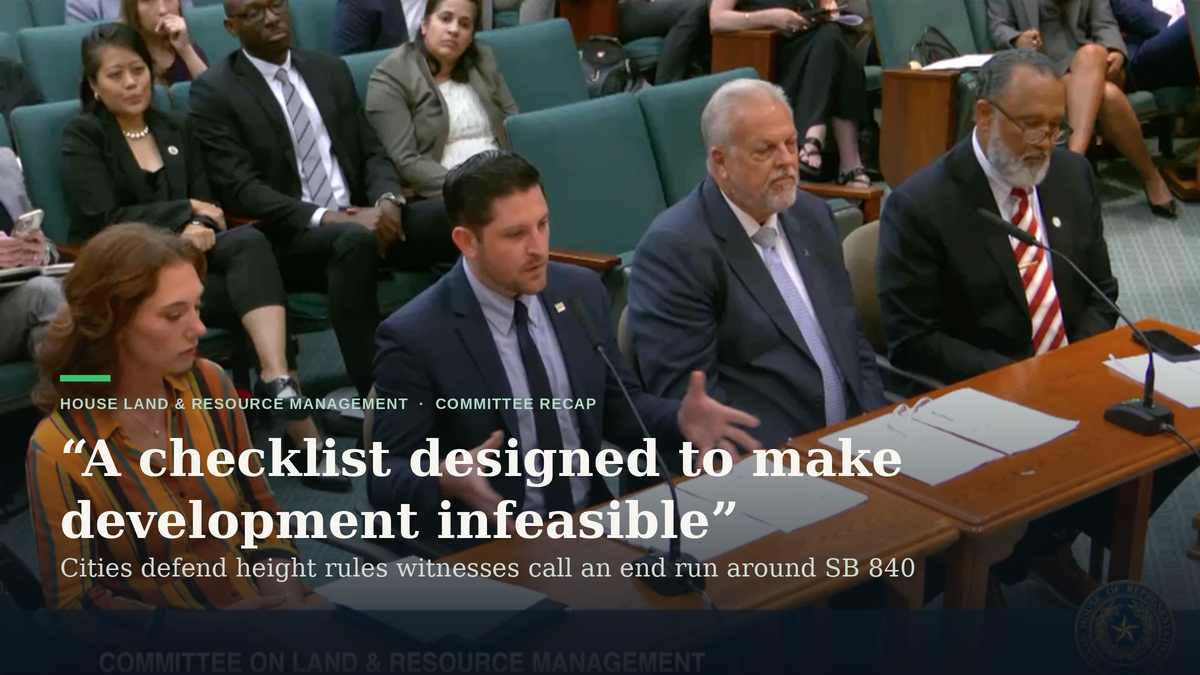
Four mayors and other city officials came to the Capitol on Monday to tell a Texas House committee they are complying with the state’s most aggressive housing law passed last session. They left after nearly three hours of testimony in which witness after witness told the same committee that compliance is exactly the problem.
The House Committee on Land & Resource Management spent the first three hours of a seven-hour hearing measuring how four 2025 housing laws are actually working — and the fight centered on Senate Bill 840, which since Sept. 1 has required large cities to allow apartments and mixed-use projects on land zoned for offices, retail and warehouses without a rezoning. As The Texas Dispatch previously reported, the panel’s monitoring charge covers that law along with three others passed in the same session.
The sharpest testimony came near the end of the block, when a witness read the committee a list of what cities did after the law took effect.
“None of those requirements technically violate SB 840, but together they function as a checklist designed to make development financially infeasible, even though it’s theoretically permitted by right,” said Christina Mojica, senior policy analyst at Reason Foundation. “Arlington required minimum heights of six stories and mandated amenities like EV charging stations and centralized courtyards, requirements unrelated to any legitimate safety or infrastructure concern. Plano adopted a 75 foot minimum height requirement, and Garland opened a formal review of its regulations explicitly designed to preserve local oversight following SB 840 passage.”
The recommendation was blunt: “I urge the committee to treat these examples as evidence that clarifying legislative language in the next session is necessary to close these gaps.”
Chairman Gary Gates, R–Richmond, had already gone looking for that pattern himself. Gates cosponsored SB 840 in 2025, and he pressed the Plano witness directly on whether the city holds residential projects to a tougher standard than the commercial buildings they would replace.
“In Plano is there now, in a commercial, you can build multi-family,” Gates asked. Told yes, he pushed further: “And, do you have higher minimum requirements for residential on that same lot than a commercial. And if so, what’s the rationale behind that?”
Andrew Fortune, director of policy and government relations for the City of Plano, testifying on behalf of the Plano City Council, said the city’s height rules grew out of its retail geography. “We have many of the four corner retail locations throughout our city and a lot of are surrounded by single family areas,” he said. Pressed for specifics, Fortune read from his notes: “We do have a range of minimum height standards, in the appropriate areas, of no minimum, 45ft, 75ft, 120ft. So I’d have to get back with you on, on” the rationale for each.
That answer confirmed on the record the 75-foot figure a later witness would cite as evidence of evasion.
The cities framed the same rules as stewardship. Ariel Traube, managing director of legislative and public affairs for the City of Garland, told the committee her city has almost nothing left to develop. “Garland is a mature, largely built out city of roughly 250,000 residents in the DFW region. We do not have significant undeveloped land remaining for new growth,” she said. “Our ability to compete for private investment and jobs in a fast growing region depends almost entirely on redeveloping and reinvesting in the land we already have.”
Traube closed with a request that the committee not tighten the screws further. “I respectfully ask this committee to treat cities as partners by preserving meaningful local authority over land use,” she said.
Jim Ross, mayor of the City of Arlington — the city accused of imposing a six-story minimum — made the same pitch less formally. “Well, I am your community. Utilize me in Arlington and other cities around here to say, let’s work together,” he said. Asked by a member to define a major thoroughfare, a threshold term in how the law applies, Ross answered: “A major thoroughfare is going to be a either a state highway or a thoroughfare that’s divided with a median.”
Kurt Johnson, mayor pro tem of the City of Grand Prairie, rounded out the invited city panel. Grand Prairie drew separate criticism earlier in the hearing over its small-lot rules, which one witness said “go in the opposite direction of the intent of the bill.”
Housing advocates put numbers behind the stakes. Christina Mojica, a senior policy analyst at the Reason Foundation, told the panel Texas cities are sitting on enormous amounts of convertible land. “Across Texas’s largest cities, there is an enormous amount of underutilized commercial land surface parking lots, vacant office buildings, struggling retail corridors that land could be housing,” she said. “One analysis found S.B. 840 alone opened multifamily development by right on approximately 118,000 acres in Dallas County. Research shows that adding residential supply near job centers decreases surrounding rents by approximately 6%.”
Then the qualifier: “multiple cities have responded to this law by not complying with its intent.”
Other witnesses described the mechanics of how a by-right law gets slowed down. Parking mandates and dimensional standards came up repeatedly. “If you don’t comply with off street parking requirements or other dimensional standards, the city has, sometimes we see that less units get built,” one witness said — the point being that projects legal on paper shrink until they no longer pencil out.
Brennan Griffin, senior deputy director at Texas Appleseed, and Kent Conine of the Texas Association of Builders also testified during the monitoring block.
The committee’s other three monitored laws drew less heat but the same theme. On House Bill 24, which rewrote zoning-protest rules, a witness told members the law has largely held: cities have not been able to write “ordinances designed to specifically circumvent H.B. 24 threshold change, and that is a credit to how the law was written. Unlike SB 15 and SB 840, which set” fixed standards cities can engineer around. On Senate Bill 15, the small-lot law, one witness reached for an out-of-state parallel, describing how Marblehead, Massachusetts, “tried to designate a high density zone” at its edges — “exactly the kind of boundary adjacent workaround that can blunt the statewide effect of these reforms.”
Gates closed the SB 840 item by reminding the room how lopsided the vote had been. The bill “did pass out of the committee, 7 to 0, and it passed 106 to 23 on the House floor and 23 to 7 over in the Senate,” he said.
Because the committee is meeting in the interim, it took no vote. Its findings feed recommendations to the 90th Legislature, which convenes in January 2027 — and the direction was set out loud. Gates opened the day by telling members he wanted to “review existing statutes and explore new areas for the next legislative session,” and more than one witness asked the committee to come back in 2027 with language that closes the gaps cities have found.
Also heard: After the monitoring charge, the committee spent roughly two hours on third-party review of plats and building plans — the largest single item on the agenda and the subject of our companion story. Members then took about an hour of testimony on local government fees, including impact fees, utility connection charges and drainage fees, and closed the day with roughly 50 minutes on whether cities should pre-approve standard house plans for repeated use, a practice witnesses said El Paso and Houston already use in some form.
The hearing at a glance
ISSUE
Monitoring implementation of the 2025 housing package — HB 24, SB 15, SB 840 and SB 1567. About 3 hours, or roughly 43% of the hearing; the SB 840 portion alone ran about 87 minutes.
WHAT HAPPENED
Invited and public testimony. Officials from Garland, Plano, Arlington and Grand Prairie defended local rules adopted after the laws took effect; housing and builder witnesses argued minimum-height, parking and amenity requirements are being used to make by-right projects infeasible, and asked for clarifying language in 2027. Interim hearing — no vote taken.
WHEN
9:00 AM CT, Monday, July 20, 2026 · ran 7 hours, 0 minutes
WHERE
Room E2.026, Capitol Extension, Austin
CHAIR
Rep. Gary Gates, R–Richmond (HD-28)
ARCHIVED VIDEO
house.texas.gov/videos/22720