
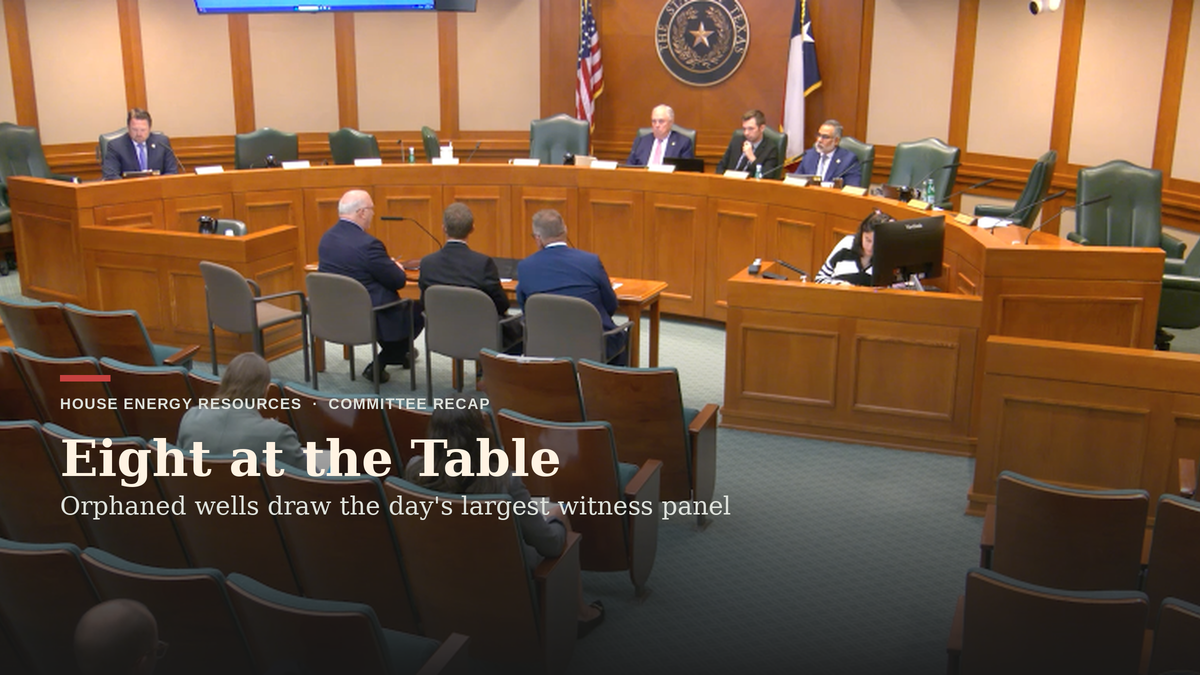
Texas asked the House Committee on Energy Resources to check the homework it set itself. The panel’s orphaned-wells charge is a monitoring assignment on Senate Bill 1150, a plugging law this committee moved 9-0 and whose House sponsor is the man who chaired the Sept. 15 hearing. Eight witnesses registered to testify on it — the largest panel of a nearly six-hour day.
The law is not yet entirely in force. SB 1150, by Sen. Mayes Middleton, R–Galveston, requires the plugging of and reporting on inactive wells under Railroad Commission jurisdiction and authorizes an administrative penalty. It took effect Sept. 1, 2025, except for Section 1, which the enrolled bill delays to Sept. 1, 2027. The committee is therefore reviewing the implementation of a statute whose central provision has not yet reached operators, a year before it does.
The witness list reads like a map of who pays when a well is abandoned. Landowners came through the Texas Farm Bureau, which sent Warren Cude, and the Texas & Southwestern Cattle Raisers Association, represented by Craig Cowden; ranchers carry orphaned wells on their own ground and cannot plug them themselves. Industry came through Karr Ingham, president of the Texas Alliance of Energy Producers, whose independent operators buy and sell the aging wells most likely to end up orphaned. The regulator sent Scott Larson of the Railroad Commission of Texas.
The pressure side was represented too. Virginia Palacios of Commission Shift, Adam Peltz of the Environmental Defense Fund and Schuyler Wight, a West Texas landowner registered for himself, have each pushed the commission publicly on the pace of plugging. Nikki Morris of the Ralph Lowe Energy Institute at TCU’s Neeley School of Business rounded out the panel from the research side. Two more, Travis Baer of the Railroad Commission and Sarah Stogner, registered without testifying.
That breadth is the point of the charge. Its second half asks members to “identify strategies and policy recommendations to reduce the number of inactive wells that become orphaned” — prevention rather than cleanup. The state has spent the past year on the cleanup end. The Dispatch has reported on 42 coastal orphaned wells plugged by the commission and the General Land Office and on a project on leaking wells in Baffin Bay. Every well plugged with public money is one the previous operator did not plug.
The charge also sat next to its mirror image on the same agenda. The P-13 water wells item the committee heard first covers abandoned oil and gas wells that landowners converted to fresh-water production, taking on the plugging obligation themselves. The orphaned-wells charge covers wells nobody agreed to take on at all. Both end at the same question — who pays to close a hole in the ground when the company that drilled it is gone — and the committee scheduled them a few hours apart. This was the second of two consecutive interim hearings for the panel, moved from an originally posted 8:30 a.m. start to 11:30 a.m. by a revised notice.
Rep. Drew Darby, R–San Angelo, sponsored SB 1150 in the House alongside Reps. Charlie Geren, R–Fort Worth, Armando Walle, D–Houston, and Eddie Morales, D–Eagle Pass, the committee’s vice chair. Two of the four sit on this panel, which makes the monitoring charge an unusually direct piece of self-assessment: the committee that wrote the House side of the bill is now the committee judging whether it works.
Darby gaveled in at 11:31 a.m. and took the orphaned-wells charge late in the day, after the P-13 water wells item, the Railroad Commission oversight block and the State Energy Conservation Office. Six members answered the initial quorum call — Darby, Jay Dean, Josey Garcia, Gary Gates, Stan Gerdes and Jon Rosenthal — with Morales and Paul Dyson arriving later, according to the committee minutes. Severed well operations followed, with two witnesses.
No legislation was before the committee and no votes were taken. Before adjourning at 5:28 p.m., Darby directed staff to begin preparing the 2026 Energy Resources interim committee report. That report is where the orphaned-wells recommendations will land, and it will be written while Section 1 of SB 1150 is still waiting to take effect — which gives the 90th Legislature, convening in January 2027, a chance to amend the law before operators ever feel its full weight.
The Dispatch is not reporting what any witness said. The House broadcast index flags this hearing with a technical-difficulties notice, and the archived stream, video 22867, is an unprocessed raw feed with no closed-caption track. Everything above is drawn from the committee’s official minutes, its witness list, the hearing notice, the enrolled bill and previously published reporting. This story will be updated if a captioned archive is published.
Also heard
The day opened on the P-13 water wells charge — hazards from abandoned oil and gas wells converted by landowners to fresh-water production under the commission’s Form P-13, more than 1,500 of them since 2001 according to the Texas Groundwater Protection Committee — with four witnesses. The chair then turned to agency oversight, where Railroad Commissioner Wayne Christian did not appear despite an explicit request from the chair and Railroad Commission Chairman Christi Craddick registered and testified. The State Energy Conservation Office charge drew the comptroller’s office and the Texas Association of Builders, and Darby delivered the Southern States Energy Board update himself.
Fact box
- Issue
- Interim charge — preventing orphaned wells and monitoring implementation of Senate Bill 1150 (largest witness panel of the hearing, eight registered; exact minutes could not be computed: no caption track)
- What happened
- Eight witnesses registered and testified on the charge — landowner, ranching, industry, regulator, environmental and academic interests — and two more registered without testifying. The committee is reviewing a statute whose Section 1 does not take effect until Sept. 1, 2027. The chair directed staff to begin the 2026 interim report. No vote (interim hearing)
- When
- Tuesday, Sept. 15, 2026, 11:30 AM CT · called to order 11:31 a.m., adjourned 5:28 p.m. (5 hours 57 minutes)
- Where
- Room E2.026, Capitol Extension, Austin
- Chair
- Rep. Drew Darby, R–San Angelo (HD-72); Vice Chair Rep. Eddie Morales, D–Eagle Pass (HD-74)
- Key witnesses
- Scott Larson, Railroad Commission of Texas; Karr Ingham, Texas Alliance of Energy Producers; Warren Cude, Texas Farm Bureau; Craig Cowden, Texas & Southwestern Cattle Raisers Association; Virginia Palacios, Commission Shift; Adam Peltz, Environmental Defense Fund; Nikki Morris, Ralph Lowe Energy Institute; Schuyler Wight, self
- Archived video
- house.texas.gov video 22867 (raw archive, flagged “Technical Difficulties”; no captions published)