
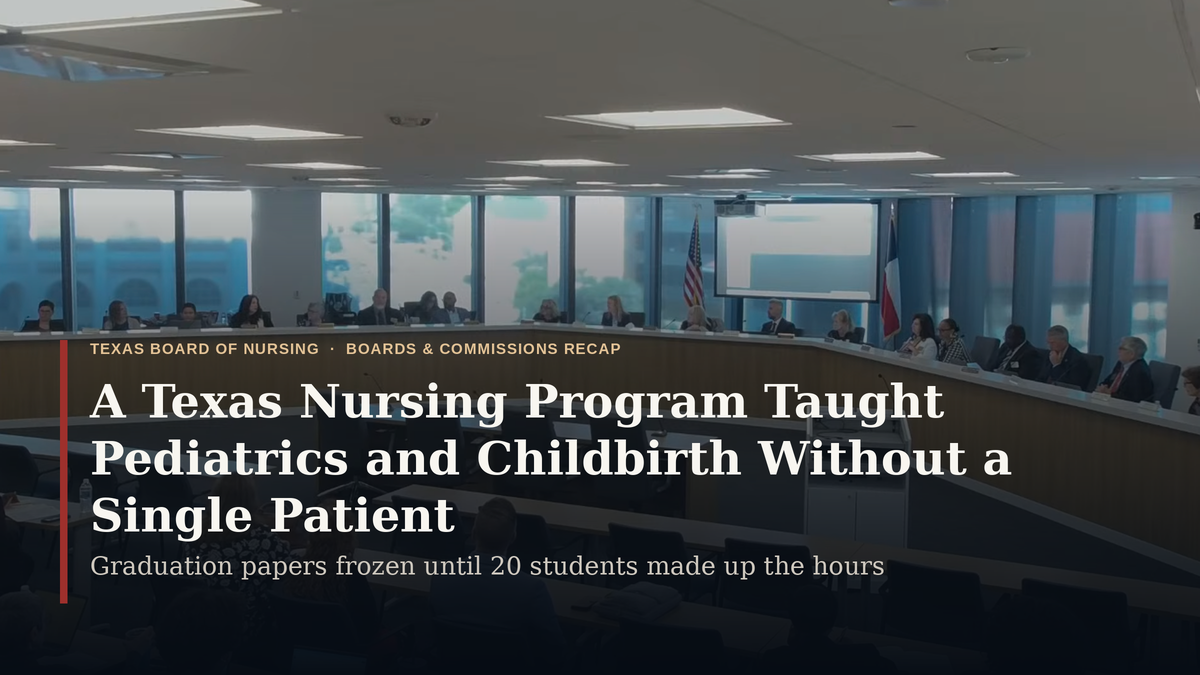
Twenty student nurses at Hill College finished their pediatrics and childbirth courses without ever caring for a real patient, and the Texas Board of Nursing would not let their graduation papers be signed until they went back and did the hours.
The board put that on the record Oct. 22, accepting the findings and putting the Hillsboro college’s vocational nursing program under an order carrying 10 conditions. Both courses had been taught on a screen — pediatrics through a courseware package called ATI, maternity through a virtual-patient program called Swift River — and even the pediatric simulation was offered “primarily through virtual online format”.
Licensed vocational nurses are the floor of bedside care in Texas. They staff nursing homes, rural clinics and school health offices, they are often the first person a sick child meets, and many become registered nurses. State rules name five subjects every vocational program must cover; two are nursing care of children and maternity nursing, and both are supposed to include “faculty-supervised, hands-on patient care” (22 TAC §214.9). Those were the two with none.
Staff caught it on a routine six-year survey visit, held remotely June 29 and 30. On July 21 they told the program director she could not sign the affidavit of graduation — the document that lets a graduate sit for the national licensing exam — until all 20 had made up the work. The college found placements within two days, and the students did 16 hours of pediatrics at Cook Children’s and 16 of obstetrics at Lake Granbury Medical Center between Aug. 10 and Aug. 31.
By then the class had already been pinned. Hill College held the ceremony Aug. 6 — four days before the first make-up shift — and named eleven graduates in an announcement that did not mention the board’s findings. Pinning is ceremonial; the affidavit is the credential, and that was what the board had frozen.
What nobody could say is how many students came through those same two courses before this one. Ken D. Johnson, who holds the board’s vocational nursing education seat and teaches at Howard College, asked whether “all the previous cohorts since 2019” had been properly evaluated, or whether a director had signed their graduation affidavits knowing the hours were not there. He told the college it was “very difficult for me because it’s saying that you are not keeping your records correctly”, and said he was “deeply concerned”.
He did not get a number. Joshua Tarbay, who became dean of health and public service in February, set out what the college does and does not know.
“It is our assumption that 2020, 2021, 2022, 2023 would be no different. It wasn’t until 2024 that we change directors from this 26-year veteran. I do not think we have an answer to your question, 25 and 26 we now know, right? And that’s what’s concerning.”
Dawn Cox, who took over the vocational program in December 2025 after seven years running the college’s registered nursing program, could not date the lapse either: she “can’t give you a direct answer” on when it began. The previous director of nearly three decades has retired, as have the two instructors who taught the cohort.
Nothing in the program’s results had flagged it. Its licensing-exam pass rate stayed above the board’s 80 percent benchmark throughout, and the college says its nursing graduates have averaged 87.5 percent over five years. Board president Kathy Shipp put it to the college directly: “Passing is not the only part of that picture.”
Nor is simulation the problem. The largest study, run by the National Council of State Boards of Nursing with a cohort that graduated in 2013, found “substantial evidence that up to 50% simulation can be effectively substituted” for traditional clinical time — but the ceiling it endorsed was half, not all. The council has taken no position on Hill College, and nobody outside the meeting has said anything on the record.
The college did not contest the findings. Cox said she “was not aware that they were not attending clinical”. Tarbay described record-keeping that was “very manual”, with “a lot of paper and pen”, at what he called “not a very rich college”. Hill College has now posted a clinical coordinator job “for the first time ever”, is buying digital tracking software, and says coming classes will get about 30 hands-on hours in each area — double the make-up rotations.
The 10 conditions were never read out — “a very long list”, in Shipp’s words — and the attachment has not been posted, so whether any requires a look back at earlier classes is not public. The program is down to 10 students and one instructor, who said they begin rotations at nursing homes in November. The board meets again in January.
The complaint backlog is back where it was in 2011. Enforcement staff reported that 42 percent of open investigations are more than a year old in 2026, after the board held that figure under a 25 percent ceiling every year through 2023. The average investigator is carrying 183 cases; a survey of other states’ nursing boards put their typical load “far less than 100.” Nine investigator posts and two staff attorney jobs are vacant, and the state’s administrative court is running behind on hearing dates. A new continuing education hour. The board proposed requiring every Texas nurse to take one hour of continuing education in nutrition and metabolic health every two years, implementing Senate Bill 25 from the last session. It would apply to licensure renewals after Jan. 1, 2027. The vice presidency is still open. Two members stood; the hand vote tied twice; the board tabled the election to January rather than keep voting. Nobody signed up to speak at open forum.