
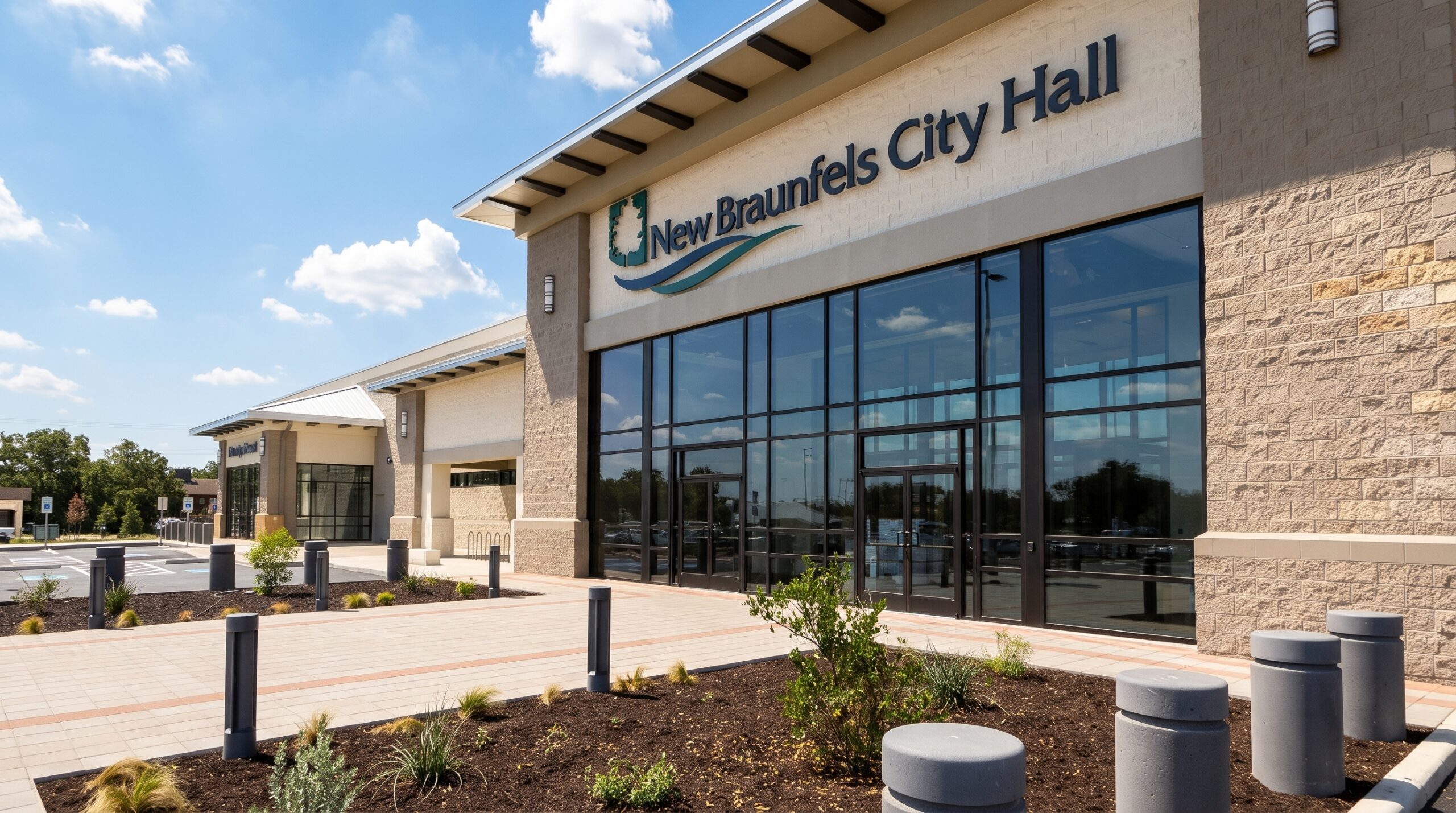
The New Braunfels City Council gave final approval Nov. 16 to zoning rules that keep data centers out of the Edwards Aquifer recharge and contributing zones and at least half a mile from homes. The vote was first reported by the New Braunfels Herald-Zeitung. The rules reach only land inside the city. Just outside it, state law bars New Braunfels from regulating how land is used, and Texas counties have no general zoning power.
That gap matters in this part of Comal and Guadalupe counties, where growth and data center proposals both reach past city lines. On Nov. 16 council approved the ordinance unanimously, and just two weeks after The Dispatch reported on the draft. Members also widened the required distance from homes and sensitive sites from 2,000 feet to 3,000 feet. And at the request of Mayor Michael French, they added a decommissioning process and a surety bond, a guarantee that money will be there to clean up a site if an operator walks away.
The version of the ordinance posted for the Nov. 16 special meeting treats a data center as more than a building of servers. It covers the backup generators, batteries, cooling equipment and fuel that come with one. Cryptocurrency mining facilities are included. A data center would be allowed only in the city’s two heavy-industrial districts, and only with a special use permit, a case-by-case approval that comes back to the council. No building permit could even be applied for until the council approved the permit.
The posted text sets a 50-acre minimum lot and a 35-decibel noise ceiling, about the level of a soft whisper. The limit applies at any property line next to homes, schools, churches, parks or trails, and it covers generator testing as well as daily operations. Projects could not sit in the 100-year floodplain or within 300 feet of it, or within 300 feet of a mapped fault line. The text says plainly that a permit “shall not be approved” over the aquifer’s recharge or contributing zone. The Edwards supplies drinking water to much of the region.
The ordinance also puts the cost of growth on the project. Applicants must bring letters from their electric, water and wastewater providers certifying that the load “will have zero impact to existing customers/rate payers” and that “no costs will be passed on” to them. Cooling must be closed-loop systems that do not evaporate water. Operators must publicly report total water and electricity use every year. Existing buildings converted to data centers are not grandfathered.
Some details differ between the city’s posted text and the newspaper’s account. The Herald-Zeitung reported a 100-acre minimum lot and a one-story, 15-foot height limit. The posted version says 50 acres and 30 feet with two stories. The newspaper described only the setback, bond and decommissioning changes as amendments made at the vote. The signed ordinance will settle which numbers govern.
Mayor Pro Tem Michael Capizzi said the permit requirement gives the council another chance to tighten terms on each project. “With it being an SUP, we have the opportunity, anytime if one of these comes up, that we could add additional restrictions, whatever those might be,” he said, according to the Herald-Zeitung. He called the rules some of the strictest in Texas, after San Marcos, which bars data centers in every zoning district.
A resident who wrote to the city before the Planning Commission’s 7-0 vote on Nov. 4 put the case for the approach. “I’m not opposed to data centers. I support them being done the right way,” wrote Elizabeth Bellman, who lives in Comal County, in a comment attached to the city’s file. She asked that the same standards apply to all large industrial uses. No data center developer or industry group was quoted in the city’s file or the newspaper’s report, and The Dispatch did not obtain industry comment before publication.
None of this reaches the unincorporated land around the city. Under Section 212.003 of the Local Government Code, a city may extend its subdivision rules into its extraterritorial jurisdiction, the unincorporated land just outside its limits where it has only limited powers. But “unless otherwise authorized by state law,” the city “shall not regulate” the use of property there “for business, industrial, residential, or other purposes,” or the height and size of buildings. Counties, as The Dispatch has reported, have no general authority to zone either. Bills filed for the 2027 session would change that for data centers.
The ordinance takes effect once it is signed, filed with the city secretary and published in a newspaper within 10 days of final passage, according to its text. The first test will come when a developer applies for a permit and the council decides what conditions to attach.
Key facts
- Nov. 16, 2026: New Braunfels City Council gave final approval to data center zoning rules, unanimously, according to the Herald-Zeitung (Nov. 17).
- Data centers allowed only in heavy-industrial districts with a council-approved special use permit; none over the Edwards Aquifer recharge or contributing zone (Ordinance 26-1266, posted text).
- Setback from homes and sensitive sites raised to 3,000 feet at final reading; surety bond and decommissioning added (Herald-Zeitung).
- Utilities must certify “zero impact” and no costs passed to existing customers (posted text).
- State law bars cities from regulating land use in their extraterritorial jurisdiction (Local Government Code §212.003).