
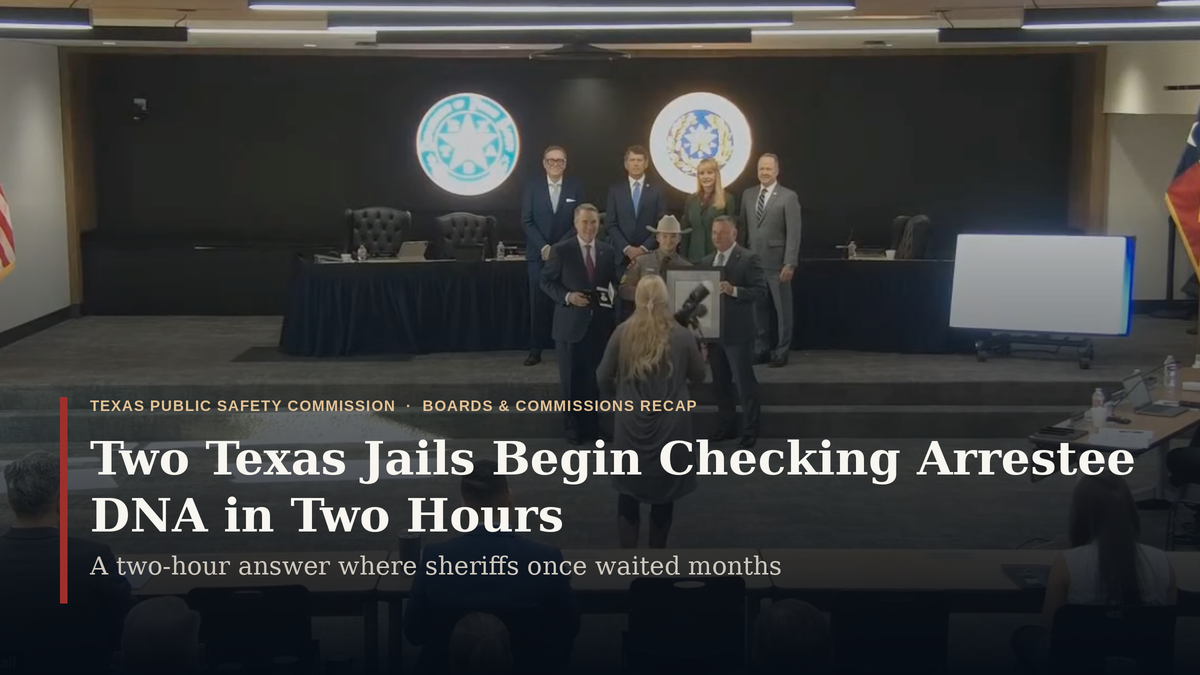
People arrested on felony charges in Montgomery and Williamson counties now have a cheek swab checked against CODIS, the FBI’s national DNA index, while they are still in the jail booking room — a two-hour answer where their sheriffs have had to send DNA to Austin and wait.
Col. Freeman Martin, the state’s public safety director, told the Public Safety Commission on Oct. 15 that both went live that morning. What is new is the speed, not the swab. Texas has required a DNA sample from everyone arrested on a felony charge since 2023, and the department says every felony sample must still be sent to its CODIS laboratory in Austin for processing. For a felony arrest, two swabs are taken: one for the laboratory, one for the machine.
The machine’s answer is not evidence: rapid results are not admissible in a Texas courtroom. What they do is tell a jail, before it sets a bond, whether the person in the chair matches DNA left somewhere else, which the department argues “could prevent violent offenders from being released back into the community”. The laboratory behind it loaded a record 148,993 arrestee and offender samples into CODIS over the past year, by its own count.
The case for doing it at booking has a Texas face. Ashley Spence, born in Austin, was 19 and a sophomore at Arizona State when an intruder broke into her apartment and, she told the Dispatch in May 2025, “smothered my face in a pillow and violently raped and beat me for hours”. Nobody was identified. “I lived in silence for 13 years”, she said. The man eventually convicted and sentenced to 138 years surfaced only when a California database matched him to another crime; by then he was living down the street from her. He had been, she said, “in and out of jail for voyeurism, burglary, but they never swabbed his cheek”.
Spence founded the DNA Justice Project in 2022, helped pass the 2023 law that made Texas the 19th state to take DNA at every felony arrest, and testified for the rapid DNA bill at its only hearing, days before the Senate passed it. She is its advocate, and her case runs both ways: “DNA technology can exonerate some people immediately”, she said, pointing to Texans cleared by post-conviction testing. “All victims deserve justice, or they at least deserve a chance”.
The pilot’s first year produced no samples at all. The 2025 law behind it ordered a start in two counties of the department’s choosing by Sept. 1, 2026, to “decrease the number of arrests for which a DNA sample is not collected and analyzed”. Year one went to installing instruments and training staff, the department said; in year two, “participants will begin entering arrestee samples into the Rapid DNA system”. Oct. 15 is the department saying that day came.
The pilot expires Sept. 1, 2028, with a report owed to the Legislature by Jan. 1, 2028. What does not expire is easy to miss. The same law wrote a second, permanent definition into the DNA statutes, covering “a known reference or forensic sample” processed “in not more than 24 hours”, and let the public safety director approve any Texas agency to run its own rapid analyses, with no county limit, no sunset and crime-scene samples included. Nothing in the law says what becomes of a rapid DNA record made outside a laboratory if the charge is dropped.
Martin’s other figures could not be confirmed. He said the CODIS unit cut its 2026 backlog from 190 days to 28, clearing 62,000 cases since March; that the 2023 requirement took the caseload “from about 70,000 to 170,000”; and that 532 kits have come in under a new program letting sexual assault victims be tested without going to the police, 368 finished. No published document carries those numbers; the department’s own release says only “over 500” kits submitted. He said four states run rapid DNA at booking, which the Dispatch could not confirm.
Nobody has argued the other side in public. At that hearing the sheriffs’ association, two district attorney’s offices and three police organizations registered in favor; one private citizen registered against, no organization. Montgomery County Sheriff Wesley Doolittle, asked about accuracy when his county was picked in September 2025, called the machine a screening tool, like a drug field test. No Williamson County official has been quoted. The one cautionary note comes from Houston, where police tried rapid DNA and, a spokesman told ABC13, “they no longer use the technology, but did not provide reasons why”.
The commission also sent four crime laboratory rules and a private security training change to the Texas Register; no comment deadline was announced. It meets again Dec. 3.
A decade-old seat changed hands. Only two companies build the emissions analyzers Texas inspection stations use, Opus and Worldwide, and one seat on the nine-member vehicle inspection advisory committee belongs to them. Opus had held it for “over a decade at this point actually”, the regulatory services chief told the commission, and its incumbent had applied again — but Worldwide applied too, and the chief said he felt “it made sense to give the other manufacturer turn so to speak”. The commission appointed Worldwide’s William Delaney without dissent, and a commissioner’s question about how the two applicants’ qualifications compared went unanswered. An ethics hour becomes optional. A rule heading for public comment would let private security owners and instructors spend one of their eight annual training hours on “one hour of either ethics or um code compliance updates” instead of ethics alone. The industry’s own advisory committee asked for it; the chief called it “a fairly innocuous request”. Nobody spoke. Public comment opened and closed with no speakers.