
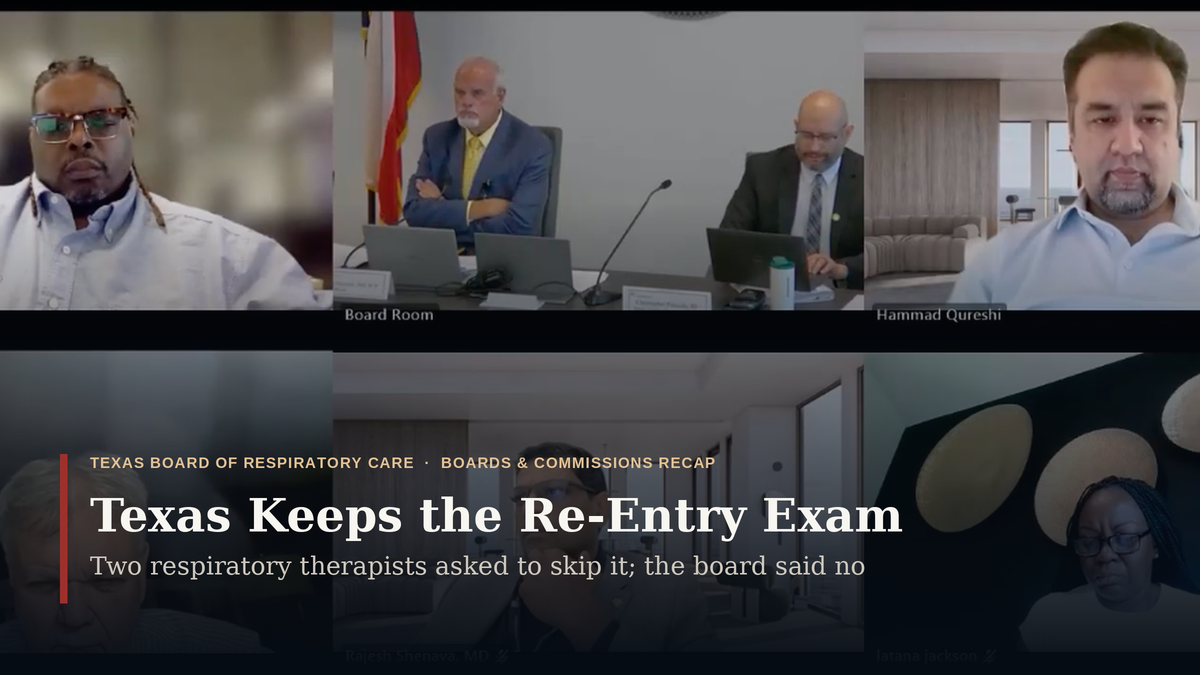
Texas told two respiratory therapists Sept. 17 that they cannot return to a hospital bedside without passing a national certification exam again — and one of them, who says she is living in her car, told the board she was giving up.
Both women came before the state board that certifies everyone who runs a ventilator, manages an airway or gives a breathing treatment in a Texas hospital. Both had let their certificates lapse: one after 10 years away, much of it spent caring for her father through terminal cancer, the other after 15 years raising a daughter and working in a laboratory. Each was handed the same three-part deal by the agency’s executive director: retake the exam, log continuing education hours, work six months under another therapist’s supervision, all inside a deadline. Each asked the board to drop the exam. Neither got it.
Texas counted 13,817 licensed respiratory care practitioners in 2022, one for every 2,220 residents, by the state health department’s latest tally — a ratio that had worsened 11 percent over the decade while the workforce grew 0.2 percent in five years. The people appealing to this board are therapists Texas already trained.
The woman 15 years out of practice was ordered to produce 36 hours of continuing education, 24 of them live rather than online, plus two in ethics; to pass the exam; and to work 20 hours a week for 20 weeks under supervision — all within 18 months. A Texas therapist who never left owes 12 live hours every two years. She told the board she has not worked in two years, cannot get a laboratory job for lack of a current reference, and cannot pay for any of it. Re-earning the credential costs $390 in test fees alone, at the national board’s posted prices.
“My house has been foreclosed on. I am living in my car.”
The board voted unanimously to deny her appeal and leave every requirement standing. “So, I guess this license is null and void because I’ll never pass that test again,” she said before the vote. “I don’t have the money for it and I’ll never pass it.”
The board’s case for the exam is the obvious one, and a member made it plainly: “if you know it was your mom or your dad needing care by a respiratory therapist, we want to make sure they know how to handle those situations.” Members also tried to solve her money problem from the dais. Latana T. Jackson, a therapist member from Cedar Hill, told her the requirement she feared most is cheaper than she thought: “as long as you log in at the time that the presentation starts, even though it’s online, it’s counted as a live CEU. It doesn’t mean you have to be sitting in the room.” The applicant had assumed live hours meant flying somewhere. “that was my confusion,” she said.
The earlier appeal turned on paperwork too. That applicant, out since 2016, had done none of the three requirements — because, her attorney said, they read the board’s three-page determination letter as a stop sign. It offers three choices, he said: withdraw, accept, or appeal, and “it doesn’t say anywhere on the letter that you can fulfill the other practice requirements that are listed on there.” Staff said there is no such bar. “There’s no sequential order,” a licensing official told the board. Months of a 12-month clock had run out on a misreading.
The board granted that appeal, then kept the exam, the live hours and the supervision. What it gave her was six more months. A member called the request “a new ground for us” — “We’ve always held to the matrix where we would do the test.” The matrix converts years out of practice into hours, months and exams. It drove both decisions and it is not published. Neither is the letter.
Texas’s own yardstick for licensing agencies anticipates people leaving and coming back. Inactive status, the Sunset Advisory Commission wrote in August 2023, lets a person step away and “return later without having to meet the strict requirements of being relicensed” — though the same passage endorses making returnees make up continuing education, so it is no criticism of this board. It is simply the on-ramp neither woman was on: a respiratory care certificate can sit inactive no more than three years before it cancels, and both of these had cancelled.
The woman living in her car has 18 months on paper and told the board she will not use them. She can still accept the terms, keep trying, or withdraw; a licensing supervisor met both applicants in a separate call right after the vote, and nothing of it is public. The minutes come up for adoption Feb. 4, 2027.
The rules the preview led on produced nothing. Items 25 and 26, proposed and adopted changes to the respiratory care rulebook, were both called and both were empty: “And there are none on item 25.” “No rules up for adoption today.” Renewals now run through a tracking service. Therapists renewing after Sept. 1 must have their continuing education logged in CE Broker or the agency cannot process them, staff said; a member asked whether respiratory therapy associations can feed their courses in automatically, as the state medical association does, and was told the agency would try to broker an introduction. One case dismissed, one agreed order approved. Both were single items, both passed on voice votes. Nobody spoke in public comment.