
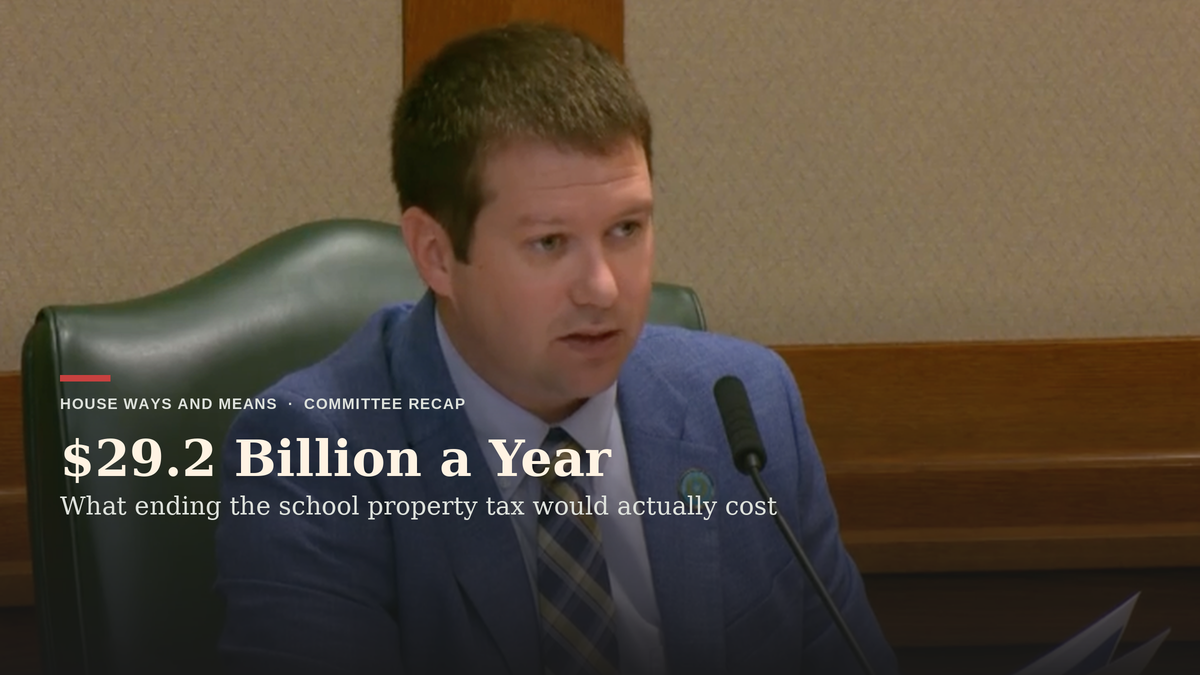
Texas lawmakers have cut school property taxes in three straight sessions and committed roughly $51 billion of the current budget to keeping those cuts in place. On Sept. 15 the House Committee on Ways and Means spent four hours and 22 minutes — more than half its day — pricing out what it would take to finish the job. The number witnesses kept returning to was $29.2 billion a year.
Rep. Cody Vasut, R–Angleton, got it on the record early. “The total that we’re collecting from local property taxes for M&O for schools is approximately 29.2 billion. Is that right?” he asked Texas Education Agency Commissioner Mike Morath. “Yes, sir,” Morath answered.
Morath had opened the charge with the arithmetic of what the state has already bought. School maintenance-and-operations tax rates have fallen from a dollar per $100 of value in 2019 to about 61 cents, he said, and the residence homestead exemption has climbed from $25,000 to $40,000 in 2023, then to $100,000, then to $140,000 under Senate Bill 4 in 2025. Even so, he told members, only one of those packages actually lowered what Texans paid year over year: “of all of the reductions provided by the legislature, probably only one of them actually did reduce year over year total tax payments.”
The relief also moved a cost onto the state that nobody voted on directly. Because rising exemptions shrink the tax base that secures school construction debt, Morath said, “the state is now in the debt service payment business with local school districts to the tune of about $1 billion a year.”
Tatiana Melnick, who directs the Revenue Estimating Division at the Comptroller of Public Accounts, supplied the other half of the equation. One cent of the state sales tax, she told Vasut, “generates for general revenue broad purposes, about 7.443 billion.” At that rate, replacing the entire school M&O levy would take four cents on a 6.25-cent state rate.
Vasut pressed for a cheaper version — exempting homesteads only, and leaving business property on the rolls. Melnick priced it at “8.6 billion. So it’s not 29, but it’s 8.6. And through 2032 that number will go up to $12 billion.” She did not endorse the trade. “Sales taxes could be a great anchor for ongoing property tax relief,” she said, “but probably worth to consider other revenue streams.”
Vice Chair Trey Martinez Fischer, D–San Antonio, took the argument somewhere else entirely. “It seems to me that we might be cutting the wrong taxes if the sales tax is the workhorse for the state,” he said. “When we have excess revenue, shouldn’t we be cutting the sales tax as a way to give thanks and show grace to the taxpayers?”
The sharpest exchange of the morning came over appraisals. Morath told Rep. Chris Turner, D–Grand Prairie, that the comptroller’s property value study exists because undervaluation quietly shifts money: “if the appraisal districts are materially undervaluing property, it is essentially a form of hidden rate reduction.” Martinez Fischer objected on the spot. “I’ve never heard this characterized as a hidden rate reduction,” he said, describing districts that take a mid-year funding hit when the study disagrees with local rolls — “when I visit with folks in Brewster County and they take a $1.2 million hit after the tax bill has gone out in the middle of the school year.” Morath backed up: “let me rephrase my statement.”
Vasut floated scrapping annual market-value appraisal altogether, asking comptroller staff whether locking values at purchase price indexed to inflation would end the protest system: “There’d be no reason to do a the mass appraisal computer system. There’d be no reason to protest your property taxes anymore, would there?”
Ryan Chizmar, testifying for the Texas Association of Property Tax Professionals, told members the system is not the problem. “The first question we have to ask is the Texas property tax system working as intended? And broadly? I believe that it is,” he said. “Let’s not confuse property tax frustration with structural failure.” Lengthening reappraisal cycles, he warned, only postpones the bill: “The market doesn’t stop moving because we stop measuring it.”
Jennifer Rabb of the Texas Taxpayers and Research Association aimed at a narrower target with a larger payoff — the “new value exclusion” that keeps newly built property out of the no-new-revenue rate calculation. Using a $10 billion data center that landed in Ellis County in 2025, she said the county “collects about $21 million more in tax revenue” at a rate voters are told is flat. Repeal the exclusion, she said, and “your no new revenue tax rate would actually go down.”
Shannon Halbrook of Every Texan was the only witness to argue the cuts themselves are the risk. “We at every Texan oppose the tax cuts largely because we were concerned about their sustainability,” he said, putting the commitment at “the $51 billion in the current state budget that’s devoted to property tax cuts out of about 150 or so billion in general revenue.” He added that “half of the benefits of tax compression go to Texas is very top earners,” and floated an income-tested circuit-breaker refund instead.
Rep. Vincent Perez, D–El Paso, pushed a complaint that cut across party lines: exemptions the state orders but does not pay for. “In the city of El Paso, I think they took a $14 million hit to their budget state didn’t provide,” he said. “This is why I say it sometimes it’s almost like a legislative property tax increase.” Compression, he added, does not reach renters — “there’s virtually no savings that’s virtually passed on to tenants, which is why I think here in Texas, we have sort of an affordability crisis.”
No votes were taken and no legislation was before the panel. What members heard will shape the committee’s interim report and the tax bills filed for the 90th Legislature, which convenes in January 2027.
The committee gave about two hours eight minutes to local government spending and certificates of obligation — the subject of the companion recap, “Texas Local Debt Service Tops $552 Billion, and a House Panel Splits on the Remedy.” The day opened with 33 minutes on monitoring House Bill 103, which created a statewide database of local bond and tax-rate election information carrying a civil penalty of up to $1,000, and House Bill 148 on appraisal district board qualifications. It closed with 45 minutes of comptroller oversight, where general counsel Chris Blackwell said the office has begun “a broad organizational restructuring” since Comptroller Don Huffines was sworn in Aug. 1.
Fact box
- Issue
- Interim charge — property tax relief, rate compression and the appraisal system (approx. 4 hours 22 minutes, about 56 percent of the hearing; longest block)
- What happened
- TEA and comptroller witnesses priced the school M&O property tax levy at about $29.2 billion a year and a homestead-only exemption at $8.6 billion, rising to $12 billion by 2032; one cent of state sales tax was valued at $7.443 billion; the vice chair argued for cutting the sales tax instead; witnesses split over appraisal caps, reappraisal cycles and the new value exclusion; no vote (interim hearing)
- When
- Tuesday, Sept. 15, 2026, 10:00 AM CT · run time 7:49:10
- Where
- Room E2.014, Capitol Extension, Austin
- Chair
- Rep. Morgan Meyer, R–Dallas (HD-108); Vice Chair Rep. Trey Martinez Fischer, D–San Antonio (HD-116)
- Key witnesses
- Mike Morath, Texas Education Agency; Tatiana Melnick and Allison Mansfield, Comptroller of Public Accounts; Antonio Najera, Legislative Budget Board; Ryan Chizmar, Texas Association of Property Tax Professionals; Jennifer Rabb, Texas Taxpayers and Research Association; Shannon Halbrook, Every Texan; James Quintero, Texas Public Policy Foundation
- Archived video
- house.texas.gov video 22814