

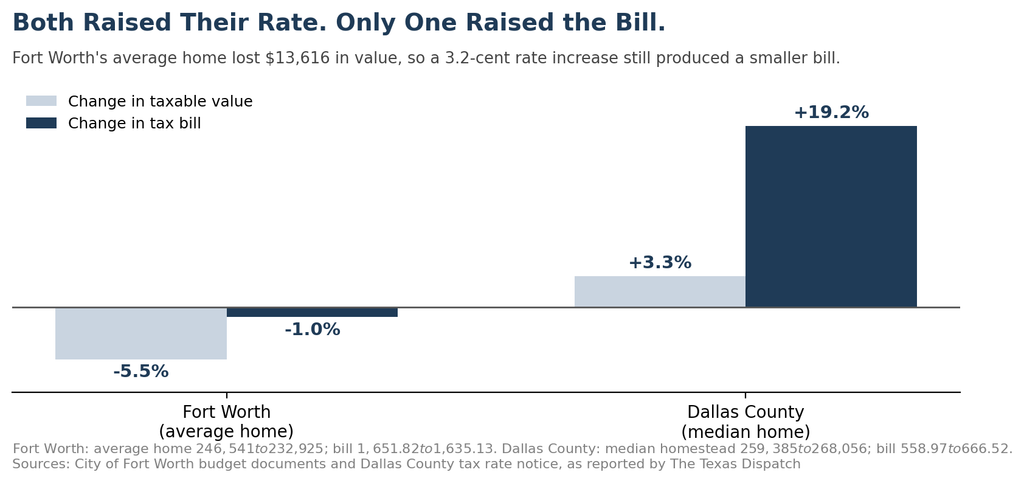
Fort Worth raised its property tax rate by 3.2 cents this year. The average homeowner’s bill went down $17.
Dallas County raised its rate by a comparable amount. The median homeowner’s bill went up about $108, and because the county went above the rate it can set on its own, voters decide on Nov. 3.
Same direction on the rate. Opposite results on the bill. Fort Worth’s average home lost $13,616 in taxable value — a 5.5 percent drop — while Dallas County’s median home gained.
The comparison is worth sitting with, because it exposes something the annual argument over rates usually obscures. Neither city council nor commissioners court set out to move a rate. Each adopted a spending plan, calculated the revenue required to fund it, and divided that revenue by a taxable base it does not control. The rate is what came out of the division.
That is the frame for budget season 2026. Across Texas this month, local governments are making spending decisions and reporting them as rate decisions, into a state debate that treats the rate as the decision itself.
The rate is an output
The rate follows from two numbers set separately. One is the budget — what a government intends to spend, which it controls. The other is the taxable base — what the appraisal district certifies, which it does not.
Divide required revenue by the base and the rate falls out. When the base grows, funding the same budget takes a lower rate. When the base shrinks, funding that same budget takes a higher one. This is why a rate increase and a falling bill are not a contradiction, and why the direction of a rate, by itself, says nothing about whether a tax bill is going up or down.
What state law constrains is narrower than the debate usually implies. Senate Bill 2, the 2019 law, caps how much revenue a city or county may collect above last year’s levy without voter approval — 3.5 percent, with adjustments for new construction and debt. It does not cap spending. It does not cap the rate. A jurisdiction may set its rate as high or as low as it likes; what it may not do without an election is collect more than the cap allows.
That distinction matters right now because the base is moving in a direction Texas has not seen since 2008, while spending obligations are moving the other way. The cap governs the revenue side. Nothing governs the demand side.
Bexar County shows what that looks like when a government declines to take what the cap permits. Commissioners voted unanimously Sept. 1 to propose 29.9999 cents — identical to last year’s rate, and below the county’s no-new-revenue rate of 30.9043 cents. Its notice says flatly: “BEXAR COUNTY is not proposing to increase property taxes for the 2026 tax year.” The county could have gone to 38.6728 cents before triggering an election, roughly 25 percent above no-new-revenue. It chose a rate that collects less than last year, and the consequence is on the spending side. County Judge Peter Sakai said jobs will go, particularly positions funded by expired federal pandemic aid: “We’ll have to tell some employees, ‘we’ll do our very best to find positions for you,’ but some positions will be cut.”
County Manager David Smith had framed the choice for the court in April, and framed it as a spending problem. Assessed value growth had gone “from double-digit growth, to barely any growth at all,” he said, and the county projected property tax revenue down 1.7 percent. “The last time we saw numbers this low, it was right after the financial crash of 2008.” Bexar’s projected general fund gap by fiscal 2028 moved from $28 million to $148 million in a single forecast revision. Roughly 80 percent of the county’s general fund comes from property taxes.
“There’s very little you can do, other than raise taxes, to affect the revenue side,” Smith told commissioners. “What you do control, to some degree, is the cost.”
Six jurisdictions, six different bets
Faced with the same choice, Texas local governments split four ways this month. Each bar below is a revenue posture — how much a jurisdiction proposes to collect relative to last year — expressed, as state law requires it to be, as a rate.
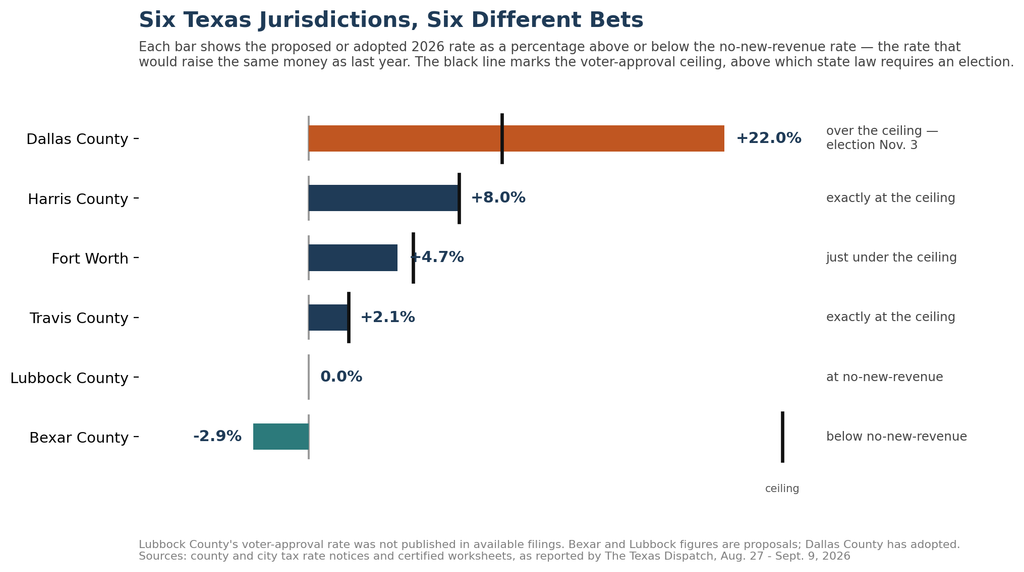
Go to the ceiling. Harris County commissioners voted Sept. 8 to advance a rate of 41.750 cents — matching its voter-approval rate to the ten-thousandth of a cent, the highest rate adoptable without an election. The county’s own notice says the median homestead bill rises $86, from $891 to $977. At the no-new-revenue rate it would have risen $14. Three of the four entities the court sets rates for are proposed at exactly their no-election ceiling. Travis County built its preliminary budget at 38.6210 cents — also precisely its voter-approval rate.
Hold the line and cut. Bexar proposed below no-new-revenue. Lubbock County commissioners proposed the no-new-revenue rate of 32.2 cents, down from 32.7 — about $27 less for the average homeowner and roughly $1 million less revenue — over objections from their own county judge, auditor and sheriff. Three commissioners walked out of a budget workshop. “It just robs our future,” Judge Curtis Parrish said. Auditor Kathy Williams told the court the rate “will not fund” a cost-of-living raise.
Let falling values do the work. Fort Worth’s recommended 70.2-cent rate is a 3.2-cent increase that still sits under its 70.7594-cent ceiling and still cuts the average bill. The budget nonetheless trims $4,085,926 in services — pay raises, code compliance, library hours, park maintenance, aquatics. Restoring all of it would cost the average homeowner $8.49 a year.
Go over and ask. Dallas County adopted 24.865 cents against a voter-approval rate of 22.465. Its notice carries the capital-letters disclosure the Tax Code requires: “THE TAX RATE WILL EFFECTIVELY BE RAISED BY 22.02 PERCENT.” The budget raises $189.4 million more from property taxes than last year’s, an increase of 22.51 percent. If voters say no on Nov. 3, the rate drops to the ceiling.
The pattern across the four is not regional. It tracks something simpler: how large a spending obligation a jurisdiction carries into a year when its base stopped growing, and how much of that obligation it is willing to cut rather than fund.
The spending side is where the pressure originates
The cities are not inventing the squeeze. Dallas is closing a $51 million gap and plans to lay off more than 100 employees and cut library hours. Fort Worth is eliminating vacant positions and slashing civilian pay raises. San Antonio and Austin are raising taxes while cutting services. “This is going to be our new normal going forward,” Dallas City Manager Kimberly Bizor Tolbert said.
Three cost drivers compound the value problem. Federal pandemic aid has run out, and the positions it funded are now general-fund obligations — Harris County alone is carrying $14 million to continue programs started with expired Biden-era grants. Population growth in unincorporated areas produces service demand without the sales tax base a city would collect; more than 80 percent of Harris County’s growth since 2000 has happened there. And in the counties, indigent health care remains a local obligation.
John Diamond, who directs the Center for Public Finance at Rice’s Baker Institute, put the outlook bluntly: “I just don’t see an out. I keep looking for what would make me believe that the fiscal health of the cities will get any better anytime soon, and honestly, I see no reason to believe that.”
The pressure from above is escalating
State leaders are moving in the opposite direction, and they moved further this month.
In Lubbock on Sept. 4, joined by Speaker Dustin Burrows and Sen. Charles Perry, Gov. Abbott proposed cutting Texans’ property tax bills by half. The package: require two-thirds voter approval for tax increases, make it easier for voters to roll back rates, cap appraisal growth at 3 percent a year, and eliminate school property taxes for homeowners, with the state assuming full responsibility for funding public education. That is a significant escalation from the five-point framework his office released Aug. 20, which named a two-thirds threshold but no cut target.
Comptroller Don Huffines has been making the parallel case. Local governments received $1.4 billion in August sales tax allocations, up 13 percent year over year. “When sales tax collections are climbing that fast, local governments have room to bring property tax rates down,” he told an ad valorem taxation seminar in San Antonio. “Every dollar a city or county council doesn’t spend is a dollar they don’t have to tax away from a homeowner.”
Sen. Paul Bettencourt, who authored the 2019 cap and chairs the Senate Local Government Committee, was more direct: “You have to live on a budget, and if that’s not good enough, you have to make cuts.”
Three things about that agenda follow from the mechanics rather than from any position on it.
First, four of the five components operate on the revenue side, not the spending side. Appraisal caps, rollback authority and a two-thirds threshold all limit what a government may collect. Only “common sense local spending limits,” the component with the least detail attached, addresses spending directly — and spending is where Smith told his commissioners the actual control lies.
Second, a 3 percent appraisal cap does very little in a year when appraisals are flat or falling. It is a boom-era instrument. Its bite arrives when values resume climbing — which is also when it decouples taxable value from market value and shifts burden toward newer owners and non-homestead property.
Third, a two-thirds voter-approval threshold binds hardest in exactly the situation now spreading across Texas. Dallas County needs a simple majority on Nov. 3; under a two-thirds rule the same election becomes close to unwinnable. That puts a specific question to the 90th Legislature: what is a county with 80 percent property tax dependence and a base that stopped growing supposed to do when it cannot reach a two-thirds vote and cannot cut fast enough to close the gap?
What the state has already absorbed
The state’s own numbers show how far the shift has gone. Bettencourt told an interim committee that 40 percent of Texas homeowners no longer pay any school district taxes, and nearly 61 percent of disabled homeowners and those 65 and older pay none. Homestead exemptions and state-funded rate compression did that.
The mechanics that remain are less visible. Comptroller Huffines certified the 2025 School District Property Value Study on Aug. 27, finding Texas school property worth roughly $47 billion more than county appraisers said. Because state law presumes local values correct within a five percent margin of error, the value actually assigned into the school funding formula was only about $1.49 billion above the local total — erasing roughly 97 percent of the measured gap. Three Panhandle districts remain uncertified.
And appraisal practice is drifting toward predictability on its own: the Tarrant Appraisal District has adopted another two-year residential reappraisal cycle, doing administratively something close to what an appraisal cap would mandate.
What local governments will do
The honest answer for the next four months is: finish this budget, and wait.
Rates adopted in September set bills that arrive in October and come due in January — the same month the Legislature convenes. Local officials now writing budgets are doing so knowing the rules may change underneath them within a single fiscal year, and that a governor running for a fourth term has committed to halving the bills those budgets depend on.
The choices visible this month suggest three postures heading into session. Some are funding their budgets to the maximum the revenue cap allows and cutting the remainder — Harris, Travis. Some are collecting less than last year and absorbing deeper service cuts to do it — Bexar, Lubbock. And one is testing whether voters will approve more when asked directly, which is the only one of the three that produces new information. Dallas County’s Nov. 3 election is the single place in this cycle where Texans answer the question the whole debate is premised on.
What to watch
Sept. 10 and 14-15: Fort Bend County’s record vote; Lubbock County’s public hearing; Bexar, Travis and Fort Worth hearings and scheduled adoptions.
Sept. 17: Harris County’s public hearing and final vote at its voter-approval ceiling. Watch whether the court comes down from the maximum it set — it can go lower, but not higher without restarting notice.
Oct. 1: Fiscal years begin for most counties. Budgets must be settled.
Nov. 3: Dallas County’s tax rate election — the only direct test this cycle of whether voters will approve an increase above the state-set ceiling. A yes complicates the case for a two-thirds threshold; a no strengthens it.
January 2027: The 90th Legislature convenes with a 50 percent reduction target, a 3 percent appraisal cap and a two-thirds voter-approval threshold on the table. All three tighten the revenue side. Whether any of them reaches the spending side — the one Smith identified as the part local governments actually control — is the question worth tracking as bills are filed.
Sources
- Harris County Moves to the Highest Tax Rate It Can Set Without Asking Voters (Sept. 9, 2026)
- Three Big Texas Counties Set Property Tax Plans in One Week, and Each Chose a Different Way to Absorb the Squeeze (Sept. 2, 2026)
- Texas Comptroller Huffines Urges Local Governments to Lower Property Tax Rates for Homeowners (Aug. 28, 2026)
- State Auditors Found $47 Billion in School Property That Texas Appraisers Undervalued (Aug. 28, 2026)
- Fort Worth Is Raising Its Tax Rate and Cutting the Average Bill. Dallas County Is Doing the Opposite (Aug. 27, 2026)
- Governor Abbott Points to Tarrant County as Model for Statewide Property Tax Reform (Aug. 24, 2026)
- Texas Legislature Online — Senate Bill 2, 86th Legislature (2019)
- Texas Municipal League — Property Tax Process Post-Senate Bill 2: Explanatory Q&A
- Bexar County — Long-Range Financial Forecast 2026
- San Antonio Report — ‘The worst year for property tax revenue that we’ve seen’: Bexar County barrels toward shortfall (April 30, 2026)
- San Antonio Report — On average, Bexar County homes decreased in value .11% in 2026
- The Texas Tribune — Texas cities eye property tax hikes, spending cuts amid yawning budget gaps (Sept. 4, 2026)
- The Texas Tribune — With voters squeezed by high costs, Texas candidates race to claim affordability mantle (Sept. 3, 2026)
- KCBD — Gov. Abbott brings affordability plan, AI data center rules to Lubbock (Sept. 4, 2026)
- Houston Chronicle — “Highest tax rate in 20 years? Please explain” (Sept. 5, 2026, editorial)
- The Dallas Morning News — “The Price of School Tax Cuts” (Sept. 8, 2026, editorial)
- The Texan — Tarrant Appraisal District Adopts Another Two-Year Residential Reappraisal Cycle (Sept. 8, 2026)
- Texas Public Radio and KCBD, via Dispatch reporting, for Bexar and Lubbock commissioners’ remarks