
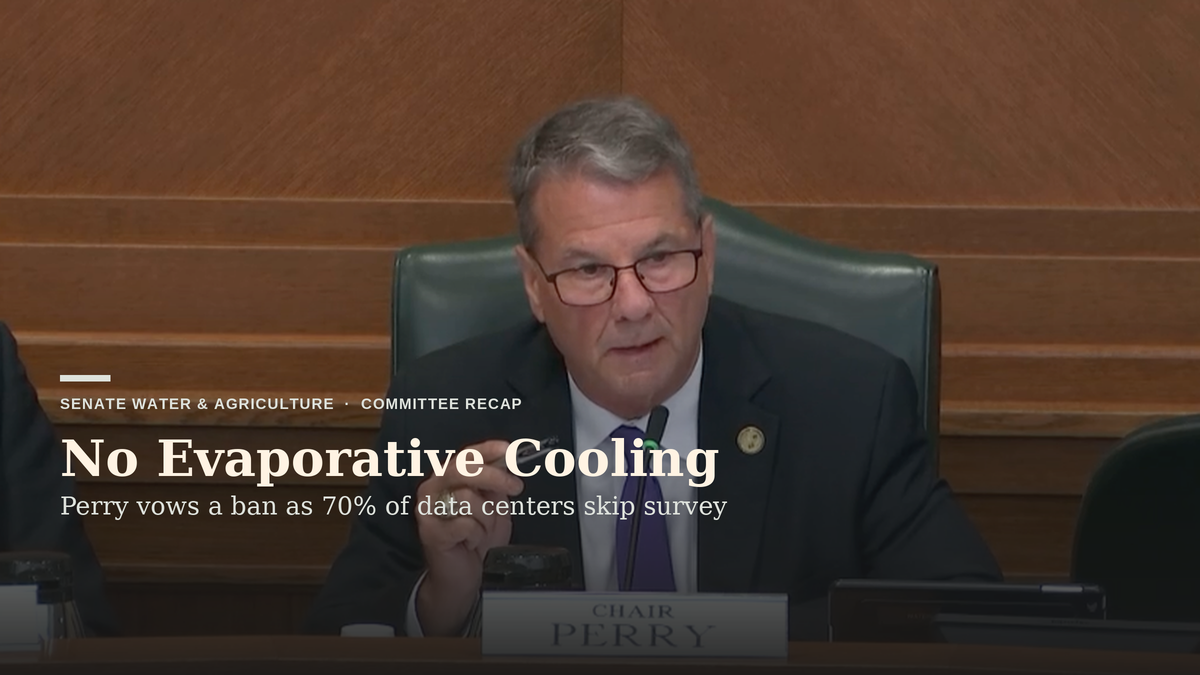
Texas sent water-use surveys to 341 data centers this year. As of Aug. 26, 30 percent had answered. The chairman of the Senate’s water committee told the industry Sept. 1 what the response will cost it.
“There is no excuse for evaporative cooling period in any sector, regardless data or otherwise going forward,” said Sen. Charles Perry, R–Lubbock, chairman of the Senate Committee on Water, Agriculture and Rural Affairs. “There’s no reason you should waste water on an evaporative cooling system. I hope that’s loud and clear. That won’t be allowed coming out of next session, I promise.”
The committee took nearly seven hours of invited and public testimony on a single interim charge: how much water the state’s data centers use and what Texas should require them to disclose. Because this was an interim hearing, the panel took no votes. The first two and a half hours went to the question of volume, and the answer from the state’s own agencies was that nobody knows.
Temple McKinnon, director of water supply planning at the Texas Water Development Board, said the agency identified the 341 facilities “through our own independent facility research” and that “as of August 26th, we have a 30% response rate.” Cooling technology is not something “the board captures,” she said, and she is “not aware of any other ongoing collection or single repository of reported projected water use in the state for data center facilities.” The survey is mandatory under the Water Code, she told Sen. José Menéndez, D–San Antonio, but the penalty is “a class C misdemeanor. So enforcement authority lies with somebody else.”
Sen. César Blanco, D–El Paso, did the arithmetic. “227 have failed to, to, respond that are statutorily required,” he said. “We have potentially 200 entities out there that are kind of in the Wild West.” He pressed the planning gap: “Your regional water plans are built on a five year demand cycle. A single large data center campus can go from announcement to a full load within 2 to 3 years.” Asked who assesses an aquifer in a county with no groundwater district, McKinnon said, “absent that, I’m not aware of would be assessing that.”
The Public Utility Commission, which ran a parallel survey under a budget rider that The Texas Dispatch reported on in February, had better returns and the same caveat. Executive director Connie Corona said “no comprehensive statewide list currently exists” of data centers and crypto mines. Chris Brown, the commission’s data program manager, said 57 companies reported 168 facilities, and that “among 81 operational facilities, they reported nearly 1.3 billion gallons of water,” about 74 percent of it potable. The technology split was stark: facilities “using evaporative cooling technologies… represented less than a fifth of the sample examined, but they accounted for nearly half of the total reported water intake.” He called the figures “directional rather than definitive.”
Perry put the total in context. “1.3 billion gallons of water total used is 4000 acre feet, which to remind people, we use 17 million acre feet a year,” he said. “So it’s not that behemoth that I think public perception is, but it’s going to grow.” He said he has seen worst-case projections of “500,000 acre feet.” On the survey, he warned the room: “44% responded 168 out of 377. Okay, that looks really bad. And that’ll be the headlines tomorrow.” He then closed the door on secrecy. “There will be no confidentiality on water use,” he said. “If that’s a proprietary problem for you as a business model, your business model needs to work differently because you’re asking for a public resource.”
University researchers gave the committee the range it lacks. Ning Lin, chief economist at the Bureau of Economic Geology, said data centers at roughly eight gigawatts in 2025 “account for just over one half of 1% of Texas water use, that is roughly 33 billion gallons per year.” At ERCOT’s 2030 forecast of 22 gigawatts, that becomes about 1.5 percent; at the 78 gigawatts transmission providers have been told to expect, “that will move up the state water use to over 5%.” That is above the 161-billion-gallon ceiling in the Houston Advanced Research Center’s January white paper.
Vaibhav Bahadur, a University of Texas mechanical engineering professor, explained why the technology matters. “All this electrical energy that goes into chips or racks, it ends up as heat 100% of it,” he said. “Dry cooling is 100% air cooling, no water, zero water. And the second is adiabatic… It’s like a patio mister on hot summer days.” His prescription was direct: “You just cannot allow water to evaporate.” Most modern Texas facilities, he said, “would use water only starting in May till the end of October.” He warned Blanco that reporting must capture more than a gallon count: “You do need numbers on water withdrawals, water consumption, water discharges.”
Lin added that a raw volume figure rewards the wrong operators. “If two facility both report just absolute volume of water use, one actually went through the recycle and reuse versus other haven’t the number would be the same,” she said.
Sen. Lois Kolkhorst, R–Brenham, questioned the scale of what is proposed — “over a thousand that are being talked about or planned… over 490GW. That’s more than the United States uses on a daily basis.” Sen. Adam Hinojosa, R–Corpus Christi, pointed to produced water from oil fields: “having that infrastructure cost borne on these data centers is not a bad thing.” Bahadur cautioned that a treatment plant serving a data center that “need[s] water for 5 to 6 months of a year” has no customer the other six.
Perry told the committee a bill is “drafted almost” and that next session “is the most important session I’ve been in… on infrastructure.” The 90th Legislature convenes in January 2027.
The committee’s longest block — about four hours from the industry panel through public testimony — turned on transparency and local authority: Google, Lancium and QTS pledged closed-loop cooling and hundreds of millions of dollars for water infrastructure, county judges said they have no power to compel disclosure and public witnesses called the pledges “chump change”; that is the subject of the companion recap, “County Judges Tell Senators They Have ‘No Authority’ Over Data Centers as Industry Pledges Millions.” Perry also said a bill to standardize groundwater districts he has failed to pass for six years will return.
Fact box
- Issue
- Interim charge — assessing the water demands of energy-intensive technologies: current consumption of high-consumption cooling technologies and the State Water Plan forecasting gap (approx. 2 hours 37 minutes, about 38 percent of the hearing; ranked first on news judgment)
- What happened
- The Texas Water Development Board reported a 30 percent response to its mandatory data center water survey; the PUC reported 1.3 billion gallons used by 81 operating facilities in 2025, with evaporative-cooled sites drawing nearly half; Chair Perry promised evaporative cooling “won’t be allowed coming out of next session” and said there will be no confidentiality on water use; UT researchers projected data centers could rise from 0.5 percent to more than 5 percent of state water use; no vote (interim hearing)
- When
- Tuesday, Sept. 1, 2026, 9:00 AM CT · run time approx. 6:56:31, no formal recess
- Where
- Room E1.012 (Hearing Room), Capitol Extension, Austin
- Chair
- Sen. Charles Perry, R–Lubbock (SD-28); Vice Chair Sen. Kevin Sparks, R–Midland (SD-31)
- Key witnesses
- Temple McKinnon (Texas Water Development Board); Connie Corona and Chris Brown (Public Utility Commission); Ning Lin (Bureau of Economic Geology, UT Austin); Vaibhav Bahadur (UT Austin mechanical engineering)
- Archived video
- senate.texas.gov video 22662