
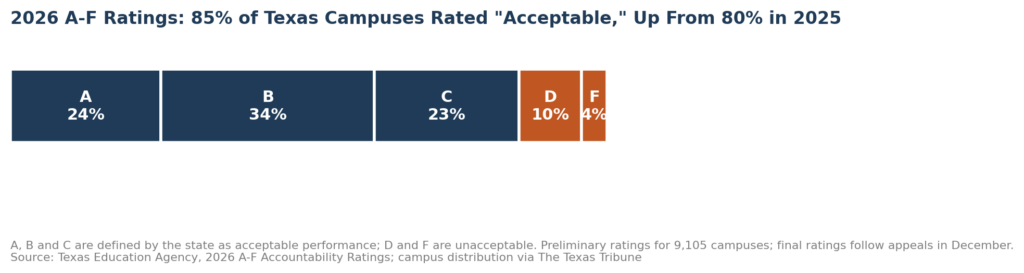
The 2026 A-F accountability ratings released Aug. 14 look like progress. Eighty-five percent of Texas campuses earned a C or better, up from 80 percent in 2025. Nearly a quarter of the state’s 1,202 districts and 9,105 campuses improved their grade. Five hundred eighty-five campuses climbed to an A from something lower. Crucially, TEA made no changes to cut points or methodology this year, so the gains are not an artifact of a recalibrated scale.
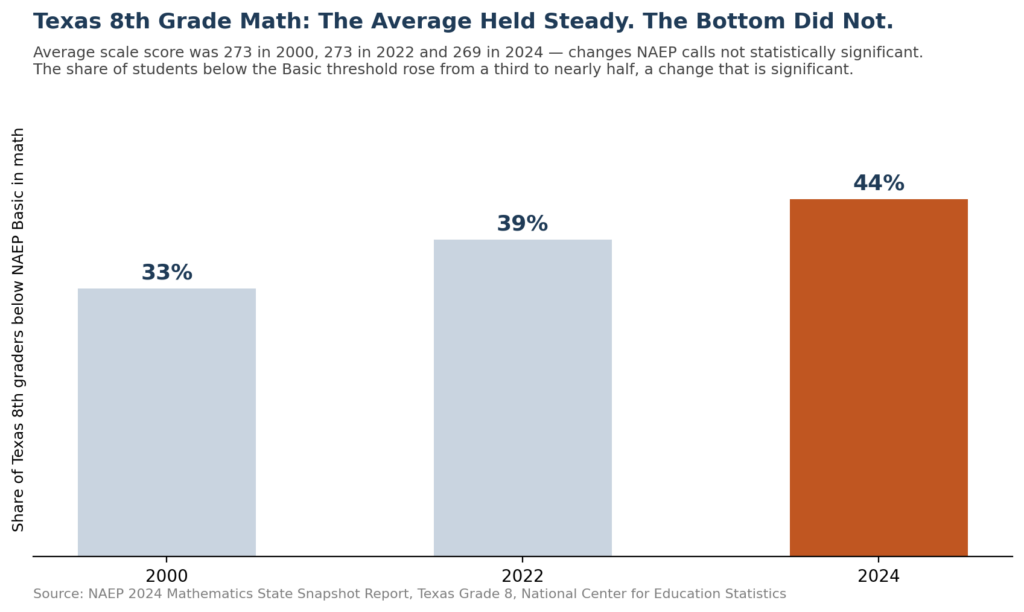
Now set that against the independent measure. On the most recent National Assessment of Educational Progress, 44 percent of Texas eighth graders scored below the Basic threshold in math — up from 39 percent in 2022 and 33 percent in 2000. Texas eighth grade reading hit the lowest level in the history of that exam. Fourth grade reading fell to its lowest point since 1994.
Both things are true, and the gap between them is the story of Texas education policy since 2010. The state has spent 15 years building an increasingly sophisticated instrument for measuring school performance — and much of that period fighting in court over whether anyone would be allowed to see the readings — while the underlying trend it was built to reverse kept sliding.
What actually declined, and where
The common shorthand — that Texas outcomes have fallen since 2010 — is close but imprecise in a way that matters for policy.
NAEP’s own snapshot is blunt about the average: Texas eighth graders scored 269 in math in 2024, a figure the assessment calls not statistically different from their 273 in 2022 or their 273 in 2000. The share reaching Proficient was 24 percent in 2024 — exactly what it was a quarter century ago.
What moved is the floor. The share of Texas eighth graders below Basic in math climbed from 33 percent in 2000 to 44 percent in 2024, a shift NAEP does flag as significant. The state did not get dramatically worse on average. It lost the bottom of its distribution.
Texas 2036 frames the longer arc as “widespread gains in the 1990s and early 2000s” followed by “little-to-no progress” — with eighth grade math on a decline “dating back to 2011.” That is the 2010-to-now decline, and it is concentrated in middle-grade math and in reading, not spread evenly.
The state ranking tells the same story. Between 2022 and 2024 Texas fell from 25th to 34th in eighth grade math, from 33rd to 37th in fourth grade reading, and from 41st to 44th in eighth grade reading. It rose from 14th to 8th in fourth grade math — the one clear bright spot, and the one area where the state’s most sustained intervention has been aimed.
This year’s STAAR results carry the same signature: 43 percent of Texas students met grade level in math and 52 percent in reading, with math gaining and reading flat.
The strategy, and why its results are hard to read
The accountability system is one instrument in a longer sequence, and the sequence is more coherent than it is usually given credit for.
Texas gave the commissioner takeover authority for chronically failing campuses in 2015. House Bill 22 created the A-F system in 2017, scoring districts on student achievement, school progress and closing the gaps. House Bill 3 in 2019 required every K-3 teacher and principal to complete a reading academy grounded in the science of reading. Senate Bill 1365 restored the rating framework in 2021 after litigation. House Bill 1416 mandated high-impact tutoring for students below grade level. House Bill 2 added roughly $8.5 billion in 2025.
The theory is straightforward: measure every campus annually, publish the results, intervene where they stay bad, and pair that pressure with instruction and money.
The problem is that for four of the last seven years, the measurement half of that theory did not function. No ratings were issued in 2020. Labels were waived in 2021. More than 120 districts sued to block the 2023 ratings, arguing TEA changed the scoring benchmark too late for schools to respond; a separate group blocked the 2024 ratings on similar grounds. Neither year’s grades reached the public until 2025, when the courts cleared them.
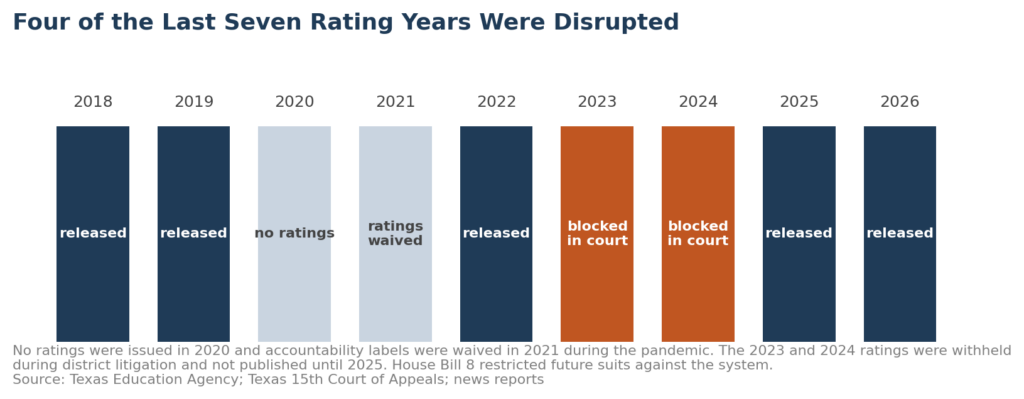
That gap has a practical consequence that gets lost in the ratings-day coverage: the five-consecutive-F clock that triggers state intervention, and the year-over-year comparisons everyone is making this month, run across a stretch when the system was dark or contested. The 2026 numbers are also preliminary — districts have until Sept. 8 to appeal, and TEA finalizes in December.
The Legislature closed that vulnerability in 2025. House Bill 8, authored by Rep. Brad Buckley, restricted suits against the accountability system, banned statewide “Not Rated” designations — and replaced STAAR itself with three shorter assessments beginning in 2027-28. The instrument that produced this month’s improvement is being retired in two years.
Where the pressure is actually landing
The intervention end of the strategy is where the abstraction becomes concrete, and the 2026 results moved several districts at once.
Burnet and Webb middle schools in Austin ISD received a fifth consecutive F, triggering the law requiring Commissioner Mike Morath either to close the campuses or replace the district’s elected board and superintendent. That happened in the same year Austin ISD’s overall grade rose from C to B and its D- and F-rated campuses fell from 41 to 31. The district closed Paredes Middle School in July ahead of a fourth failing rating. Three San Antonio-area districts moved closer to the same threshold.
Houston ISD, entering its fourth year under state control, offers the longest available read on whether takeover works. The district earned a B, with 92 of 272 campuses rated A. But four elementaries dropped to F — two of them from B — and HISD must have no campus with two consecutive unacceptable ratings to exit state control. David DeMatthews of UT-Austin told the Chronicle the pattern may indicate the district is “plateauing.”
The critiques of the system are worth stating precisely, because they are different from each other. Texas 2036’s Mary Lynn Pruneda argues the college, career and military readiness component “needs serious improvement,” with high schools credited for readiness in pathways that do not lead anywhere. The Texas Public Policy Foundation’s Matthew McCormick argues the opposite risk — that Texas should “resist calls to water the accountability system down with non-academic factors.” Teacher organizations note that failing grades and takeovers fall disproportionately on low-income, Black and Hispanic campuses. All three can be accommodated in a redesign; they point in different directions.
What to watch
Sept. 8: Austin ISD’s appeal deadline. Whether the district contests the Burnet and Webb data — and whether TEA accepts any of it — determines if the takeover decision proceeds on this year’s numbers.
Fall: Morath’s decision on Austin ISD. TEA has used the intervention law seven times since 2015 and chose campus closure over board replacement in three of them. Which option he picks in a district whose overall grade is rising will signal how the agency reads partial improvement.
December: Final 2026 ratings after appeals. Expect the improvement figures to shift modestly; the 85 percent acceptable share is a preliminary number.
January 2027: The 90th Legislature convenes with HB 8 implementation underway. The open questions are the CCMR measure, whether the three new assessments preserve year-over-year comparability, and what the accountability system looks like when its underlying test changes.
2027 and 2028: The first NAEP administration and the first new-assessment results that could show whether the post-2019 slide has turned. Until then, every claim that Texas schools are improving or declining rests on a state-designed test that is being replaced, measured against a national one administered every two years.
The scoreboard is better than it was in 2010 — annual, public, harder to litigate away, and now tied to consequences that have actually been used. What it has measured so far is a state that stopped losing ground on average while losing considerably more of its lowest-performing students. Whether the instrument can drive the second number back down is the question the next five years will answer.
Sources
- Texas Education Agency — 2026 A-F accountability ratings release; 2026 accountability rating system methodology; 2024 Annual Report: A National Comparison; Texas Reading Academies; HB 1416 accelerated instruction
- National Center for Education Statistics — 2024 NAEP Mathematics State Snapshot, Texas Grade 8
- Texas 2036 — NAEP results: reading and math scores in Texas cause concern; Guide to Texas STAAR results 2026; 2026 Texas A-F school ratings
- The Texas Tribune — Look up your Texas school’s A-F grade (Aug. 14); Austin ISD moves closer to state takeover (Aug. 13); Texas is officially replacing STAAR
- Austin American-Statesman — Two Austin ISD middle schools trigger state takeover law (Aug. 13); Appeals court approves release of 2024 A-F ratings (July 2025)
- Houston Chronicle — “HISD academic gains slow in latest ratings” (Aug. 16, subscription)
- KERA News — TEA finally released 2023 accountability grades after lawsuit; Texas schools see modest improvement in 2026 A-F ratings (Aug. 14)
- The Dallas Express — 2026 Texas school preliminary ratings (Aug. 14)
- Texas Scorecard — 2026 A-F ratings show improvement (Aug. 18)
- Texas Insider — Sen. Bettencourt on SB 1365 and the 2026 release (Aug. 14)