
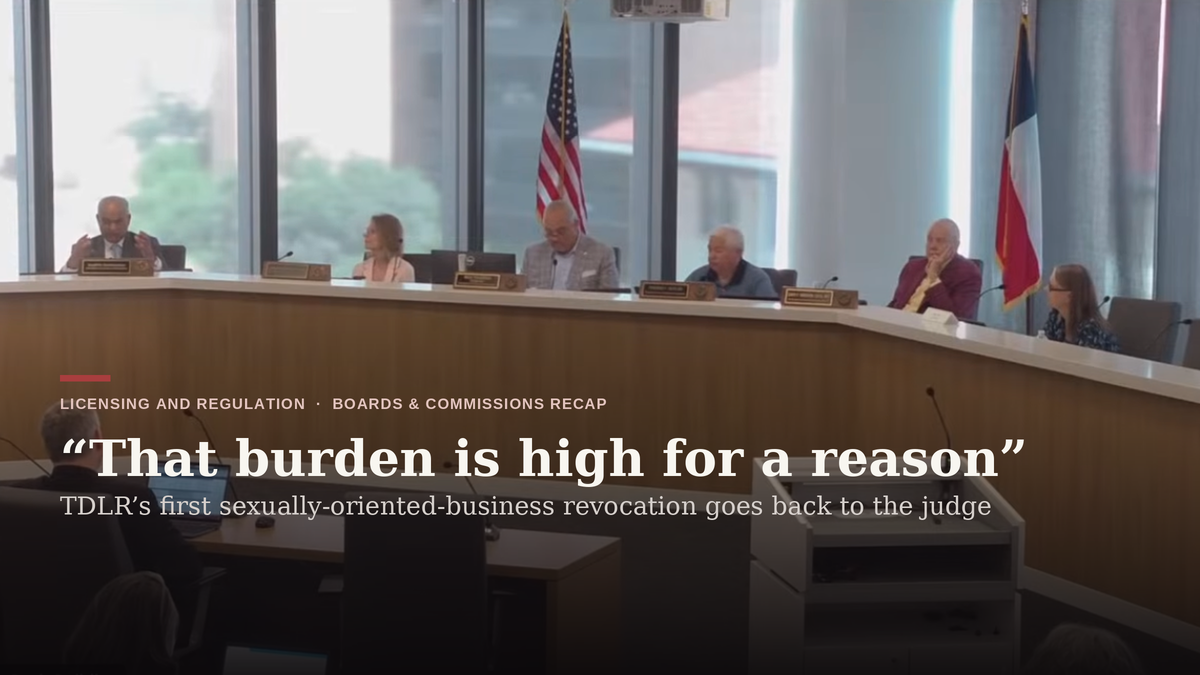
The Texas Commission of Licensing and Regulation spent more of Tuesday morning on one contested case than on any of the other seven, and the reason had nothing to do with the size of the business involved. It had to do with the theory.
The case was against Gina Lopez, doing business as SA Foot Massage, and the license at stake was a massage establishment permit, ME8976. What made it unusual is what the department chose to allege: not unsanitary conditions, not people living on the premises, not any of the routine violations that carry fines. The Texas Department of Licensing and Regulation alleged that the shop was a sexually oriented business as that term is defined in the Local Government Code — a finding that, if made, requires revocation of its license.
An administrative law judge at the State Office of Administrative Hearings heard the case on January 5, 2026, and recommended against revoking. Nicole Burns, a prosecutor with TDLR’s anti-human trafficking division, told commissioners the judge “found that the facts viewed individually were insufficient… to establish that the respondent operated a sexually oriented business,” and asked them to reject that proposal for decision.
“Respectfully, we believe that conclusion was incorrect,” Burns said. “We agree that no single fact standing alone necessarily proves the operation of an [SOB], but the proper analysis requires reviewing the totality of the circumstances.” The judge, she said, “found the unused condom was out of place. But do condoms and lingerie have any place in a legitimate massage establishment?” Accepting the judge’s recommendation, she argued, “would send the message that this conduct is acceptable in the mass[age] industry that TDLR has been entrusted to regulate.”
Her fallback was the one the commission ultimately took: “Alternatively, I would ask that you remand the case back to SOAH for further review under the appropriate totality of the circumstances analysis.”
Trevor Thielen, appearing for Lopez, argued that the department had walked into a trap of its own making. In most contested cases, he said, commissioners weigh an appropriate penalty; here “TDLR chose to allege things so that they could determine whether revocation happened or not and take that issue off of the table.”
The definition it borrowed, he noted, comes from a zoning statute: “normally when we’re talking about those businesses, we’re talking about adult movie theaters or places where they sell adult toys, things like that are nowhere near.” The only clause that could reach a massage shop, he said, is the one requiring proof “that the primary business of a commercial enterprise was the selling of sexual services. That is a tough thing in my opinion to prove in almost any situation.”
“That burden is high for a reason because of the draconian nature of the consequences,” he said.
Thielen then walked through what the record did not contain: no audit of services performed, no interviews with customers or workers, no police allegations of prostitution, no sting. “All of this case, in my opinion, is based off of the… investigator finding in one drawer in a dresser an unopened condom in its wrapper,” he said. “Obviously, anyone would prefer that there not be condoms anywhere near a massage establishment, but that one unopened condom is not sufficient evidence to prove that the primary business of this massage establishment was the selling of sexual services.”
As for the bedding, food and clothing the department pointed to, the judge had already weighed it: “there’s food, there’s clothing there, but there’s no indication it’s being used for anything in particular, and it could just be for personal use.”
He also flagged an evidentiary problem with the advertising exhibit the department had asked commissioners to study — it was offered “not for the truth of the matter asserted,” he said, and “if you put your case on… exhibit 4 as your proof, I believe that’s an appealable issue.”
Commissioner Tom Butler put the question that framed the rest of the discussion. “This seems like a… novel theory to prosecute one of our cases… under… the sexually oriented business, but it seems kind of narrow to me. And is this the first one that we’ve… done from your recollection?”
It is, Burns said. “This case did proceed under the department’s newly implemented… [SOB] process. In these cases we specifically identified businesses that are operating as sexually oriented businesses… and we pursue the license revocation… because the commission is… authorized to do that. We don’t seek any monetary penalties or any other violations.”
Butler then laid out the scale he was working from. “In my mind it seems that we’ve closed somewhere in the neighborhood of 70… illicit massage parlors… when we found some sort of evidence of… sexual activity. And generally they have… maybe five to 10 women working there. So that… starts to become a lot of people, right? 350 to 700 women that may be involved in… human trafficking, sex trafficking.”
He was careful about his own lane: “I’m here for the TDLR… not specifically a sex trafficking organization, but it’s important.” Then he asked for exactly what the motion would later say: “maybe the ALJ needs to take a look at this kind of in not such a narrow way, but look at everything that they encountered, locked doors, condoms, beds, foods… lingerie.”
Commissioner Draksharam attacked the record from a different angle — the name over the door. “What is this massage parlor name?” he asked. Told it was SA Foot Massage, he pressed: “In a foot massage are bedrooms needed?… Typically the foot massages are you sit on a chair and you massage. But here you have a bedroom.” The inventory in the exhibits struck him the same way. “In a foot massage it’s quite ironic that you have a bathroom kitchen and… it says that the back had ribs meat hanging from a hook. I think something is not adding up.”
Thielen answered that massage establishments “are generally operated by first or second generation immigrants to this country. People that bring traditions and… practices for food preparation… with them here,” and that in a city like Houston stocking up on Asian groceries can mean a long drive. The commissioner, who told the room “I’m an Asian, don’t get me wrong,” did not accept it: “The Kroger bag is not a Chinese Asian market… that’s what it said in the material evidence right there.”
Thielen’s closing point was that the department had options it declined to use. “[TDLR] could have charged them… for sanitary violations. They could have even charged that they violated the rules against living on the premises. They didn’t.” The narrow charge, he said, was chosen deliberately: “they want the narrow question of revocation or no to be taken care of but I don’t think they meet their burden.”
Commissioner Butler then said “because they did… prosecute under that theory when we closed 70 down in the last year and a half tells you the alarms that went off in somebody’s mind.” He then ran the inventory past Thielen himself — “I’m sure the… ALJ knew all these facts, correct?… The condom, the neglige, the food, the beds, the locked doors” — and Thielen agreed she had. She “went category by category,” he said, had received the department’s exceptions, and had declined to change her mind before he even filed a reply.
The chair cut off further discussion, reminding commissioners to stay inside the SOAH record: “that’s why we have to stay lane. We can’t wander from that lane.”
Then came the motion: “I move that the commission remand the case to SOAH for further proceedings. On remand the ALJ should consider the department’s evidence as a whole and explain why the unrebutted evidence was insufficient to prove that the establishment’s primary business was providing sexual services. The ALJ should also clarify the meaning applied to primary business [and] whether the lack of direct evidence such as an observed transaction or admission affected the decision.”
The meeting at a glance
Issue
Contested case 3 of 8 — listed as agenda item H on the posted agenda, though the chair calls the contested-case block “item G” on the broadcast; confirm the lettering against the final agenda. Gina Lopez d/b/a SA Foot Massage, massage establishment license ME8976. TDLR’s anti-human trafficking division sought revocation on the theory that the shop was a “sexually oriented business” as defined in the Local Government Code, the first case brought under the department’s newly implemented SOB process.
What happened
The SOAH administrative law judge found the department’s evidence insufficient and recommended against revocation. TDLR asked the commission to reject the proposal for decision and revoke, or in the alternative remand. The commission remanded to SOAH on a voice vote, directing the ALJ to weigh the evidence as a whole, explain why it was insufficient, and clarify what “primary business” means and whether the absence of a direct observed transaction drove the result. No revocation; no penalty; case unresolved.
When
Tuesday, July 28, 2026
Where
George H.W. Bush Building, 1801 Congress Ave., 4th floor, Room 4.300, Austin — and by videoconference.
Governing body
Texas Commission of Licensing and Regulation
Archived video
youtube.com/watch?v=gLFiMEGGqbw