
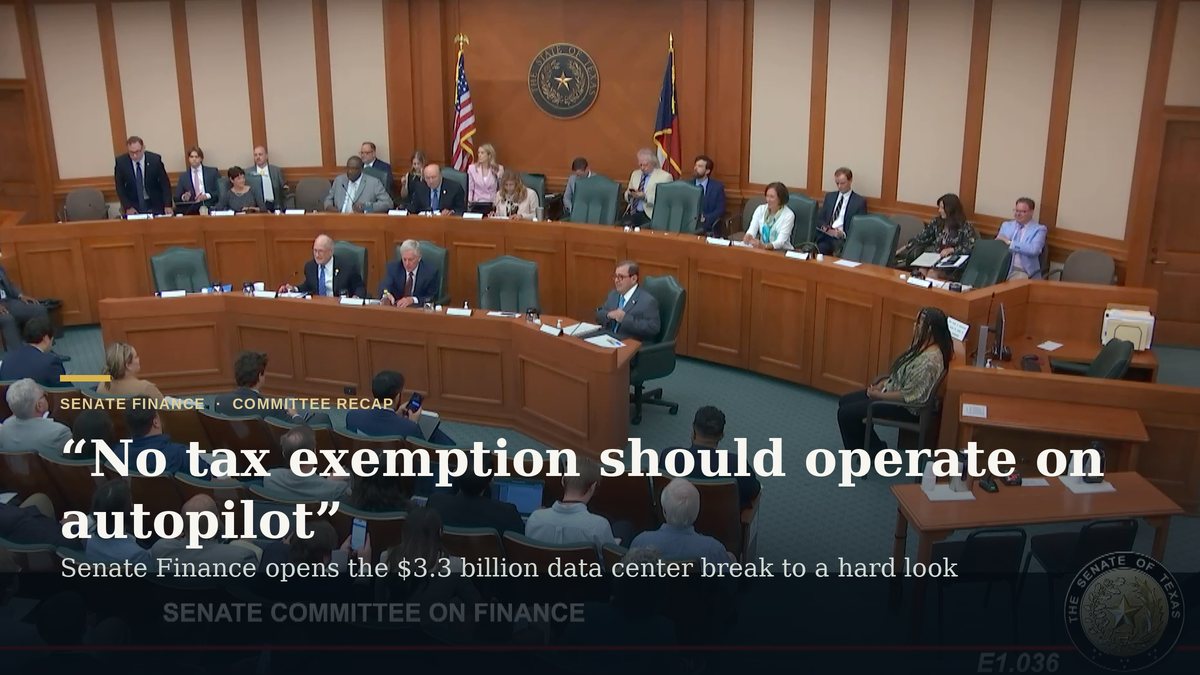
A sales tax break that cost Texas an estimated $14.6 million a decade ago is now on track to cost the state roughly $3.3 billion in a single two-year budget — and on Monday the Senate’s budget-writing committee spent the better part of a nine-hour hearing asking whether taxpayers are getting their money’s worth.
The Senate Committee on Finance opened its interim agenda with the data center exemption, and Chair Joan Huffman, R-Houston, framed the review in a single line: the break should be “judged not by the investment it attracts, but by its overall effect on Texas taxpayers, our resources and the state’s long term fiscal health.”
Huffman opened with a dry understatement, calling the issue “a little bitty topic.” The 14-member committee has been directed, she said, “to evaluate the cost and benefits of the current sales and use tax exemption for data centers, and to recommend safeguards ensuring Texas taxpayers receive a clear return on that investment.”
The exemption traces to House Bill 1223 in 2013 and lives in Tax Code Sections 151.359 and 151.3595, which spare equipment for a qualifying data center from the state’s 6.25% sales and use tax. The Texas Tribune reported this spring that the state is now forgoing more than $1 billion a year.
The first witnesses came from the Texas Comptroller of Public Accounts. Brad Reynolds of the agency’s revenue estimating division walked members through the mechanics, and the tax-policy director, Jennie Burleson, fielded questions on how the office estimates the cost. Reynolds laid out two tiers: a regular qualifying data center must make “a commitment to spend $200 million over a period of three years,” he said, and in return “their exemption period would be for a period of ten years”; a large data center is “subject to a 40 permanent job requirement and a $500 million minimum investment.”
The Comptroller’s office told members it has for years reported the forgone revenue “of both the large and the regular together” — and argued the number has grown large enough to warrant a fresh look. It is “appropriate and necessary,” one witness said, “for the legislature to reexamine whether this exemption still delivers a return that justifies its rapidly mounting forgone tax revenue. No tax exemption should operate on autopilot.”
Members did not need much prompting. Sen. Paul Bettencourt, R-Houston, opened his questioning with a nod to the volume of data on the table. “Brad, as usual, you know, we’re now awash in detail. So I want to thank you,” Bettencourt said, before adding a personal aside to the retiring analyst: “thank you for your service because I’m not sure you will be here next time we meet.”
Sen. Lois Kolkhorst, R-Brenham, picked up the thread. “I’m just going to follow up on a few questions here that Senator Bettencourt started on,” she said, pressing the Comptroller’s staff on exactly which purchases the exemption covers. Sen. Royce West, D-Dallas, thanked Reynolds “for your service for these many years” and bored in on the state’s ability to recoup value.
The longest stretch of the day belonged to the public. For hours, residents from across the state — Henderson County, Deaf Smith County, El Paso, and beyond — lined up to tell the committee that the incentive is outrunning the communities that host the facilities.
Stacy Farmer told members, “I’m from Henderson County,” and joined a chorus asking the state to slow the buildout. Jay Mania, “a community organizer with the People’s Project in El Paso,” pressed the panel to put the burden of proof on the industry: developers should “come into a community, then prove it, prove it to us, don’t make us prove it to you.” Caitlin Cirillo said she had driven from Deaf Smith County; Sue Ellen Davis ticked off the asks she had already brought to her county — “moratorium, no tax abatements, infrastructure, fire.”
Water ran through nearly every complaint. Witnesses described data center operators shielding water-use plans from public view, one recounting that after records surfaced, a company was “specifically asking if any discussions about water will be part of a public information request.” The result, the witness said, was corrosive: “Everybody’s already worried about the water issue to begin with.”
The committee has heard versions of this before; a House panel was told in June that no state agency limits how much groundwater a data center may pump across much of Texas, as The Texas Dispatch previously reported, and Hill Country officials have since asked lawmakers to curb data center permits outright. The public sentiment on display Monday tracks with polling the Dispatch has covered showing most Texans oppose a data center in their own community.
Because the committee met in the interim, it took no vote. Its findings become recommendations to the 90th Legislature, which convenes in January 2027 — and the direction of travel was unmistakable. The Comptroller’s office all but invited lawmakers to add “safeguards,” the charge’s own word, and members from both parties treated the exemption’s growth curve, not its existence, as the problem to solve. Whether that means a spending cap, a sunset, tighter job or water conditions, or a clawback, the committee left for the drafting table. What it signaled Monday is that the break will not run on autopilot into the next session.
Also heardThe same marathon hearing took up three other interim charges. After the data center testimony, the committee turned to the Crime Victims’ Compensation and Assistance Funds, where an Office of the Attorney General official fielded pointed questions about claim denials, and then to Rural Fire Protection Funding and the Texas A&M Forest Service’s volunteer-department grants. Its longest remaining segment — transportation funding, from Proposition 7 to the state’s $95 billion road plan — is the subject of the companion story.
The hearing at a glance
ISSUE
Data Center Investment and State Fiscal Effects — the cost and benefits of the sales tax exemption for qualifying data centers, and safeguards for taxpayers. Roughly 5 hours, or more than half of the hearing.
WHAT HAPPENED
Invited testimony from the Texas Comptroller of Public Accounts laid out the exemption’s mechanics and its climbing cost; hours of public testimony from residents urged limits, citing water use, tax abatements and strain on rural services. Interim hearing — no vote taken.
WHEN
10:30 AM CT, Monday, July 27, 2026 · hearing ran about 9 hours 42 minutesWhereRoom E1.036 (Finance Room), Capitol Extension, Austin
CHAIR
Sen. Joan Huffman, R–Houston (SD-17)
ARCHIVED VIDEO
senate.texas.gov · vid 22654