
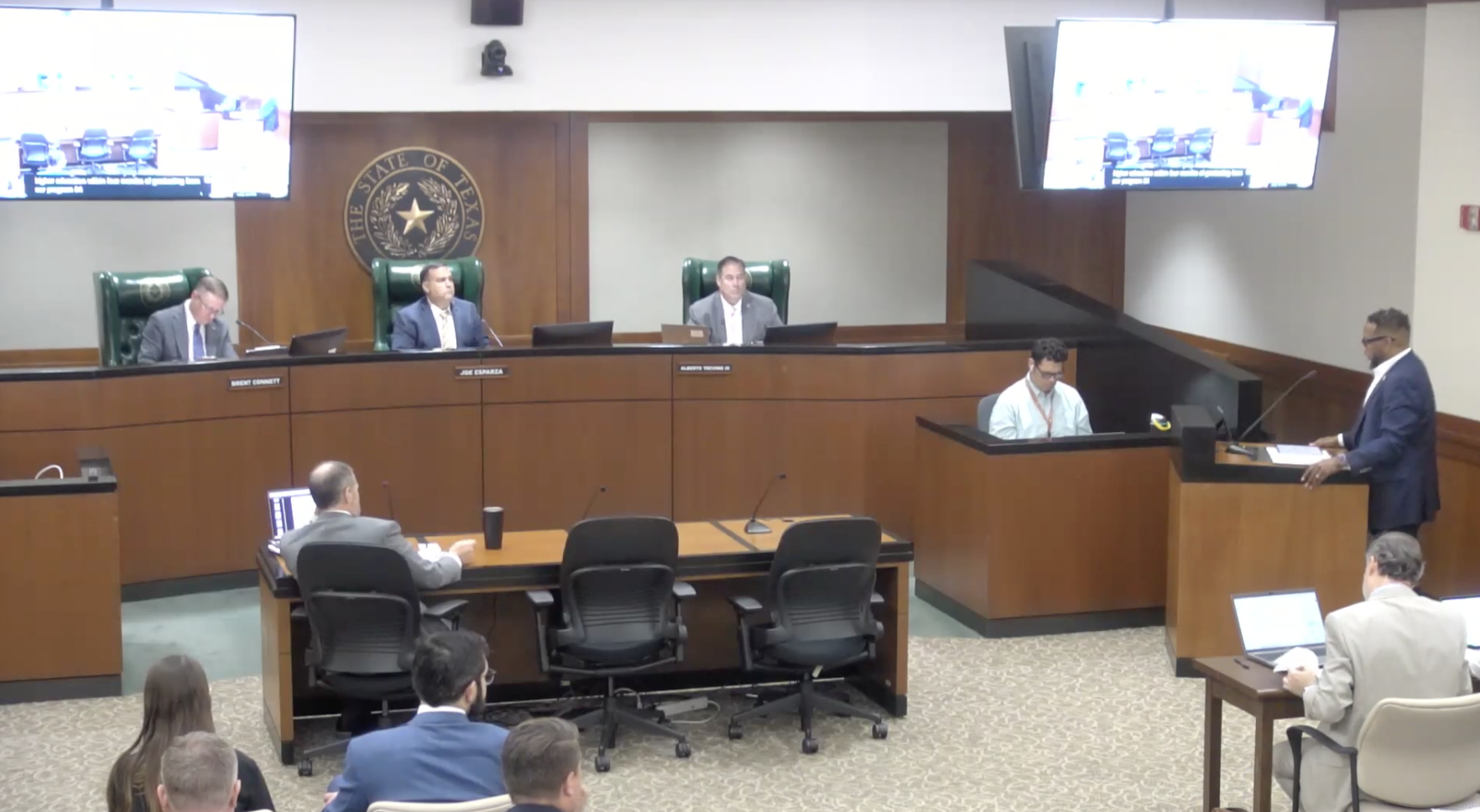
The Texas Workforce Commission gave more of Monday morning to one item than to any other on its agenda — and took no vote on it. Agenda item 14 asked a question the agency has never had to answer: should Texas go after federal money that arrives only after the results do?
The vehicle is the Social Impact Partnerships to Pay for Results Act, which the commission’s own briefing paper abbreviates SIPPRA and under which the U.S. Treasury has been issuing funding notices since 2018. Joel Mullins of the Workforce Development Division described it to commissioners as “a pay for results program where the federal government provides funding to state and local governments only if a project achieves specific measurable social outcomes that result in federal savings.”
The item existed because Commissioner Brent Connett asked for it at the commission’s June 2 meeting, and staff opened by apologizing for how long the answer took. “I would like to apologize to… Commissioner Connett and the entire commission for the length of time it took us to bring a paper back in response to this request,” Mullins said. “We should have… been quicker to respond and… promise to do so in the future.”
Staff “believe that it is feasible to submit a SIP[PRA] application and implement a SIP[PRA] grant in Texas,” Mullins said, but not by doing it alone. The recommended structure is to hire an intermediary — an outside firm that would “prepare the SIPPRA application… recruit private investors, manage the investment portfolio, raise and collect funds, partner with service providers and an evaluator, and track and analyze project performance.” That arrangement, he said, “would greatly reduce the financial and operational impact to TWC as the intermediary would carry a majority of the operational, financial, and contractual responsibilities.”
Hiring that intermediary is the catch. Staff’s “only concern,” Mullins told the commission, is that selecting one “would require a competitive procurement that would take 6 to 9 months from initial project kickoff to award execution and the application window and past NOFO was only 5 months.”
The Treasury Department has issued two notices of funding opportunity under the law since 2018; a third is expected in federal fiscal 2026, and Mullins said Treasury “has notified states that workforce development projects will be prioritized in this new round of funding.” Nobody knows the release date. If the clock runs out, TWC staff “would need to draft the application ourselves… relying on our own financial legal and evaluation expertise.”
Connett called it “exceptionally well done… thoughtful… and thorough,” then asked whether the procurement path was settled. Mullins said staff had checked the week before: a sole-source award would take about as long as a competitive one, and “there’s the belief that… we would probably not get approval for a sole source procurement. So the competitive procurement from six to 9 months is… the most likely.”
Four witnesses signed up, and all four supported the idea. Michael Bettersworth of Texas State Technical College framed it as Washington catching up to Austin: TSTC, he said, is already “paid by the state of Texas based on the earnings outcomes of our students. It’s an entirely ROI based structure.” SIPPRA appealed to him because “the federal government is… replicating what we in Texas have already demonstrated as a good public policy position which is instead of paying for activity paying for outcomes.” Under it, he said, a college could “accept private investment or even our own foundation’s investment to go towards training more Texans” — investment “recouped only if we deliver on the results.”
Francisco Martinez, president and CEO of San Antonio’s Project QUEST, testified “in strong support of agenda item 14” and leaned on evidence: a 14-year randomized controlled trial in which participants “earned approximately $54,000 more than individuals in the control group over the study period,” with earnings gains that “exceeded 138,000” for participants 35 and older and “a societal return of investment of $2.34 for every dollar invested.”
A separate 30-year study, he said, found QUEST “generated more than two billion in increased earnings, over 1.2 billion in regional economic impact, and an estimated 4 billion in total economic impact.” A witness for Year Up United, which runs Austin and Dallas–Fort Worth sites, cited more than 2,300 Texas participants and average starting wages of “$27.66… per hour or more than $55,000 annually.”
The fourth witness, appearing virtually for Dallas College, works on the college’s partnership with Harvard University’s Opportunity Insights and used the time to press the point that outcome measurement need not mean exposure. Linking program records to Census Bureau and federal administrative data happens “through secure privacy protected methods,” the witness said, and “individual data remain protected throughout.” That drew the only substantive commissioner response to any of the testimony — from a member the captions do not name: “thank you for… underscoring the… data integrity… element. That’s… critical anytime we’re… dealing with… personal identifying information at the whether the federal level, the state, or both.”
Executive Director Steve Pier returned to the item in his own report to make sure nobody left with the wrong impression. “A decision has not been made as to what path we go down here,” he said. The report “did take a little bit longer than anticipated but this is a highly complex and very different way of doing things and we wanted to be certain that we were looking at this… thoroughly.” He was blunt about why an outside partner appeals: “given some of the other things that are going on right now… with sunset and… session coming and whatnot… being able to take on a partner… could really alleviate some of the… effort and stress that would… be placed on staff by… trying to accomplish something completely new for the first time.” His summary: the alternatives “don’t look like easy solutions, but… probably better solutions than just trying to… do it ourselves.”
No motion was made on item 14, and the captions record no timetable for when one might be.
Also heard
The commission adopted three rule packages implementing bills from the 89th Legislature, each on a motion, a second and an unrecorded “motion passes”: amendments to 40 TAC Chapter 804 opening Jobs and Education for Texans grants to the Texas Juvenile Justice Department and juvenile boards and probation departments (SB 1728); new Chapter 812 creating the Rural Workforce Development Grant Program (SB 2448); and new Chapter 814 creating the Advanced Nuclear Energy Workforce Development Program (SB 1535). Proposed housekeeping amendments to Chapter 800 were sent to the Texas Register for a 30-day comment period. Commissioners also adopted the JET Advisory Board’s fiscal 2027 parameters, whose headline change — described by staff as “probably the most significant one” — carves out 10 percent of JET funding for correctional education entities including the Windham School District, TJJD and juvenile probation boards, leaving 30 percent for higher education and 60 percent for school districts and open-enrollment charters; grant minimums and maximums stay at $40,000 and $375,000. The commission adopted U.S. Labor Department–required definitions of “long-term unemployed” and “significantly und[ere]mployed” for disaster-recovery national dislocated worker grants. Under agenda items 3 through 8, presided over by Connett, the commission disposed of one tax liability case and the wage-claim and unemployment-insurance dockets for docket 30, with short-form dissents noted on several UI cases. HR Director Jerry White closed the meeting by recognizing the workforce, IT, business operations and HR staff behind January’s rebuilt State of Texas job application.
The meeting at a glance
Issue
Agenda item 14 — briefing paper on the federal Social Impact Partnerships to Pay for Results Act (SIPPRA) and whether TWC should pursue a Texas project under Treasury’s expected third round of funding.
What happened
Staff reported it is feasible for Texas to apply and recommended procuring an outside intermediary to run the application, investor recruitment, evaluation and performance tracking. The obstacle is timing: competitive procurement runs 6–9 months against a past application window of 5 months, and the notice of funding opportunity release date is unknown. Four witnesses — Year Up United, Project QUEST, Texas State Technical College and Dallas College — testified in support. No commission action was requested or taken.
When
Monday, July 27, 2026, 10:00 a.m. CT; 47:29 total broadcast
Where
Texas Workforce Commission, 101 E. 15th St., Room 244, Austin
Governing body
Texas Workforce Commission
Archived video
youtube.com/watch?v=g7D8IlN1uqk