
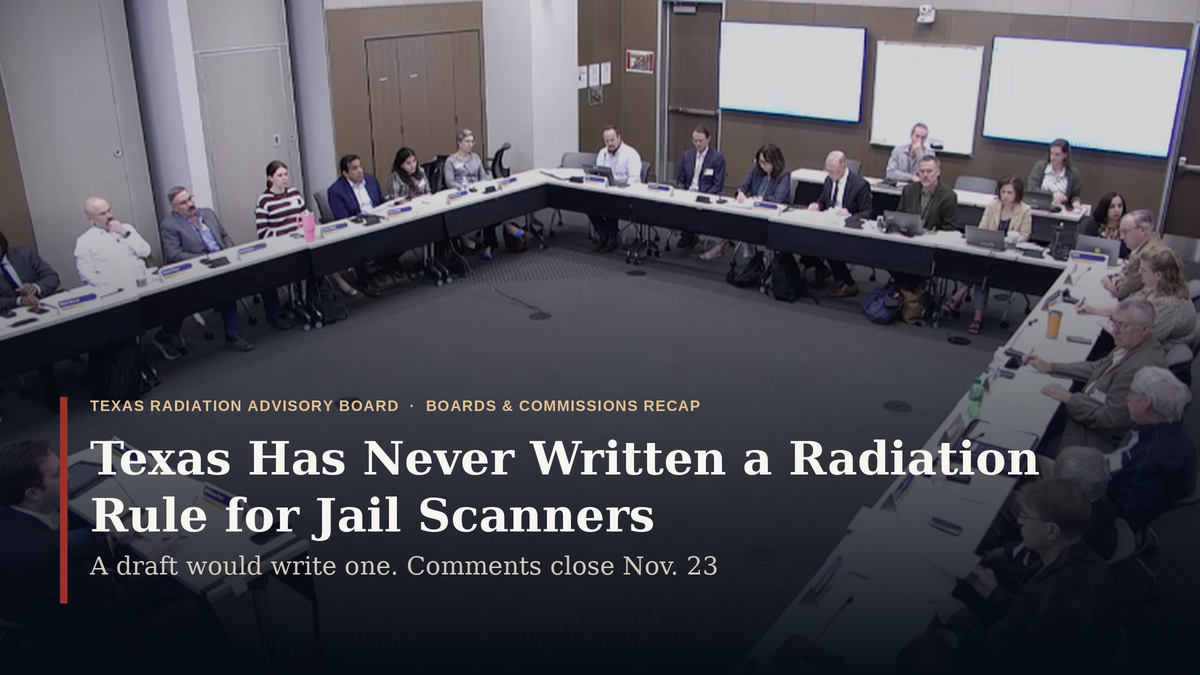
The X-ray scanners that Texas jails point at the people they book would come under radiation-safety rules written for them for the first time, under draft rules the state health department sends out for public comment on Oct. 23.
These are not the machines at airport security. A transmission scanner drives X-rays all the way through a body to find what a pat-down cannot — packets that have been swallowed, objects pushed into body cavities. Texas has about 230 county jails, holding 71,235 people at a given time in 2024 by the jail standards commission’s count, and the state’s radiation rulebook has never carried a line written for the machines standing at their booking doors.
What it carries instead is a sentence written for doctors. The general Texas standard for machine-made radiation, last revised in 2011, says who may deliberately irradiate a person:
“However, no radiation may be deliberately applied to human beings except by or under the supervision of an individual authorized by and licensed in accordance with Texas’ statutes to engage in the healing arts.”
A detention officer at a scanner console is not engaged in the healing arts. Nothing in that chapter mentions security screening, detention or correctional facilities anywhere, and the department has not said publicly how it has treated the machines in the meantime. That does not make them unregulated — anyone who keeps a radiation machine in Texas must register it and meet general dose limits — but no rule has been written around what these particular ones are for. The Dispatch reported in September on the parallel question in medicine, where the state cut the classroom hours required of uncertified technicians who run X-ray equipment in doctors’ offices.
The department told the Texas Radiation Advisory Board on Oct. 16 that its draft “introduces requirements for whole-body security scanners used by detention facilities and removes the language for minimal-threat machine exemptions” — the exemption the 2008 industrial-machine rule (§289.228) gives to equipment during whose operation “no deliberate exposure of an individual occurs”. What those requirements say is not public. The department has posted no draft for informal comment; its draft-rules page said as of Oct. 19 that it had none open.
Other governments have written such rules, and they are mostly arithmetic. The federal Bureau of Prisons caps a federal prisoner at 250 microsieverts of scanning a year — between 1,000 and 5,000 passes through the machine, depending on the model — and its 2017 program statement tells wardens that “It is critical to ensure that the annual limit on the number of scans allowed per inmate is not exceeded,” counted by software inside the scanner. It requires a radiation survey when a machine is installed and at least every twelve months after, and refresher training for operators every twelve months. Health Canada’s 2022 guidance for this exact class of machine says “The dose per screening procedure must not exceed 10 microSv”.
The case for the scanners is the one sheriffs make everywhere: the machine finds what a strip search misses, and spares the strip search. It is not a case about consent, and neither is the federal rule — the same Bureau of Prisons statement says that where prisoners refuse to be screened, “proper disciplinary action should be taken”. A dose cap governs how much radiation a person absorbs, not whether they can decline. Nothing in the one sentence Texas has published about its draft says which of those questions it answers, or whether it says anything about pregnancy or people under 18, both of which the federal program statement leaves alone and other states have legislated on.
Nobody in Texas has said anything about it, for or against. The proposal is not new — the department described it in the same words in its April report to the board, which assigned two people to advise on it: Sandra Ramirez of the department and a Dr. William Pate, a name the board’s own posted agenda gives as its chair. Six months on, no advocacy group, sheriffs’ organization or legislator has been found taking a position, and no comment has been filed, because the comment period does not open until the proposal is published.
It reached the Oct. 16 board having already passed through the Health and Human Services Commission’s executive council the day before, where it was one of five items and came to no vote. The Dispatch’s preview of that meeting grouped it with the day’s other business: the items, it said, “cover labeling imported shrimp, bulk milk hauling and industrial radiation machines.”
The proposal publishes in the Texas Register on Oct. 23. Comments close Nov. 23, at RadiationRules@dshs.texas.gov. The department expects the rule to take effect March 3, 2027.
Two radioactive seeds may have broken inside two patients. The department’s report to the board carries a medical event it labels non-reportable: a licensee told the agency on Sept. 17 that mammogram images of two women, weeks apart, were read as showing that the iodine-125 seed placed in the breast to mark a tumor had fractured. The manufacturer disputed the first reading. Bioassays on the first patient found no leakage; the second was given blockers within about an hour. The licensee has pulled the needles at that site from use. Vets would need fewer hours. A separate rule, prompted by a petition, would cut to 80 the hours of training and experience required of an authorized user of radioactive material in veterinary medicine, publishing in January. Inspectors are short. The department listed eleven unfilled technical posts, including four X-ray inspector vacancies and two in the mammography branch, against inspection rounds that found violations at 43 percent of X-ray sites in the most recent quarter.