
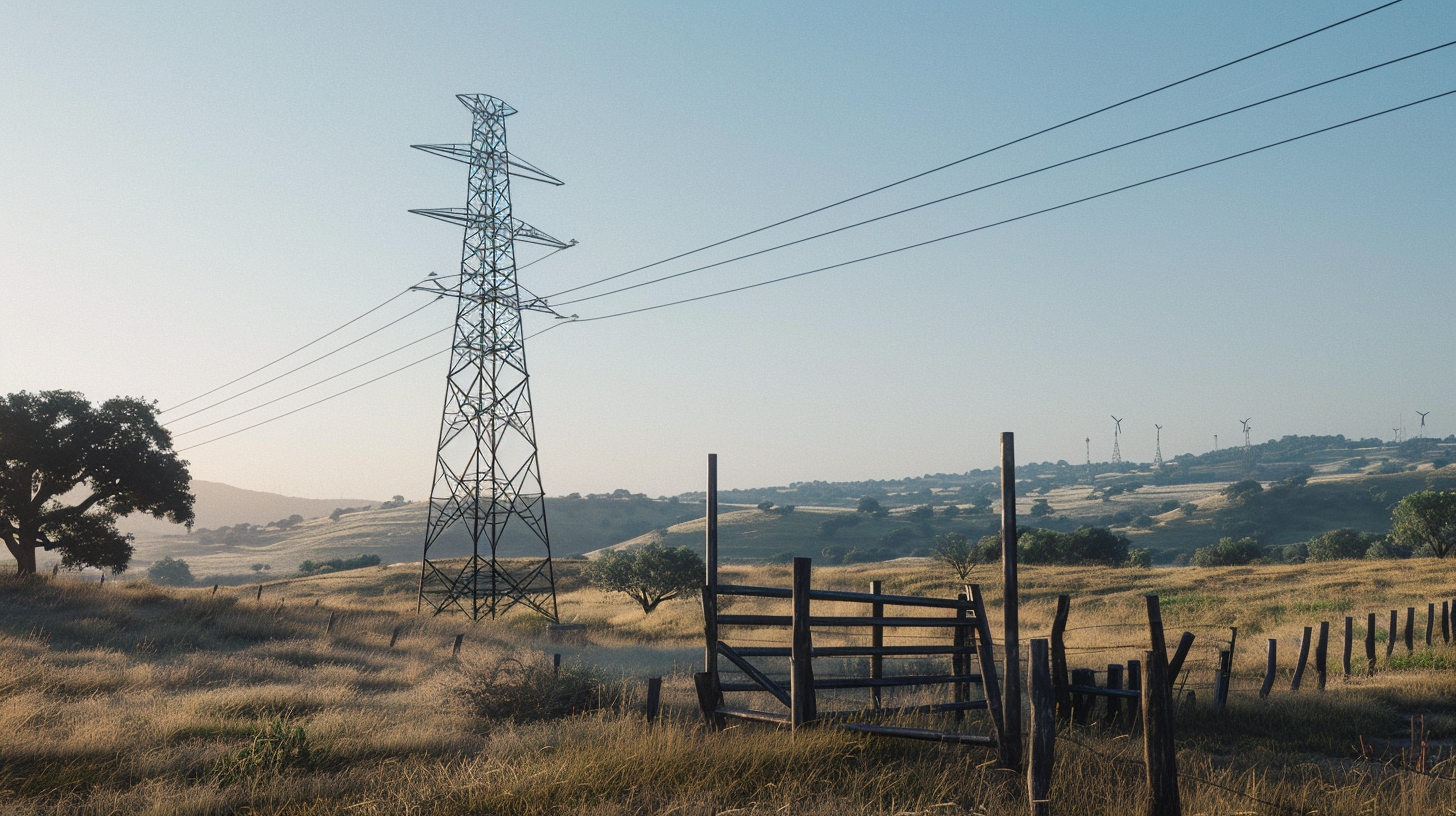
The southernmost leg of Texas’s Permian Basin Reliability Plan — the Howard–Solstice 765-kilovolt line proposed by CPS Energy and AEP Texas — has moved into its proposal-for-decision phase, leaving landowners, conservation groups and the utilities to await an administrative law judge’s route recommendation.
The State Office of Administrative Hearings held the merits hearing May 19-22, and its procedural schedule runs through August, according to filings at the Public Utility Commission of Texas. No route order has been issued.
The project would connect CPS Energy’s Howard Road Station in Bexar County to AEP Texas’s Solstice Station in Pecos County, near Fort Stockton — roughly 300 to 370 miles of new extra-high-voltage line, the highest transmission voltage yet built in Texas.
The joint application filed March 2 identifies 77 alternative routes made up of 268 segments. PUC records show candidate routes crossing more than a dozen counties, including Atascosa, Bandera, Bexar, Edwards, Kerr, Kinney, Medina, Pecos, Real, Sutton, Terrell, Uvalde and Val Verde. More than 600 landowners, businesses and governmental entities filed to intervene by the April 1 deadline, according to the Hood County News.
Supporters frame the line as necessary infrastructure. CPS Energy and AEP Texas describe it as improving grid reliability and power delivery to meet load growth in the Permian Basin, and the project is part of the reliability plan the PUC approved in 2025 after the Electric Reliability Council of Texas endorsed the 765-kV approach in 2024.
PUC staff have backed 765-kV construction over lower-voltage options in the reliability plan, citing a 2024 ERCOT study finding that the higher voltage moves more power over longer distances with fewer losses. The commission’s five members, all appointed by Gov. Greg Abbott, will make the final routing decision after the administrative judges issue their recommendation.
The Devils River Conservancy, which engaged throughout the pre-filing process, said the applicants’ preferred Alternative Route 4 avoids bisecting the Devils River between the two units of the Devils River State Natural Area and the headwater springs near Juno, concerns the group had pressed for months.
“From the beginning, our objective has been clear: protect the heart of the Devils River and the integrity of the conservation corridor that has kept it pristine,” Executive Director Romey Swanson said in a statement, adding that the group would keep pushing to minimize impacts and warning that any alignment south of Route 4 “would significantly degrade both the river itself and the culture of stewardship that has protected it for generations.”
The Hill Country Preservation Coalition filed to intervene in March, saying it would represent landowners whose properties lie along proposed segments across several counties.
The next milestone for Howard-Solstice is the administrative law judges’ proposal for decision, expected under a schedule that runs through August; the PUC is not bound by the judges’ route choice and may adopt, alter or substitute any of the identified alternatives when it rules.