
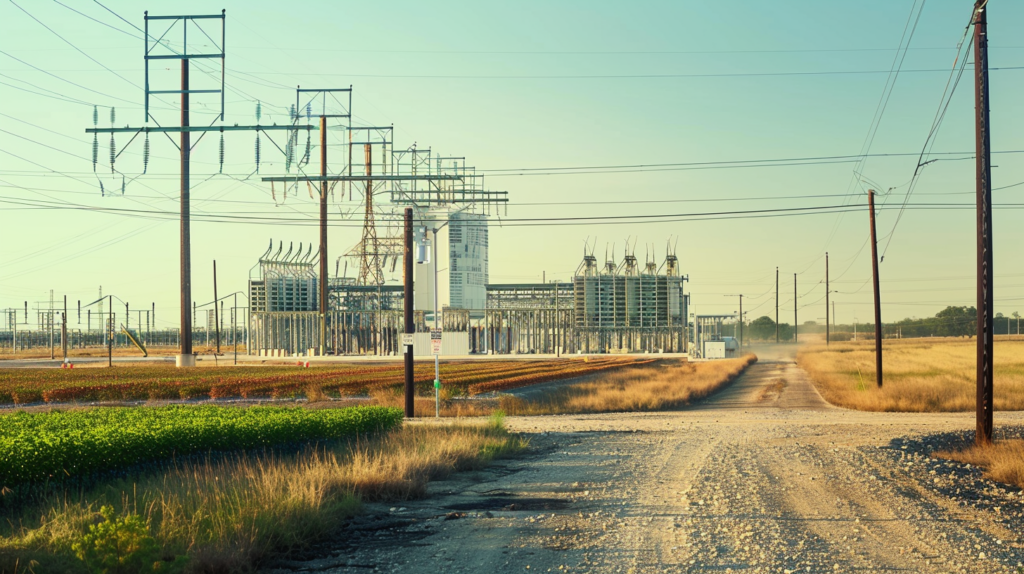
Lawsuit Says Two San Antonio Data Centers Built Their Own Power Plants Without the Permits
David Thompson lives across the road from one of two data center campuses rising on San Antonio's far West Side, each with its own gas-fired power plant.

Coverage of the Texas electric grid and energy sector -- ERCOT reliability, generation capacity, rising power demand, rates, and the policy decisions shaping how the state keeps the lights on.

David Thompson lives across the road from one of two data center campuses rising on San Antonio's far West Side, each with its own gas-fired power plant.

Gov. Greg Abbott's Sept. 21 order halting state permits for data centers reaches a group his first pause left alone: projects that plan to build their own power plants instead of solely drawing from the grid.
The chairman of the agency that regulates Texas utilities wants two of the state's biggest proposed power lines sent back to the judges who just recommended rejecting them — a step that would keep the projects alive but push a decision months further out for landowners across 23 counties.
A rancher who is representing himself in one of the biggest transmission cases in Texas history told state utility regulators on Sept. 5 that if they approve two enormous power lines over their own judges' recommendation, landowners will take them to court.
The Public Utility Commission of Texas is set to vote Sept. 11 on the permanent rule for connecting the state's largest new electricity users to the grid.
By Charles Blain Don’t mess with Texas, a phrase as widely known as the state’s identity itself also captures a useful rule for policymakers: Don’t mess with what works.
Oncor and the Lower Colorado River Authority's transmission arm filed an 81-page rebuttal Sept. 2 asking Texas utility regulators to overrule two administrative judges who recommended denying a pair of 765,000-volt power lines across Central and West Texas, arguing the judges leaned on "lay witness testimony" over the state grid operator's engineering and that denying the lines would leave Far West Texas facing forced outages of more than 2,000 megawatts.
A customer of AEP Texas living in the brush country west of San Antonio could get a phone call three days before a windy afternoon warning that the lights may go out on purpose, then a second notice at 48 hours, a third at 24, and a final one somewhere between one and six hours before the power is cut.
Texas utility regulators approved the state’s first 765,000-volt transmission lines on Aug. 28, clearing Oncor to build 424 miles of them across 30 counties, from near Glen Rose to the New Mexico line, at a cost of about $3.9 billion — and in the same orders they threw out an administrative law judges’ finding that the utility had failed to give some landowners the notice the rules require.
The agency that runs the electric grid for most of Texas told the market at 7:16 p.m. on Aug. 31 — the last hours of the day it had promised an answer — that it would not meet its own deadline for telling utilities which enormous new electricity customers make the first round of grid connections.
The Public Utility Commission of Texas will meet Aug. 28 to settle the route of a 370-mile power line from San Antonio to the Permian Basin, the first of three high-voltage paths the state approved out of the oil field to reach a decision.
On Sunday, Aug. 23, Texas homes and businesses drew 90,411 megawatts of electricity in a single hour — more than on any weekend day in the state’s history, and more than on any day ever recorded except one.
The Public Utility Commission of Texas called a special meeting Aug. 21 for the sole purpose of taking up two of the giant power lines proposed to carry electricity out of the Permian Basin, moved it into a hotel ballroom to hold the crowd, heard argument from the parties, and then approved nothing, denied nothing and paused nothing.
Texas Oil & Gas Association President Todd Staples told a Texas House committee that West Texas needs new electric generation and transmission capacity now, warning that delaying the buildout will only raise its eventual cost.