
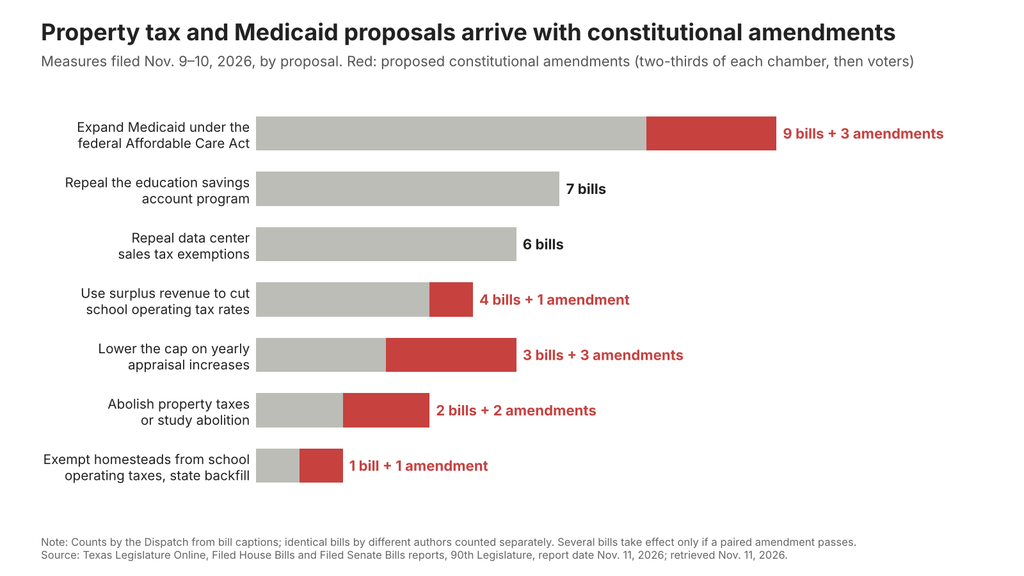
Of the 1,378 bills and resolutions filed for the 90th Legislature on Nov. 9 and 10, the lead proposals to expand Medicaid and to end school operating taxes on homesteads take effect only if two-thirds of each chamber and then a majority of voters approve them. Repeals of data center tax breaks and of the education savings account program need only a simple majority and the governor’s signature.
Lawmakers and members-elect filed 1,059 measures in the House and 319 in the Senate on the first two days prefiling was allowed, by the Legislature’s own counts. The Texas Dispatch sorted the filings by caption and read the full text of the core-issue bills below. The Legislature convenes Jan. 12.
Two tracks, two vote counts
A proposed constitutional amendment needs “a vote of two-thirds of all the members elected to each House” and then a majority of voters at a statewide election. That is 100 of 150 House members and 21 of 31 senators, the chambers’ fixed sizes. The governor has no veto over an amendment, as the Dispatch explained Nov. 5.
An ordinary bill needs a simple majority of each chamber and the governor’s signature. It takes effect Sept. 1, 2027, unless two-thirds of each chamber votes to make it take effect sooner.
Of the first filings, 61 are proposed amendments, called joint resolutions: 51 in the House and 10 in the Senate.
Property taxes: most roads run through the ballot
House Bill 1075 by Rep. Armin Mizani of Keller would exempt the remaining taxable value of every homestead from school district operating taxes, the part of the bill that pays for salaries and day-to-day costs. The state would pay each district the operating revenue it loses, beginning in the 2028–29 school year. Debt-service taxes for school bonds would still be levied. The bill takes effect Jan. 1, 2028, “only if the voters approve” the companion amendment, House Joint Resolution 71. The comptroller’s chief revenue estimator put the cost of ending homestead school operating taxes at $8.6 billion a year at a Sept. 15 hearing.
Lowering the 10% yearly cap on homestead appraisal increases also runs through the ballot. The constitution sets the floor: lawmakers may limit growth to “110 percent, or a greater percentage” of the prior year’s value. House Bills 457 and 563 and Senate Bill 298 come paired with joint resolutions HJR 35, HJR 38 and SJR 14 to allow a lower cap. Two more amendments, HJR 23 and HJR 58, would abolish property taxes outright.
The statutory option is narrower. House Bill 332 by Rep. Carrie Isaac of Dripping Springs would set aside general revenue above 104% of the prior two-year collections in a dedicated state fund, to be spent only on reducing the state compression percentage, the factor the state uses to lower school districts’ maximum operating tax rates, a process called rate compression. It would not start until the budget period that begins Sept. 1, 2029. Three other House bills take a similar approach, and HJR 60 would write a version into the constitution using general revenue otherwise bound for the economic stabilization fund, known as the Rainy Day Fund.
Medicaid: an amendment first
Nine bills and three joint resolutions carry the same caption: expanding Medicaid to people the state could cover with federal matching money under the Affordable Care Act. Senate Bill 31 by Sen. Judith Zaffirini directs the Health and Human Services Commission to cover “all individuals” for whom federal matching funds are available and to report each Dec. 1 on the effect on the uninsured, state costs and hospitals’ uncompensated care. It takes effect Jan. 1, 2028, and only if voters approve a constitutional amendment requiring expansion. If they don’t, “this Act has no effect.”
Two bills go another way. House Bill 113 and Senate Bill 313, both captioned a “Texas solution,” would run Medicaid under a federal block grant if Washington authorizes one, with coverage through private plans.
Schools: repeal or rewrite
Seven bills would repeal the education savings account program, which pays private school tuition and other approved education expenses from a state-funded account. House Bill 164 runs five sections: it repeals the program’s chapter of the Education Code and strips the comptroller’s related background-check authority. The Senate version, SB 294, lists 10 authors. No amendment is needed; the program exists in statute.
Four other bills keep the program and change its rules. House Bill 324 would require participating private schools to post the services they offer students with disabilities and to state that they are not required to follow a student’s individualized education program. House Bill 916 would require the same disclosure for students with medical absences. Senate Bill 291 deals with online courses paid for with program money.
Data centers: a majority already on paper
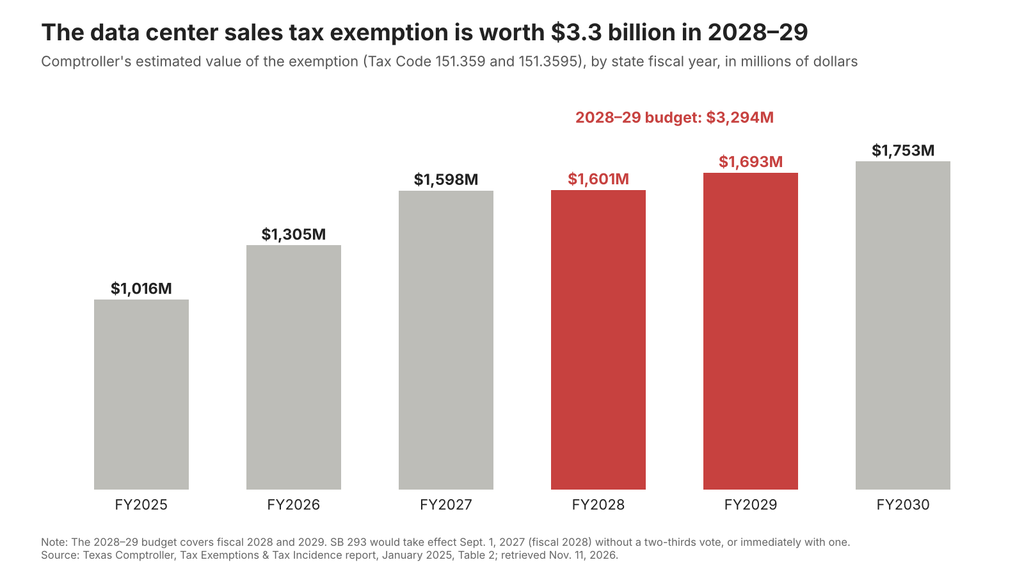
Six bills would repeal the sales tax exemptions for data centers. The Senate version, SB 293, lists 23 of 31 senators as authors, two more than the 21 needed to give a bill immediate effect in the Senate. No other Senate bill filed in the first two days lists more than 10. The comptroller values the exemption at $1.6 billion in fiscal 2028 and $1.69 billion in fiscal 2029, or $3.29 billion over the next budget. The Dispatch reported Nov. 10 that three House versions would let centers already certified keep their breaks.
The industry’s case is that the break pays off over time. “By defraying some of the cost of the inputs, it fosters continuous reinvestment in the facility,” Dan Diorio of the Data Center Coalition told Senate Finance in July, according to Texas Public Radio, as the Dispatch reported.
Other data center bills ask whether the state will set uniform rules or let counties decide. Senate Bill 33 would assign transmission costs for computing sites to a rate class made up only of those customers. Senate Bill 34 would let commissioners courts create zoning districts for large computing loads in unincorporated areas. Senate Bill 296 goes furthest: a two-year moratorium on new permits, a local election for each project, and an annual payment to county residents equal to the greater of 2% of the center’s gross receipts or $10,000 per megawatt of demand.
Counties argue they have no tools now. “Under current state law, counties have limited authority to stop projects like these outright,” Robertson County Judge J.D. Scarpinato wrote in June, as the Dispatch reported. Sen. Paul Bettencourt of Houston has argued the rules “should be statewide, top-down guidelines,” according to a Texas Observer account cited by the Dispatch.
Local debt: tighter terms, lower petition bar
House Bill 412 by Rep. Carl Tepper would narrow what cities and counties may finance with certificates of obligation, debt issued without an election. Roads, airports, libraries, parks and administrative buildings would come off the list; water, drainage, landfills, police and fire stations and jails would stay. Hospital districts could no longer issue them. The bill would cut the longest term from 40 years to 30 and lower the petition needed to force an election from 5% to 2% of registered voters.
Local officials have argued that much of what they borrow and spend for is not optional. Police, fire and EMS take “around 53% of general fund expenditures” in Texas cities, Rick Ramirez of the Texas Municipal League told House Ways and Means in September. Certificate debt outstanding rose from $13.24 billion to $30.85 billion over 10 years, James Quintero of the Texas Public Policy Foundation, which favors lower local taxes and debt limits, told the same hearing.
What to watch
- Nov. 16, 2026: The New Braunfels City Council takes a final reading on a data center ordinance with noise and buffer limits, the Dispatch reported, the kind of rule counties cannot write under current law.
- Jan. 12, 2027: The 90th Legislature convenes at noon. Committee referrals will show which of the competing data center, property tax and education savings account bills get hearings first.
- Jan. 19, 2027: The governor-elect is sworn in. The governor signs or vetoes the statutory repeals but has no role in sending an amendment to voters.
- Jan. 1, 2028: The earliest date SB 31 (Medicaid) and HB 1075 (homestead school taxes) could take effect, and only if voters first approve their companion amendments.
Sources
Primary documents
- Texas Legislature Online, Filed House Bills report, 90th Legislature (report date Nov. 11, 2026): https://capitol.texas.gov/Reports/Report.aspx?LegSess=90R&ID=housefiled
- Texas Legislature Online, Filed Senate Bills report, 90th Legislature (report date Nov. 11, 2026): https://capitol.texas.gov/Reports/Report.aspx?LegSess=90R&ID=senatefiled
- SB 31 (Zaffirini), introduced text: https://capitol.texas.gov/tlodocs/90R/billtext/html/SB00031I.htm
- SB 33 (Zaffirini): https://capitol.texas.gov/tlodocs/90R/billtext/html/SB00033I.htm
- SB 34 (Zaffirini): https://capitol.texas.gov/tlodocs/90R/billtext/html/SB00034I.htm
- SB 291 (Perry): https://capitol.texas.gov/tlodocs/90R/billtext/html/SB00291I.htm
- SB 293 (Huffman et al.), text and authors page: https://capitol.texas.gov/tlodocs/90R/billtext/html/SB00293I.htm ; https://capitol.texas.gov/BillLookup/History.aspx?LegSess=90R&Bill=SB293
- SB 294 (West et al.), authors page: https://capitol.texas.gov/BillLookup/History.aspx?LegSess=90R&Bill=SB294
- SB 296 (Gutierrez): https://capitol.texas.gov/tlodocs/90R/billtext/html/SB00296I.htm
- HB 113 (Lalani): https://capitol.texas.gov/tlodocs/90R/billtext/html/HB00113I.htm
- HB 164 (Bucy): https://capitol.texas.gov/tlodocs/90R/billtext/html/HB00164I.htm
- HB 324 (González): https://capitol.texas.gov/tlodocs/90R/billtext/html/HB00324I.htm
- HB 332 (Isaac): https://capitol.texas.gov/tlodocs/90R/billtext/html/HB00332I.htm
- HB 412 (Tepper): https://capitol.texas.gov/tlodocs/90R/billtext/html/HB00412I.htm
- HB 916 (Dorazio): https://capitol.texas.gov/tlodocs/90R/billtext/html/HB00916I.htm
- HB 1075 (Mizani), introduced PDF: https://capitol.texas.gov/tlodocs/90R/billtext/pdf/HB01075I.pdf
- HJR 71 (Mizani), bill history (text not yet posted): https://capitol.texas.gov/BillLookup/History.aspx?LegSess=90R&Bill=HJR71
- Texas Constitution, Art. XVII, Sec. 1: https://statutes.capitol.texas.gov/Docs/CN/htm/CN.17.htm#17.1
- Texas Constitution, Art. III, Secs. 2 and 39: https://statutes.capitol.texas.gov/Docs/CN/htm/CN.3.htm#3.2
- Texas Constitution, Art. VIII, Sec. 1(i): https://statutes.capitol.texas.gov/Docs/CN/htm/CN.8.htm#8.1
- Texas Legislative Council, Dates of Interest: https://tlc.texas.gov/docs/legref/Dates-of-Interest.pdf
Data
- Texas Comptroller, Tax Exemptions & Tax Incidence report (January 2025), Table 2: https://comptroller.texas.gov/transparency/reports/tax-exemptions-and-incidence/2025/96-463.pdf
Research and interest groups (lean labeled)
- Texas Public Policy Foundation (favors lower local taxes and limits on local debt), testimony as reported by the Dispatch, Sept. 18, 2026
- Texas Municipal League (represents cities), testimony as reported by the Dispatch, Sept. 18, 2026
- Data Center Coalition (industry trade group), testimony as reported by Texas Public Radio via the Dispatch, Nov. 10, 2026
News reporting
- The Texas Dispatch, “Texas House Panel Puts a $29.2 Billion Price Tag on Ending the School Property Tax,” Sept. 17, 2026: https://thetexasdispatch.com/texas-house-ways-means-school-property-tax-29-billion-recap-september-15/
- The Texas Dispatch, “Texas Local Debt Service Tops $552 Billion, and a House Panel Splits on the Remedy,” Sept. 18, 2026: https://thetexasdispatch.com/texas-house-ways-means-local-government-debt-552-billion-recap-september-15/
- The Texas Dispatch, “Analysis: What a Texas Governor Can Do Alone, and What Takes Two-Thirds of the Legislature,” Nov. 5, 2026: https://thetexasdispatch.com/texas-governor-powers-veto-two-thirds-legislature/
- The Texas Dispatch, “Senate Bill With 23 Authors Would End Data Center Tax Breaks Already Granted,” Nov. 10, 2026: https://thetexasdispatch.com/sb-293-data-center-sales-tax-exemption-repeal-house-bills/
- The Texas Dispatch, “Two House Bills Would Give Texas Counties a Say Over Data Centers They Now Cannot Zone,” Nov. 10, 2026: https://thetexasdispatch.com/hb-928-hb-547-county-approval-data-centers/