
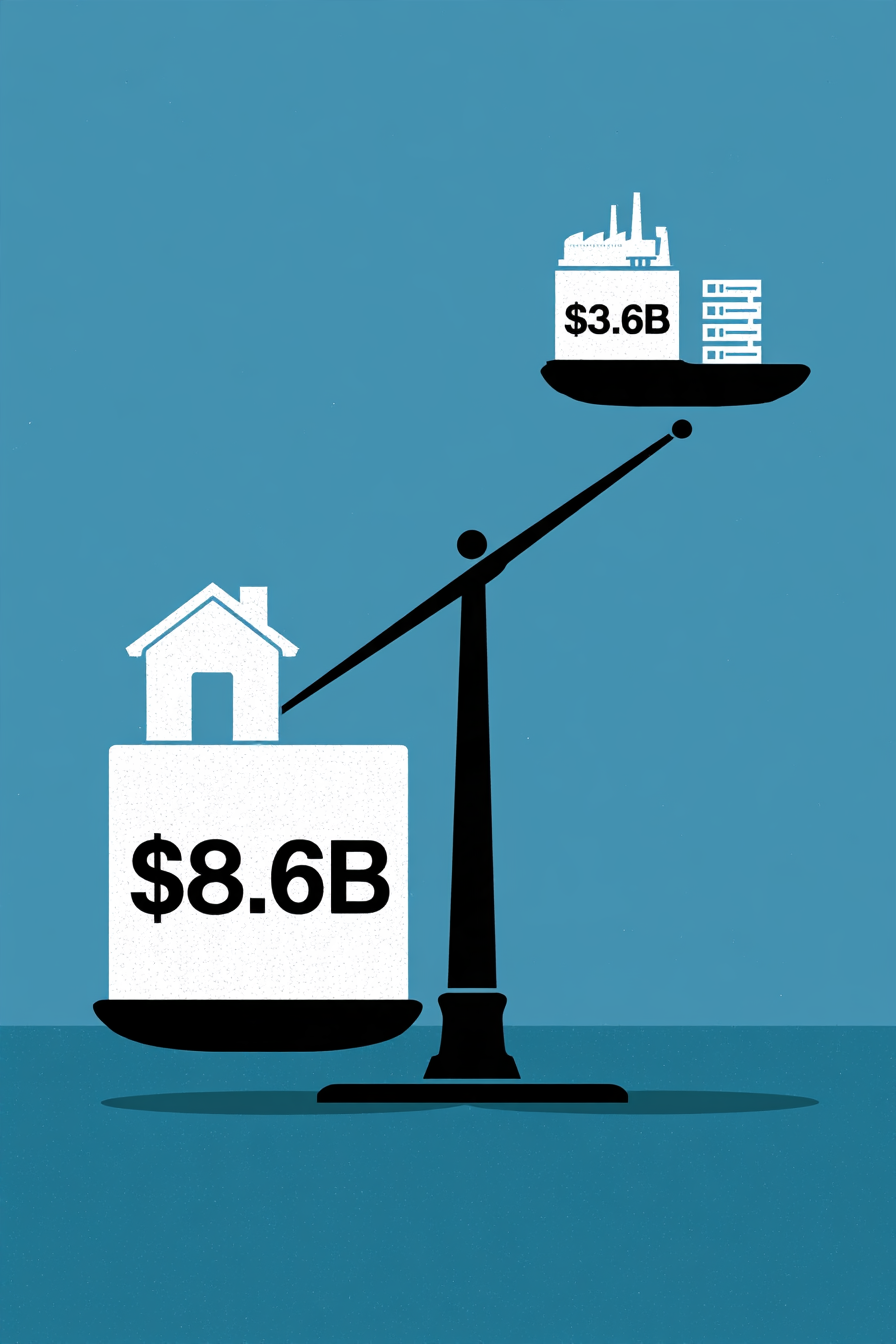
Ending school operating taxes on Texas homesteads would cost the state about $8.6 billion a year, and the three largest business tax breaks in the debate are worth $2.7 billion to $3.6 billion combined, by the comptroller’s estimates.
That gap is the arithmetic behind the goal Governor-elect Gina Hinojosa set: end “corporate subsidies” and use the savings to cut property taxes, “with the end goal of eliminating residential property taxes.” She takes office Jan. 19. The Legislature that would write the plan convenes Jan. 12, and bill prefiling opened Nov. 9.
The price of each version
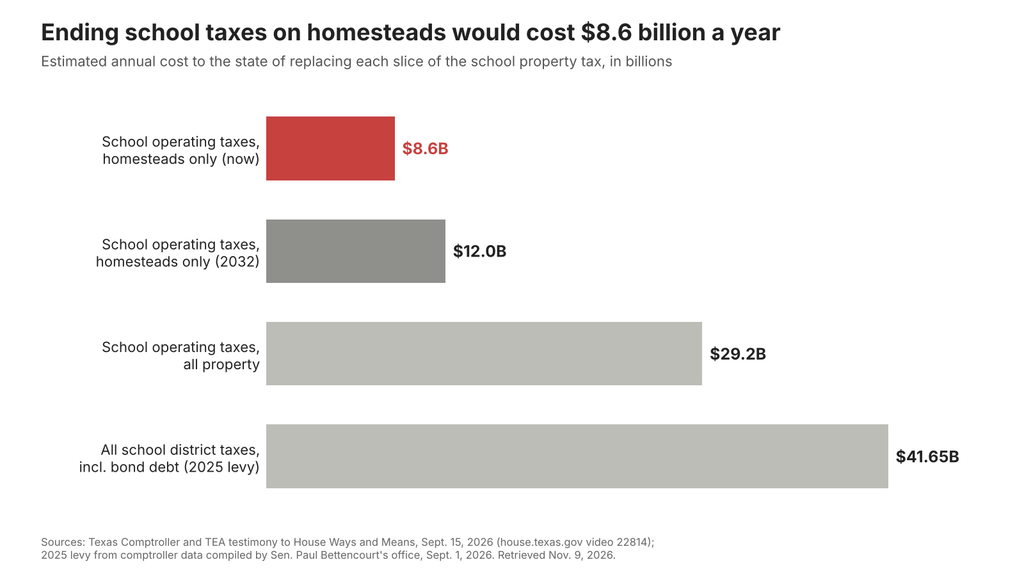
Tetyana Melnyk, the comptroller’s chief revenue estimator, priced the options for the House Committee on Ways and Means at a Sept. 15 hearing. Ending school maintenance-and-operations taxes, the part of the bill that pays for salaries and day-to-day costs, on homesteads alone would cost $8.6 billion. That rises to $12 billion by 2032 as home values climb.
Ending those taxes on all property would cost about $29.2 billion a year, Texas Education Agency Commissioner Mike Morath confirmed at the same hearing.
The comptroller’s office told the panel that one cent of the state sales tax raises about $7.4 billion. By that figure, the homestead-only version equals about 1.2 cents on top of the 6.25-cent state rate, and the full version about 3.9 cents.
Neither figure covers a homeowner’s whole bill. School districts levied $41.65 billion in 2025, counting the debt-service taxes that repay construction bonds, according to comptroller data compiled by the office of Sen. Paul Bettencourt, who chairs the Senate Local Government Committee. Cities, counties and special districts levy their own taxes on top. The Dispatch found no published state estimate of the cost of ending all residential property taxes.
Who would get the money
The state already spends about $51 billion of the current two-year budget keeping earlier school tax cuts in place. Those cuts raised the homestead exemption, the share of a home’s value a school district may not tax, to $140,000 in 2025. Homeowners 65 and older or disabled get an additional $60,000 under Article VIII, Section 1-b of the Texas Constitution.
The result: 39.2 percent of Texas’ 6.14 million homesteads paid no school district tax in 2025, including about 61 percent of senior and disabled homesteads, according to Bettencourt’s office. The Dispatch reported the county-by-county findings in September.
So any new cut flows to the six in 10 homesteads that still owe a school bill: homes worth more than the exemption. The more a home is worth, the larger the cut. Renters and business owners would see no change in their school tax bills under a homestead-only plan. They would share in paying for it through state revenue.
The tax breaks on the table
The campaign has not said which breaks it would end, the Houston Chronicle reported. The comptroller’s January 2025 Tax Exemptions and Tax Incidence report prices the largest candidates.
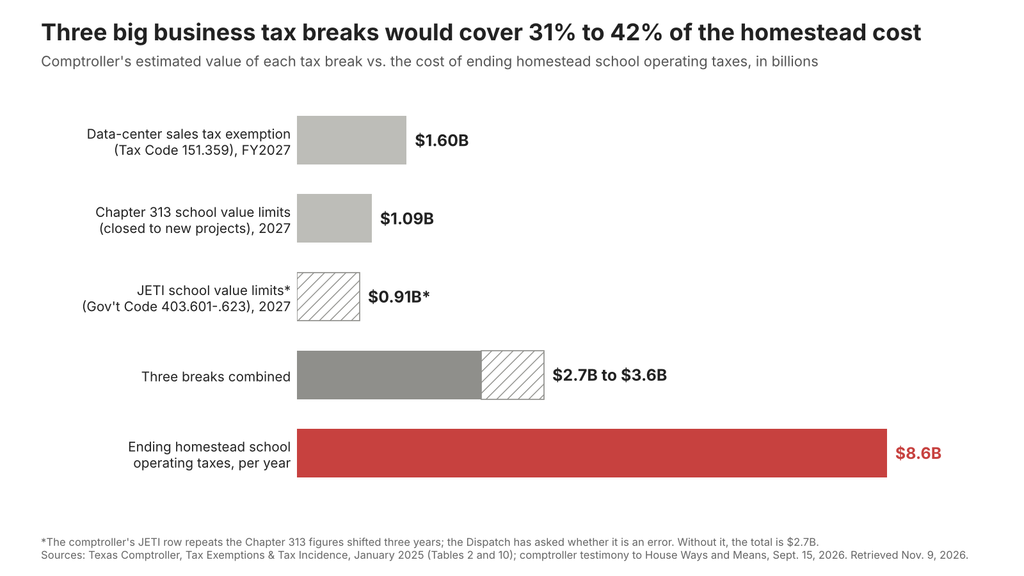
Data centers. The sales tax exemption for equipment and electricity used in qualifying data centers, Tax Code Section 151.359, is worth an estimated $1.6 billion in fiscal 2027, rising to $1.75 billion by 2030. Both the outgoing governor and the governor-elect have called for ending it, the Chronicle reported.
Chapter 313. Value limitation agreements cap the taxable value of factories, power plants and other large projects for school operating taxes. They are worth an estimated $1.09 billion in tax year 2027. The program closed to new projects Dec. 31, 2022, but agreements already signed run to their end dates, the comptroller’s report says.
JETI. Its replacement, the Texas Jobs, Energy, Technology and Innovation Act, works the same way. The governor’s office signs JETI agreements along with the school district and the company. The comptroller’s report lists the program at $914 million in 2027. That row repeats the Chapter 313 figures shifted three years later, so the Dispatch treats it as the high end of the range.
Together the three come to about $3.6 billion with the JETI figure and about $2.7 billion without it: 42 percent or 31 percent of the current homestead-only cost, and 30 percent or 23 percent of the $12 billion projected for 2032. The data-center estimate is for a fiscal year and the other two for a tax year; the sum treats them as comparable.
Two other incentives, the high-cost natural gas tax reduction and the Texas Enterprise Fund, are often named in the same debate. The comptroller has published no current estimate for either, and they are left out of the total.
Repeal would not deliver that sum at once. Most of the Chapter 313 and JETI value sits in signed agreements. Ending the programs for new projects would leave those in force unless lawmakers reached back into existing contracts.
Hinojosa called full elimination the “ultimate goal” in an interview with Hearst Newspapers and added, “I don’t know if we can get there,” the Chronicle reported. She also pointed to Texas Education Agency contracts, which total more than $2 billion in active agreements.
The case against the trade
Bettencourt rejects the premise. He told the Chronicle that state contracts hold too little money to cover school taxes and that taxing businesses more shifts the cost to buyers: “The consumer pays anyway, because the taxes are passed through.”
Every Texan, an Austin research group that favors more state spending on public services, opposes deeper cuts for a different reason. Its analyst Shannon Halbrook told the House committee the group was “concerned about their sustainability,” and told The Texas Newsroom, “Eventually there will be an economic downturn.”
School districts have their own stake. The $51 billion the state spends on earlier cuts pays districts what property taxes would otherwise have raised. Each new cut moves more of a district’s budget onto that state payment, which the Legislature has to appropriate every two years. Districts that asked voters for more on Nov. 3 mostly lost, and they will budget for 2027-28 around whatever the Legislature writes.
The Senate’s route
The Senate’s interim charges point elsewhere. Outgoing Lt. Gov. Dan Patrick’s March 27 charges called for raising the homestead exemption to $180,000 for homeowners under 55 and $240,000 for those 55 and older. They also called for lowering the age for the senior tax ceiling, which freezes a homeowner’s school tax bill, from 65 to 55.
Patrick put the cost of the whole plan at about $4 billion when he announced it in December and said it would reach 3.3 million homeowners, The Texas Newsroom reported. He did not say whether the figure is annual or for a two-year budget. No official fiscal estimate has been published.
Where else the money could come from
The comptroller’s October 2025 revenue estimate projected $4.66 billion left in general revenue at the end of the 2026-27 budget. It projected $28.48 billion in the Economic Stabilization Fund, the state’s savings account, by August 2027.
Fiscal 2026 tax collections then beat the forecast by $1.6 billion. The comptroller urged lawmakers to dedicate “surplus sales tax collections to reducing property taxes.”
Surpluses vary. The homestead bill recurs: $17.2 billion per two-year budget at the current price, and growing.
The savings account faces a competing claim. The governor-elect’s $1,500-per-household payment would draw about $17 billion from it once.
And the homestead plan would need voters. The Texas Constitution taxes property by value unless it is exempt “as required or permitted by this Constitution.” An amendment takes two-thirds of all members of each chamber and a majority of voters. The money to pay for it moves through the budget.
What to watch
- Nov. 9, 2026, onward: Prefiled bills and joint resolutions for the 90th Legislature, including any amendment to Article 8 of the Texas Constitution to exempt homesteads from school taxes (Texas Legislative Council; Texas Legislature Online).
- Jan. 12, 2027: The Legislature convenes (Texas Legislative Council).
- January 2027: The comptroller’s Biennial Revenue Estimate for 2028-29, required before the session under Article 3, Section 49a, sets how much room the budget has for a recurring $8.6 billion cost.
- Jan. 19, 2027: The governor takes office and may submit emergency matters that can move in the session’s first 30 days (Article 3, Section 5). Watch whether a property tax or business-incentive item is among them.
Sources
Primary documents
- Texas House Committee on Ways and Means, interim hearing video, Sept. 15, 2026: https://house.texas.gov/videos/22814
- Office of the Lieutenant Governor, release on 2026 interim charges, March 27, 2026: https://www.ltgov.texas.gov/2026/03/27/lt-gov-dan-patrick-releases-2026-interim-charges-to-the-texas-senate/
- Office of Sen. Paul Bettencourt, release on homestead ISD tax study, Sept. 1, 2026: https://senate.texas.gov/press.php?id=7-20260901a
- Texas Constitution, Article 3 (Secs. 5, 49a), Article 8 (Sec. 1), Article 17 (Sec. 1): https://statutes.capitol.texas.gov/Docs/CN/htm/CN.3.htm · https://statutes.capitol.texas.gov/Docs/CN/htm/CN.8.htm · https://statutes.capitol.texas.gov/Docs/CN/htm/CN.17.htm
- Texas Legislative Council, Dates of Interest, 90th Legislature: https://tlc.texas.gov/docs/legref/Dates-of-Interest.pdf
Data
- Texas Comptroller of Public Accounts, Tax Exemptions & Tax Incidence, January 2025 (Table 2, p. 5; Table 10, p. 38; Chapter 313 and JETI descriptions, pp. 44–45): https://comptroller.texas.gov/transparency/reports/tax-exemptions-and-incidence/2025/96-463.pdf
- Texas Comptroller, Certification Revenue Estimate 2026-27: https://comptroller.texas.gov/transparency/reports/certification-revenue-estimate/2026-27/
- Texas Comptroller, release on fiscal 2026 state revenue, Sept. 11, 2026: https://comptroller.texas.gov/about/media-center/news/20260911-texas-comptroller-huffines-announces-state-revenue-for-fiscal-2026-1788892132074
Research and interest groups
- Gina Hinojosa for Texas (campaign), “Money in Your Pocket”: https://ginafortexas.com/priority/an-affordable-texas-that-works-for-everyone/
- Every Texan (research group that favors more state spending on public services), testimony and statements as reported by the Dispatch and The Texas Newsroom
News reporting
- The Texas Dispatch, “Texas House Panel Puts a $29.2 Billion Price Tag on Ending the School Property Tax,” Sept. 17, 2026: https://thetexasdispatch.com/texas-house-ways-means-school-property-tax-29-billion-recap-september-15/
- The Texas Dispatch, Bettencourt county survey recap: https://thetexasdispatch.com/texas-senate-local-government-homestead-exemption-zero-school-tax-recap-september-1/
- The Texas Dispatch, “What a Texas Governor Can Do Alone, and What Takes Two-Thirds of the Legislature,” Nov. 5, 2026: https://thetexasdispatch.com/texas-governor-powers-veto-two-thirds-legislature/
- The Texas Dispatch, Nov. 3 school tax-rate and bond results, Nov. 5, 2026: https://thetexasdispatch.com/texas-school-tax-rate-bond-elections-nov-3-2026-results/
- Houston Chronicle, “Gina Hinojosa wants to eliminate homeowners’ property taxes. But how?”: https://www.houstonchronicle.com/politics/texas/article/gina-hinojosa-property-taxes-22463261.php
- The Texas Newsroom via Texas Standard, Dec. 29, 2025: https://texasstandard.org/stories/texas-property-tax-cuts-homestead-exemption-2026-election/
- Fox 4, constitutional timeline for the governor’s inauguration, Nov. 4, 2026: https://www.fox4news.com/news/here-is-constitutional-timeline-when-gina-hinojosa-assumes-office-texas-governor