
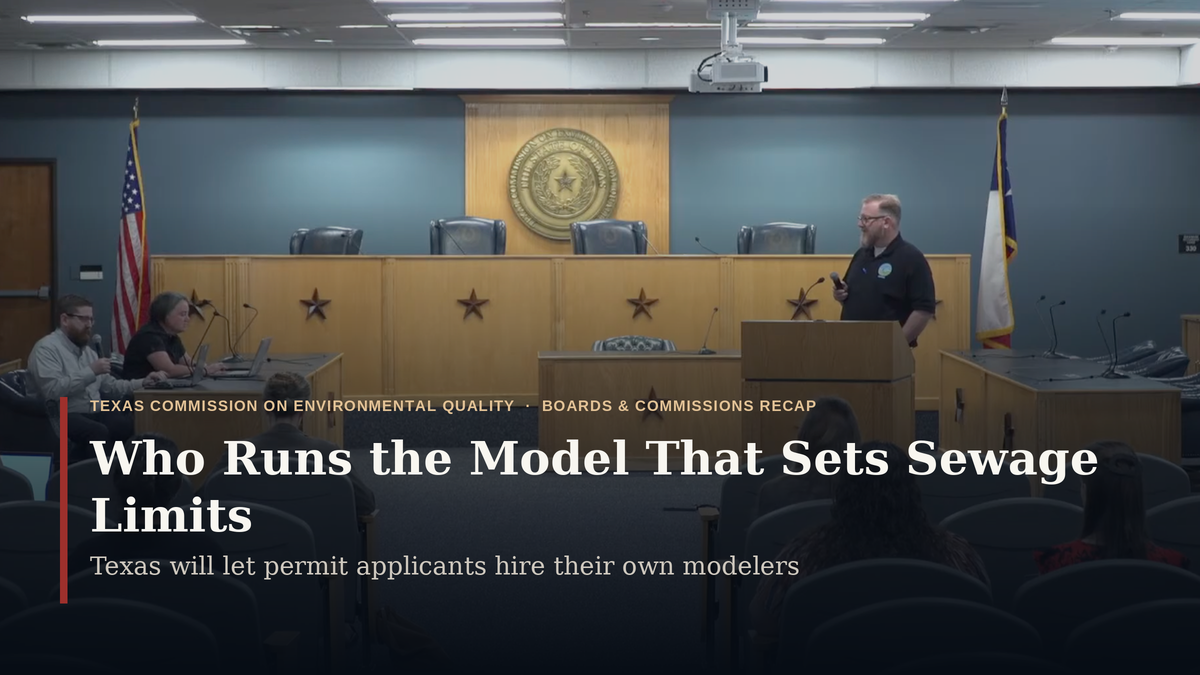
Cities and developers seeking permission to pipe treated sewage into a Texas creek may now hire their own consultants to run the computer model that decides how clean that water has to be, under a change the state’s environmental agency put into effect Oct. 13 — with no rule, no comment period and no written policy it has published.
The model measures dissolved oxygen, the oxygen in a stream that fish and everything else living in it breathe. Pour too much treated sewage into too small a creek and the oxygen falls until the creek can no longer support life. The Texas Commission on Environmental Quality’s own explainer for applicants states what the modeling is for: “DO modeling determines what permit effluent limits are required to meet the DO criteria of a waterbody.” Whoever runs the model, in other words, effectively sets the pollution limits written into the permit.
Those limits are what neighbors fight over. The commissioners sent four disputed wastewater permits to hearings in a single day on Oct. 7, as The Texas Dispatch previously reported — among them a 400,000-gallon-a-day sewage plant near Florence challenged by a married couple who live nearby, and a 240,000-gallon-a-day plant planned beside Interstate 30 in Hunt County. TCEQ offered no comparable figure of its own for the change: it did not say how many of these models it runs in a year, how long one takes, or how many applications will qualify.
Mike Lindner, who introduced himself as team leader for water quality assessment, told the agency’s quarterly water quality work group that the switch is “effective immediately and we are opening it up to all eligible applications.” Eligible means anyone applying for a new municipal sewage permit, or for a major amendment to one — the kind of rewrite that lets an existing plant discharge more. The agency’s modelers would stop doing the work and start checking it:
“To make sure that the third party has um done modeling that is sound and according to all the TCEQ procedures”
Lindner was candid about why. Texas is growing, he said, and “lo and behold they all go to the bathroom” — more dischargers on the same creeks, with effects that stack up rather than adding up neatly. Public participation has grown with them: in the past two years, he said, one of his most experienced colleagues sat through more contested-case hearings, the trial-like proceedings an opponent can demand before an administrative law judge, than “in the two decades previous to that.” The agency has already stopped offering small applicants a full review before they apply, he said, because “we we don’t have the time for that.” What they get instead is a quick look for anything disqualifying.
The program has edges. It is offered only where the discharge goes somewhere TCEQ considers “a location that’s relatively straightforward”; the Houston Ship Channel was named as a place it is not. The agency says it may take the modeling back in-house if correcting an outside consultant’s work proves slower than doing it. And the modeler must be among the “DO modelers that are familiar with Texas procedures and Texas DO modeling.”
What is missing is any way for an outsider to test that. There is no published list of qualified modelers, no posted qualification standard, and no stated rule about a consultant who works repeatedly for one applicant or who both models the discharge and designs the plant. Applicants who want to know whether their firm passes were told to call Lindner, who read his desk number into the record and said, “I’m happy to take any calls about that.” The eligibility checklist goes to him personally; the agency has not yet created a shared mailbox for it.
The case for the change is that it clears a bottleneck, and Lindner said plainly that it “does result in getting a permit issued quicker” — which matters to a fast-growing suburb waiting on a plant as much as to its builder. No one outside the agency has taken a public position, because there has been nothing to take one on: the initiative was announced here for the first time, and there is no comment docket. The sharpest counter-evidence comes from the agency itself, which is handing a technical judgment to the regulated party at the same moment it concedes it cannot keep up with the work it already owes them.
Applicants’ consultants may yet have to answer for the result in public. Once the agency signs off, Lindner said, the one task that could still fall to an outside modeler is showing up at a public meeting or a contested-case hearing “in order to defend their modeling as applicable.” The work group meets again Jan. 12, 2027.
A November deadline that cancels permits. Industrial sites covered by the state’s multi-sector storm water general permit must file renewal paperwork by Nov. 12 or lose coverage outright and have to reapply; TCEQ mailed and emailed postcard reminders between Aug. 28 and Sept. 5. Oilfield wastewater on the ground. The rulemaking moving produced-water land application permits from the Railroad Commission to TCEQ drew 617 oral and written comments, with concern raised about groundwater, human health and public participation; the commissioners take it up Nov. 4. Which form is current? Staff told applicants to use the April 2026 domestic wastewater application, then said on the record that only the instructions had been updated, then corrected that again mid-meeting.