
Neighbors of a biogas plant that would spray treated waste across 4,553 acres of Ellis County farmland won the right Oct. 7 to fight the permit in front of an independent judge. So did people living near three other Texas wastewater projects, decided the same morning.
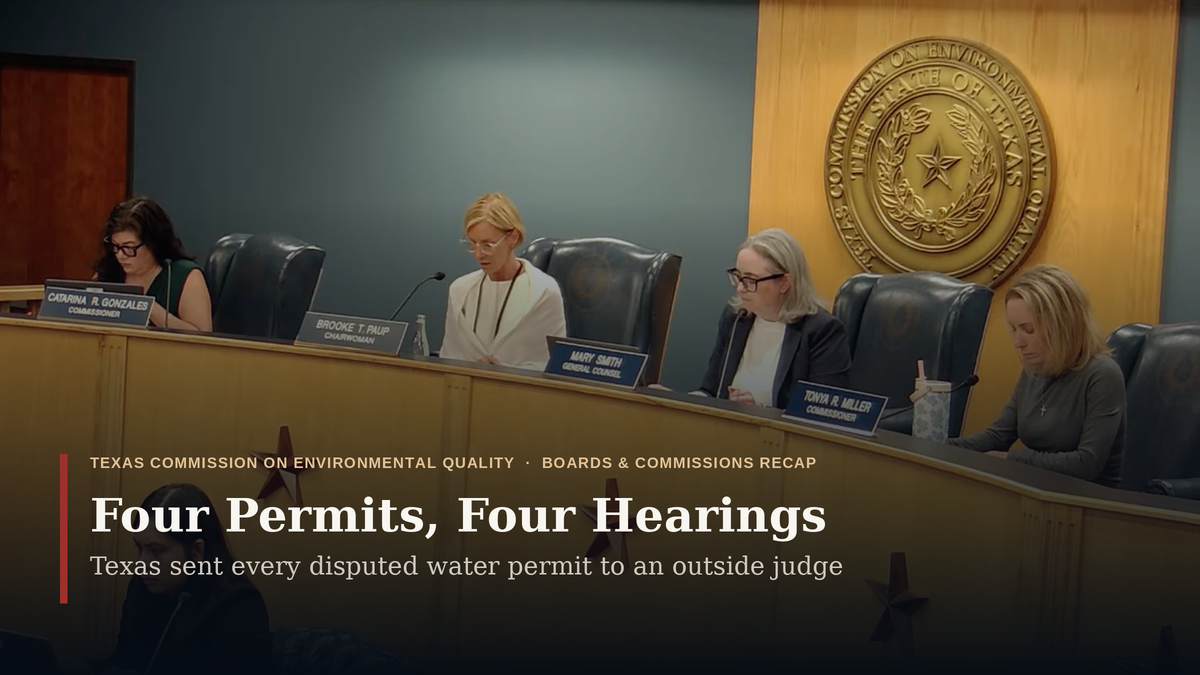
The three members of the Texas Commission on Environmental Quality granted at least one hearing request on every disputed permit in front of them and sent all four to the State Office of Administrative Hearings. A contested-case hearing is the trial-like proceeding in which an objector can put an applicant’s engineers under oath and cross-examine them. Without one, a neighbor’s only recourse is a written comment the agency answers on its own terms.
For the Ellis County project, that means the first adversarial test of a plant built to take restaurant food waste and cow manure, break them down in two sealed digesters, sell the captured methane as renewable natural gas, and get rid of what is left — about 56,000 gallons of liquid a day — by spraying it on “4,553.84 acres of corn, Bermuda grass, and Sorghum Sudan hay” scattered up to 11 miles from the plant in Ellis and Navarro counties. Between sprayings the liquid sits in an on-site lagoon holding 36.8 acre-feet, close to 12 million gallons. The permit, the agency notes, “will not authorize a discharge of pollutants into water in the state” — the fight is over what happens on the fields and in the air above them.
Chairwoman Brooke T. Paup said she would grant the requests of eight people who filed on time and “reside within close proximity to the proposed facility” or to the tracts the liquid would be sprayed on. Commissioners Catarina R. Gonzales and Tonya R. Miller agreed with her on every item, and every vote was unanimous. What the judge will weigh is whether the permit protects groundwater, surface water, livestock, wildlife and human health, whether the buffer zones and storage are adequate, and whether it keeps the smell off the neighbors’ property.
Granting on all four cuts against the agency’s recent reputation. Public Citizen and the Texas Campaign for the Environment wrote in April 2026 that the commission denied contested-case hearings 40 percent of the time in 2025, in some cases where its own Office of Public Interest Counsel — the in-house office that represents ordinary Texans — had recommended granting them. One morning is not a trend, and no commissioner said anything from the dais to suggest a change of policy.
The other three are sewage plants. A discharge of up to 240,000 gallons a day planned beside Interstate 30 in Hunt County drew requests from an organization and from individuals who, Paup said, “own or reside on properties near the proposed facility or along the proposed discharge route”. A 400,000-gallon-a-day plant near Florence, in Williamson County, was challenged by a married couple, one of them “an adjacent land owner, according to the map in this application”. And a plant that would irrigate 70.2 acres of public golf course in Burnet County drew a single request, from a man living “a little over a third of a mile from the facility” who raised “nuisance odor and wastewater migration”.
Not everyone got in. Paup denied one Ellis County request for failing to show a personal stake, denied several Hunt County requests on distance or missed deadlines, and denied every request to reconsider the permits outright, on the ground that the hearings will deal with the objections anyway. Two of the four were also sent to the agency’s mediation program, to run alongside the hearing schedule.
The rest of the meeting, which ran just over half an hour, was the enforcement docket: 55 agreed and default orders adopted in a single unanimous vote, with one item remanded the day before at the executive director’s request. The public interest counsel’s office told the commissioners it “does not object to their approval”. The penalties come to $2,706,043 — this newsroom’s own reconciliation of the three components the enforcement division read aloud, because the total it gave was garbled in the captions.
Each case now goes to a preliminary hearing at the administrative-hearings office, which has 180 days from that date to issue a proposal for decision — the judge’s written recommendation. The commissioners vote on the permits themselves only after that. Their next agenda meeting is Oct. 21.
A watchdog says the data-center permit pause is not being honored. Kathryn Guerra, who directs Public Citizen’s TCEQ watchdog campaign, told the commission the agency has kept noticing data-center-related permits for public comment despite Gov. Greg Abbott’s Sept. 21 directive halting them, and asked it to issue a notice clarifying the pause: “It is unreasonable to expect members of the public to abide by deadlines for regulatory process that has been halted by the governor”. She also said a Lufkin Daily News article published days earlier reported an agency permit reviewer asking a data-center developer whether its particulate-matter estimate could be recalculated below the major-source threshold, which would have removed the public-notice requirement. The Dispatch has not read that article and reports only that she made the claim. No commissioner responded. Gifts. The commission acknowledged gifts of $500 or more, mostly “travel for employees to these trainings and workshops”.