
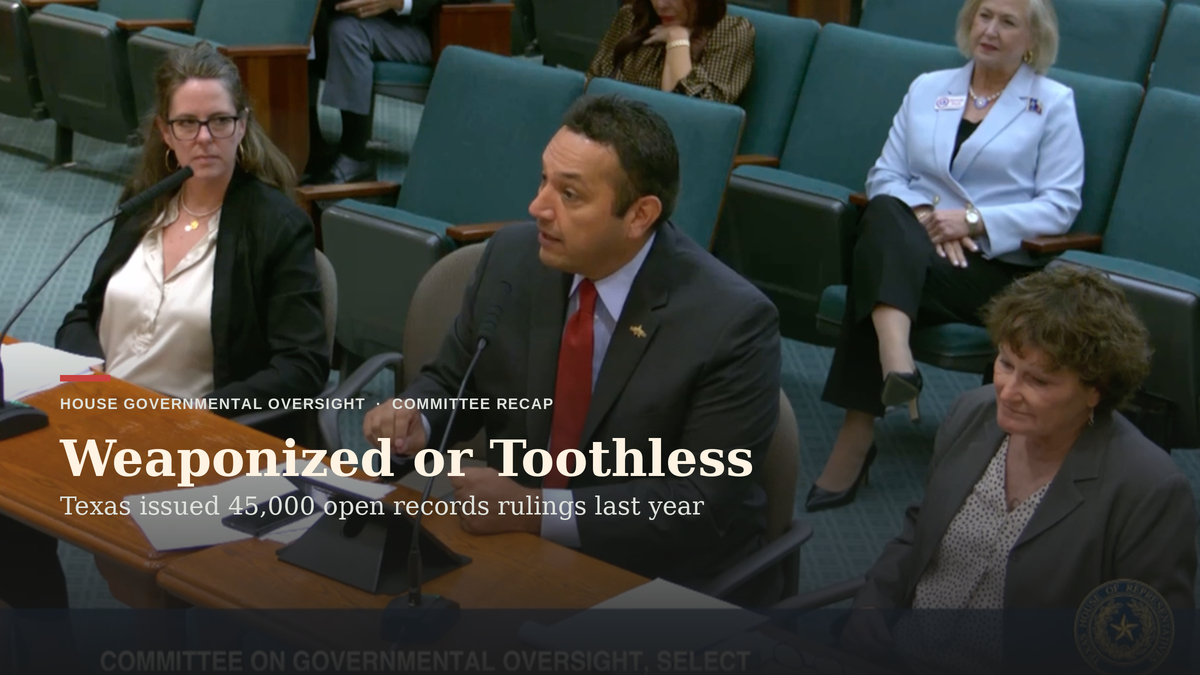
Texas issued more than 45,000 open-records rulings last year and is on pace to beat that by 10 percent. On Aug. 26 a House committee spent five hours listening to two groups of people who both say the system is broken, for opposite reasons.
“The Texas Open Records Act is being weaponized. It’s being abused,” said Angelina County Judge Keith Wright, who told members he gave the same testimony in 2016. “We’re doing this again, because what we did last time did not fix the problem.” He described one requester’s demand: “He wanted us to hire him as the law librarian and set up a salary of $60,000. And if I did not do that, he was going to file another removal suit against me.”
An hour later, James Quintero of the Texas Public Policy Foundation described the same statute from the other end. “What I see are problems related to non-responsiveness, long delays, exorbitant cost estimates, excessive redactions, and unsearchable electronic information,” he said. The law “features an excessive number of exceptions, with more than 70 separate, permissive and mandatory exclusions found throughout chapter 552. And because of these flaws, the promise and the reality of the Pia are worlds apart.”
The House Select Committee on Governmental Oversight gave the Texas Public Information Act about five hours of an 11-hour, 16-minute interim hearing that ran gavel to gavel without a recess. Rep. Cody Vasut, R–Angleton, chaired. No votes were taken.
The volume is not disputed. Tamara Smith, chief of the Open Records Division at the Office of the Attorney General, told members the division “issued over 45,000 rulings” in calendar 2025 and “over 27,000” in the first half of 2026, “so this year, we’re on track for more than a 10% increase year over year.” One exception drives it: the law-enforcement carve-out was raised in “more than 26,000 rulings last year,” she said, followed by the general privacy exception at “more than 22,000 times.”
Local governments described a staffing problem. Comal County District Attorney Jennifer Tharp said her sheriff’s office answered about 249 requests in July 2025 and 349 in July 2026, and “over 1700 open records request” so far this year. She flagged what she expects next: “Thankfully, we have not seen too many AI generated open records requests. I do believe that is a matter of time.”
Rep. AJ Louderback, R–Victoria, a former sheriff, backed them, describing “a small city and a small county that is hit repeatedly by up to 300 FOI requests, many of which are redundant, many of which are not factual.” Tony Hopkins, board president of the Texas Association of School Boards, offered a template: “Alabama changed its open records laws in 2024 to sort requests into two categories a standard request and what it calls a time intensive request, meaning one that takes more than eight hours of staff time. Each category has its own timeline.”
Transparency advocates told members not to touch the burden of proof. “It’s a power for the individual requesters, for the citizens,” said Kelly Shannon, executive director of the Freedom of Information Foundation of Texas. “And the burden is on the government if it wants to hide information or keep information secret. So let’s don’t mess with that dynamic.” Cost estimates, she said, end most requests on their own: “Most requesters don’t have that money laying around.”
Requesters brought receipts. Debbie Lindstrom of Citizens Defending Freedom said her group “asked 32 counties of varying sizes in Texas for the same public election records. Some counties handed them over for free, such as Travis and Denton. Harris County quoted us over $14,000 for the exact same kinds of records. Tarrant County gave nearly everything away for free, then charged $12,060 just to redact one machine log.” One district, Quintero said, “wanted $33,000 to respond and required half of the money up front.”
The day’s sharpest collision came between two members of the transparency coalition. Rep. Richard Peña Raymond, D–Laredo, asked Quintero whether the counties had made a compelling case. “No, I was not persuaded,” Quintero said, adding: “I can think a person is crazy, but also recognize his right to access public information.” Raymond did not accept it. “Personally, I think you’re absolutely wrong about not even recognizing the case that he laid out,” he said. “And I think you lose credibility, at least with me, when you can’t even see that.”
Rep. Erin Zwiener, D–Driftwood, drew a different line with the law-enforcement panel. “I am getting frustrated at the continuous ask for more and more protections, more and more hiding from transparency when it doesn’t seem like we are seeing good faith efforts to deal with bad apples,” she said. “If you’re going to ask us to continue to provide more and more shields from sunlight then we need to see some more effort to make sure these incidents don’t happen.”
The charge also reached public notice. Yvonne Mintz, president of the Texas Press Association, argued against moving notices to government websites. “Texans need to have their public notices published, distributed and archived by a neutral third party in a highly visible and easily accessible manner,” she said. “Newspapers have been doing that for 175 years. Yet in every session of the legislature, there are lawmakers who file bills proposing to eliminate newspaper notification.”
Several witnesses asked lawmakers to make attorney general rulings stick and to revisit a provision Sen. Mayes Middleton carried in Senate Bill 824 last session. One put it plainly: “The master should not have to sue the servant just to make it obey the law.” Raymond signaled where the House is likely to land. “We’ve passed bills where more and more stuff has to be put online,” he said. “And we’ll keep doing that. So that’s coming.” The 90th Legislature convenes in January 2027.
The committee opened with about four hours and 41 minutes on education foundations, where a Texas Public Policy Foundation researcher said Barbers Hill ISD routed roughly $97.1 million into its affiliated charity and Rep. Ellen Troxclair questioned the superintendent about the board’s business ties. The final 88 minutes examined whether political subdivisions may hold Open Meetings Act meetings outside their boundaries, after Bastrop’s council retreated to Fredericksburg. The attorney general’s chief of opinions told members nothing in the act says where a body must meet; Rep. Louderback told the mayor, “you just got caught”; Chair Vasut said he would like a rule that governments “meet where you have authority or right next door.”
Fact box
- Issue
- Interim charge on the Texas Public Information Act — which entities are subject to it, how effective it is in practice, whether its exceptions from disclosure are still necessary, and requirements for public notice (approx. 5 hours 4 minutes, about 45 percent of the hearing and the longest of three charges)
- What happened
- County officials and school board representatives asked lawmakers for tools against high-volume and repetitive requests, citing staffing costs and one requester’s demand for a $60,000 job; the attorney general’s open records chief reported more than 45,000 rulings in 2025 and a 10 percent pace increase this year; transparency groups, newspapers and conservative advocacy organizations asked instead for fewer exceptions, enforceable rulings and limits on cost estimates, citing quotes ranging from free to more than $14,000 for identical records; Reps. Raymond and Zwiener pushed back on witnesses from opposite directions; no vote (interim hearing)
- When
- Wednesday, Aug. 26, 2026, 10:00 AM CT · run time 11:16:14, gavel to gavel with no recess (10:06 a.m. to 9:22 p.m.)
- Where
- Room E2.028, Capitol Extension, Austin
- Chair
- Rep. Cody Vasut, R–Angleton (HD-25); Vice Chair Rep. Armando Walle, D–Houston (HD-140)
- Key witnesses
- Judge Keith Wright (Angelina County); Jennifer Tharp (Comal County criminal district attorney); Tamara Smith (Open Records Division, Office of the Attorney General); Tony Hopkins (Texas Association of School Boards); Kelly Shannon (Freedom of Information Foundation of Texas); James Quintero (Texas Public Policy Foundation); Carrie Griffith (Our Schools Our Democracy); Yvonne Mintz (Texas Press Association); Debbie Lindstrom and Shannon Ayers (Citizens Defending Freedom)
- Archived video
- house.texas.gov video 22756