
Cities across the country are grappling with rising homelessness, limited public resources, and tense debates over how best to respond. In Austin, lawmakers are trying different ideas tied to federal funding, nonprofits have more freedom to test alternative models rooted in community and dignity.
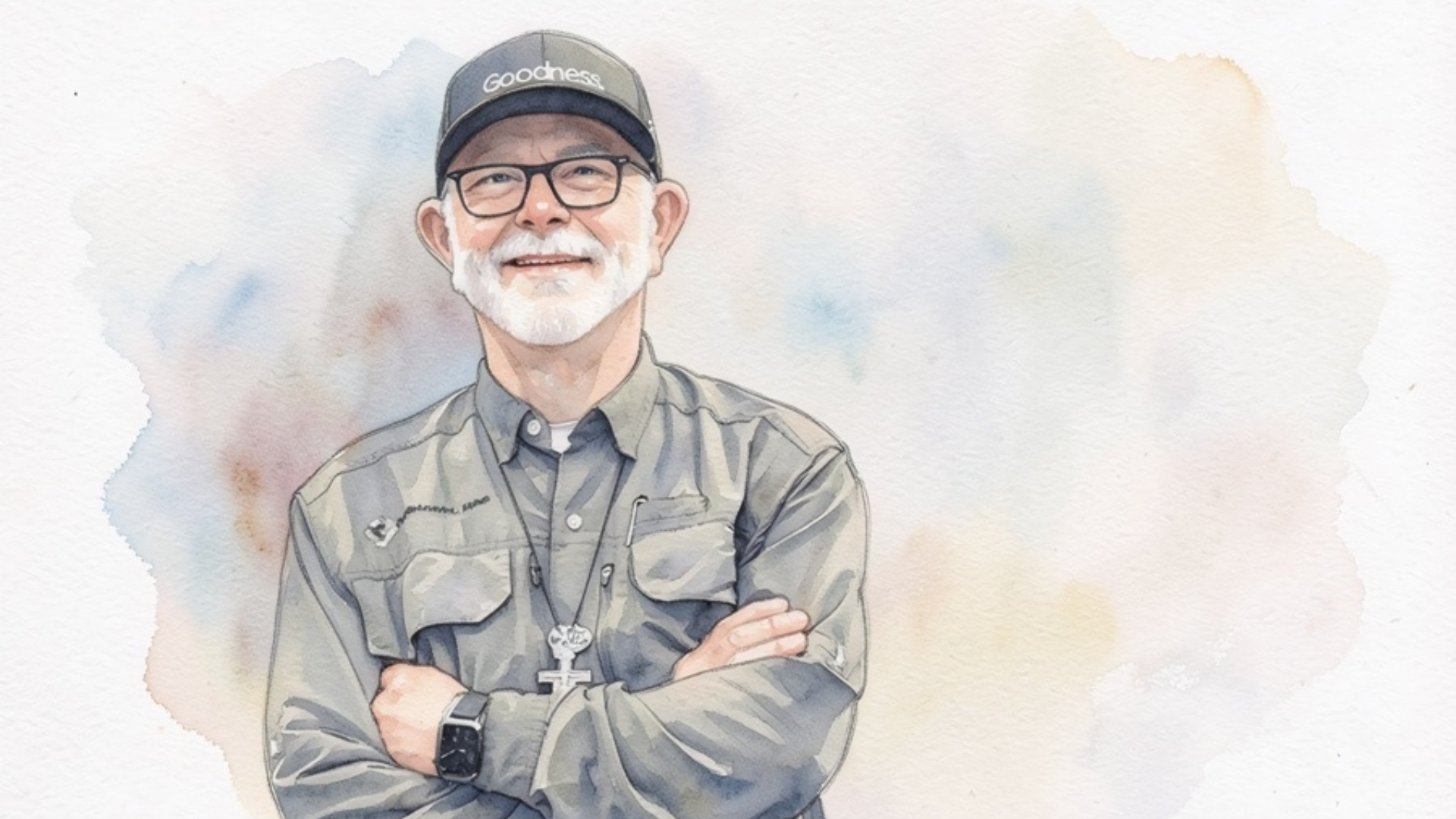
Alan Graham, founder and CEO of Mobile Loaves and Fishes, argues that lasting solutions come from personal engagement and building support systems around the individual rather than distant systems, and he has built a model that reflects that belief.
Graham grew up in the Houston area before moving to Austin in 1976. He pursued real estate after dropping out of college, building a successful career that included commercial development and large financial deals. He says that period brought financial success but little spiritual reflection. His outlook began to change after marrying his wife, Tricia, raising children, and attending a men’s retreat in 1996.
That experience led him to ask God, “What do you want me to do?”—a question he calls “very dangerous” because “you better be ready for the answer.”
That turning point led to the founding of Mobile Loaves and Fishes in the late 1990s. Graham says the idea began as “a side hustle deal to go out and feed people on the street with the catering truck.” He says that it “was never meant, in my mind originally, to end up the way that Mobile Loaves and Fishes has ended up.”
Early momentum came quickly. After launching the first truck, “250 people from our parish signed up to volunteer,” he says, adding, “man, we were on to something.”
Graham’s view of homelessness evolved over time. He recalls an early encounter when he confronted a homeless man while “trying to impress” his future wife. “I went and ripped him a new one… said things like, you ought to go get a job,” he says. That moment stands in contrast to his current perspective. He now rejects the idea that people choose homelessness. “There’s not a 12-year-old kid ever in the history of the world that lay in bed at night dreaming about being a crackhead and living on the streets,” he says. “Resignation, yeah. Choice, no.”
That philosophy shaped the creation of Community First Village, a master-planned community for the chronically homeless. The idea began after Graham saw an RV on a friend’s property and realized affordable housing could take a different form. “What if we built an RV park dedicated entirely to the chronically homeless,” he recalls thinking. That concept became what he calls “a movement,” now replicated in dozens of communities nationwide.
The village focuses on permanence rather than transition. “The goal is to create a permanent place for people to live,” Graham says. Residents pay rent and live in small homes within a neighborhood designed for human connection. “Everybody pays rent. Number one rule,” he says.
The population does often faces significant health challenges, however. “The average age there is about 57 years old. Average age of death is 61,” he says, adding that many residents are “at the end of their deal.”
Graham says stability changes behavior in measurable ways. “Drug use and alcohol use drops about 50% when people move from the streets into the village,” he says. He argues that traditional recovery approaches often fail without housing first. “The $50,000 a month [recovery] deals don’t always work,” he says, pointing instead to the importance of environment and community.
His broader philosophy emphasizes personal responsibility over reliance on government. He points to the principle of subsidiarity, saying “government should only play a subsidiary role… and we have abdicated this responsibility.” He adds that public institutions still play a role by supporting infrastructure, health care, and development, but “we need that human to human, heart to heart contact” to address the root issues.
Graham eventually stepped away from his real estate career to focus entirely on the nonprofit. He describes the shift as gradual, driven by where his “interest level and creativity level” were strongest.
Today, Mobile Loaves and Fishes operates with a large staff and budget, and Graham serves as its CEO. “I’m a pretty well paid CEO… I buy my groceries with money that I earn,” he says, noting that the organization has grown into a significant operation.
Despite that growth, he frames the work in personal terms. “I wake up every day and I have to be vying for number one” among the happiest people, he says. He credits that fulfillment to a mission centered on service. “It’s not about the money,” he says. “It’s about this extraordinary journey that we get to be on.”
Graham says the work is far from finished. Expansion efforts are underway, and organizations across the country are attempting to replicate the model. He encourages people to see it firsthand. “You’ve got to come out and see what we do,” he says. “We would love to have you out and come see what we’re doing.”