
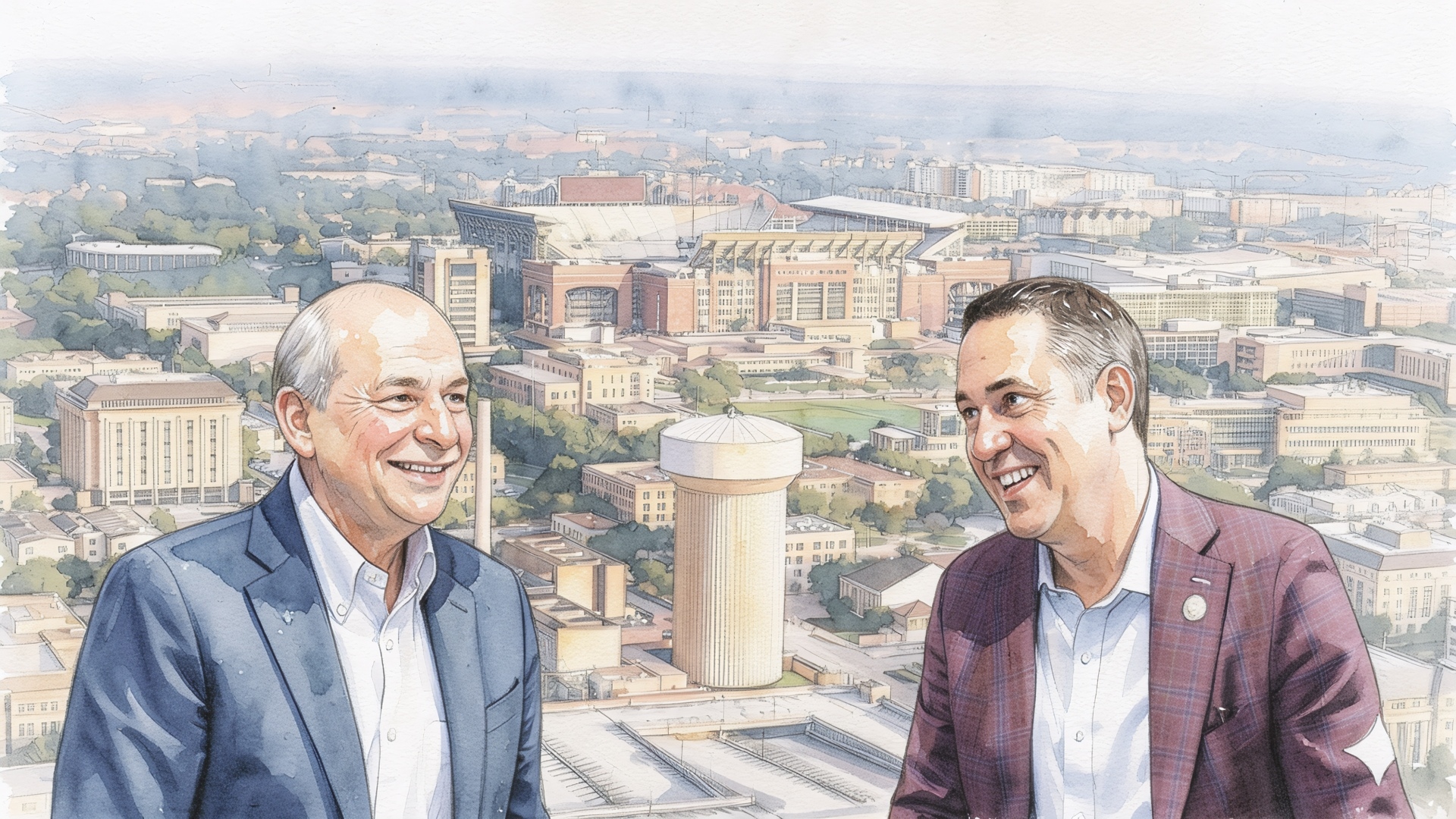
In the center of the world’s eighth-largest economy, a quiet but massive transformation is underway. Texas higher education is no longer just a collection of ivory towers; it has become a sprawling, high-tech engine designed to sustain a state population that is expected to gain up to five million people by 2036. As public institution enrollment hits an all-time record of 1.52 million students, the stakes for the “Texas Miracle” have never been higher.
In the most recent conversation for the Future of Texas series, Texas A&M University System Chancellor Glenn Hegar and Texas 2036 CEO David Leebron dissect the blueprint for this evolution. Their discussion reveals a state that is rapidly moving past traditional degree models toward a future defined by “credentials of value,” “interdisciplinary connections,” and “game-changing breakthroughs” in industries like space, semiconductors, and nuclear energy.
“Texas is a destination,” David Leebron says, observing that just as the state attracts businesses, it has become a global magnet for students who “get here and they see the opportunity, and they like living here”. But with Texas skewed young, the challenge is building enough capacity to catch the coming “population cliff”—a nationwide decline in birth rates that is hitting other states while Texas continues to grow.
Chancellor Hegar, who oversees 12 universities and eight state agencies serving over 180,000 students, views this growth through a regional lens. “We need to continue to add capacity,” Hegar explains, “and adding capacity… is in our regional universities across the state”. These institutions serve as the “backyard” anchors for students who cannot afford to leave their communities for a flagship campus. By providing these local gateways, the system is engineering an “economic change” that impacts families for generations.
As the cost of living climbs, the question “Is it worth it?” looms over every admissions office. Texas 2036 data shows that while 90% of Texas students graduate high school, only one in three currently completes a postsecondary credential. For the state to succeed, this must change: by 2031, 61% of Texas jobs will require postsecondary training.
“Are their incomes afterwards reflecting the value of those credentials?” Leebron asks. The data offers a resounding yes: while a higher education degree provides a 60% income increase nationally, in Texas, that “premium” is closer to 80%.
To bridge the affordability gap, Texas systems are deploying aggressive financial models. At Texas A&M, 63% of students graduate debt-free—a figure that far outpaces the national average of 45%. Hegar attributes this to keeping tuition flat for years and leveraging regional networks where students can “live and work in home and go to school”. Meanwhile, systems across the state are expanding free tuition for families earning under $100,000, ensuring that first-generation students don’t have to guess if they can afford their future.
Beyond the classroom, Texas universities are functioning as R&D powerhouses for the federal government and private industry. Chancellor Hegar is currently presiding over some of the most “audacious” bets in the state’s history.
In Houston, the Texas A&M Space Institute is preparing to open a $200 million facility adjacent to the Johnson Space Center. It will house the world’s largest indoor moonscape and Mars scape, a four-story facility designed to position Texas as the “center of two generations of future exploration”. Hegar sees this as a “generational impact” that ties back to daily life, from GPS-coordinated farming to lunar mining.
Anchoring the “Silicon Prairie,” A&M is building a $226 million Semiconductor Institute on its RELLIS campus. Hegar describes it as the “most expensive per square footage building” in the system’s history, but its true value lies in national security and the global supply chain. By creating world-class clean rooms and R&D labs, Texas is ensuring that the chips found in everything we touch are “sourced here in Texas”.
Facing a future where AI data centers and space exploration will triple energy demand, the A&M system is making a “potentially big bet” on nuclear fission and fusion clusters. Hegar envisions the RELLIS campus as an “applied research campus where we test, we break, we figure out how to do it better” to solve the country’s energy gap.
One of the most striking elements of the current Texas boom is the level of inter-institutional partnership. “Competition is not a bad thing,” Hegar says, but he emphasizes that the “next step in game-changing impacts” requires collaboration between A&M, the University of Texas, Rice, and Texas Tech.
Leebron agrees, noting that the “separation between universities and industry” has evaporated. Institutions are now building ecosystems—like the Ion in midtown Houston—where startups, established industries, and researchers “thrive off each other’s technology”. This collaboration is essential because, as Leebron puts it, “When there’s innovation, industry is going to flock to the location that there is talent and discovery”.
How will Texans know if these investments are working? Leebron points to data and accountability as the key metrics. The state is focusing on “college, career, and military ready” standards, as well as overhauling community college funding to reward student outcomes rather than just enrollment.
“Unlocking the real potential of this system” is Hegar’s top priority leading into the bicentennial. For him, success in 2036 means more than just a eighth-ranked global economy; it means developing “men and women that have leadership capabilities and the foundation bedrock of character”.
The vision shared by Hegar and Leebron is one where the “Texas Miracle” is no longer an accident of geography, but a deliberate construction of human capital. As the state builds the labs for Mars and the factories for the next generation of chips, the goal remains singular: to ensure that for every Texan, “a fair shot at success” is not a slogan, but a reality.
The Future of Higher Education in Texas This video features the full discussion between Chancellor Glenn Hegar and David Leebron regarding the strategic decisions shaping the future of Texas’ higher education systems.