
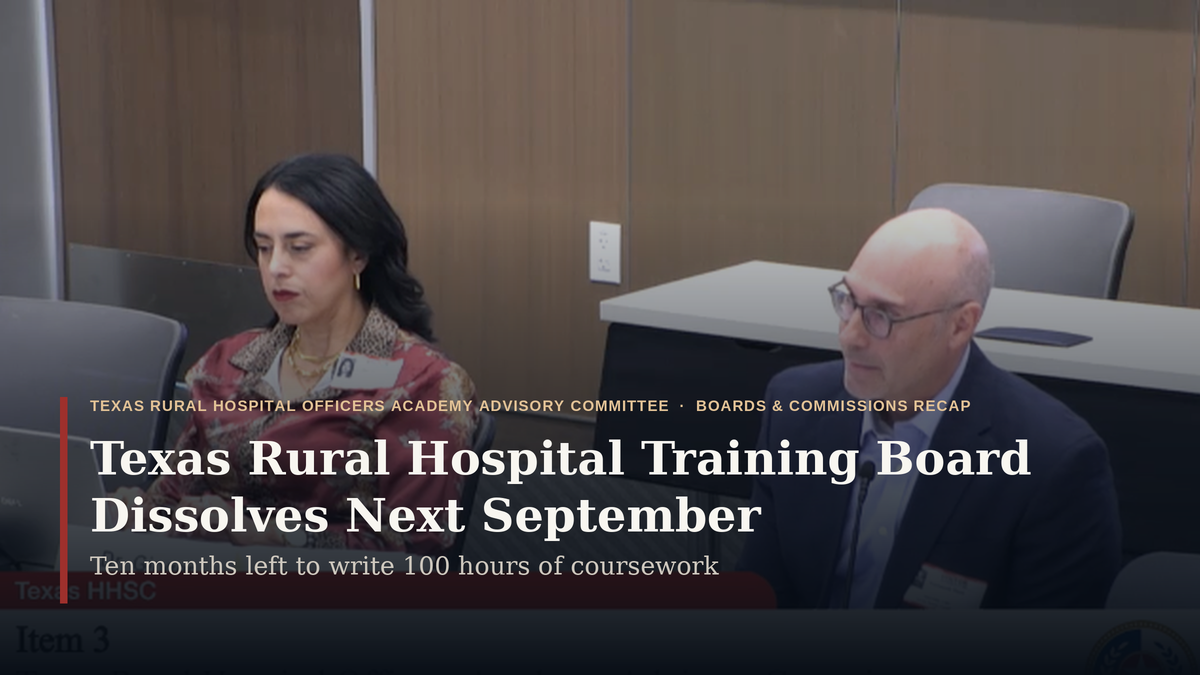
Texas owes the people who run its 156 rural hospitals a free management school, and the nine-member state committee writing the coursework has until Sept. 1, 2027 to deliver it — the day the law puts the committee out of existence, finished or not.
The school is for the “board directors, chief executive officers, hospital administrators and other senior-level roles” who keep a rural hospital solvent. A rural hospital here means one in a county of 68,750 people or fewer, or a small hospital Medicare treats as the only one for miles. The coursework is to run at least 100 hours every year on billing, regulation, revenue and running a building. Four university systems will teach it — Texas Tech, Texas A&M, the University of Texas and Texas State — and none may charge a student or skip offering to cover travel.
What stands between that promise and a syllabus is the committee that met Oct. 19. The law says the committee (§526.0305)
“Is abolished on the earlier of: (1) the date the advisory committee adopts a curriculum; or (2) September 1, 2027.”
That is not a reporting deadline that slips. It ends the committee, not the academy, which carries no expiration date in the law. But the committee is the only body the statute charges with overseeing the curriculum, and by the health commission’s own account the universities administer the academy only once a curriculum has been adopted.
The committee started behind. On National Rural Health Day in November 2025, the commission said “HHSC will begin developing curriculum for the academy early next year.” The committee did not hold its first meeting until July 13, 2026. The Legislature had told the agency to sign the university contracts by Dec. 1, 2025 and to appoint the committee by Jan. 1, 2026; neither set of dates has been published, so whether those deadlines were met cannot be established. What can is that curriculum work began in July, about ten months before the leaders it is meant for are supposed to start class.
The posted agenda lists one substantive item among the housekeeping: “Discuss Overarching Curriculum Pillars” — the broad subject areas the coursework will be built around, the frame rather than the courses. What was said about any of it is unknown: the meeting ran two hours and 49 minutes, the archive served no transcript, the video carries no captions, and the commission’s page for the committee carries no minutes of any of its meetings.
By the Dispatch’s own count from the schedule the commission publishes, the committee has eight meetings in all — about 28 scheduled hours — to frame 100 hours of instruction, and four of them are already behind it. That figure describes what is posted, not what is possible: the schedule is marked subject to change, the committee may add meetings, and the subcommittees and the universities do work that never appears on it.
There is a fair case that none of this is alarming, some of it from the committee’s own side. The academy was always contingent on an appropriation, and the Legislature gave the agency three months from the law taking effect to contract with four university systems. A committee that finishes early dissolves early, which is what the law intends. Texas State’s delegate on the committee, Melinda Villagran, who directs its Translational Health Research Center, described the task in May 2026 as having to “create a program that gets approved by the state”, and the same account put that approval at March 2027 — five months before the committee’s life runs out. The commission has published no such milestone; its only stated date is fall 2027 enrollment. The Dispatch has reported that the larger rural health pot moves into contracts slowly, and covered another provision of the same law in July.
One of the nine seats the commission filled belongs to a rural hospital, held by Diane Moore. The other eight go to the health commission, the state health department, the insurance department, the state auditor’s office and the four university systems. The single rural-hospital seat is the Legislature’s; the statute fixes no total, so the rest is the agency’s.
No rural hospital, trade association, legislator or advocacy group has taken a public position on the curriculum or on the committee’s pace. That is not the same as nobody watching: the House Public Health Committee took testimony in June on how this law is being carried out — from the health commission, the rural hospital association and one of this committee’s own members — and nothing in that record addressed the curriculum’s schedule.
The committee meets next on Nov. 9, from 1 to 4:30 p.m. Its published calendar ends after Feb. 8, 2027. Its authority ends Sept. 1, 2027.
Minutes nobody can read. The committee was down to consider the draft minutes of its Sept. 14 meeting. The commission’s page for the committee carries no minutes of any of its meetings, so the record of three prior meetings is not readily available to the public. Three subcommittees, no notices. Cost reporting, revenue cycle and strategic planning each had an update slot. None of the three appears on the committee’s published meeting calendar, and whether their meetings are separately noticed could not be determined. Bots barred. The meeting notice states that “The use of artificial intelligence (AI) bots is prohibited in this meeting” and that producers will remove any that gets in. That governs admission to the videoconference; it is not a restriction on the archived public record, and nothing in this story was gathered from inside the meeting.