
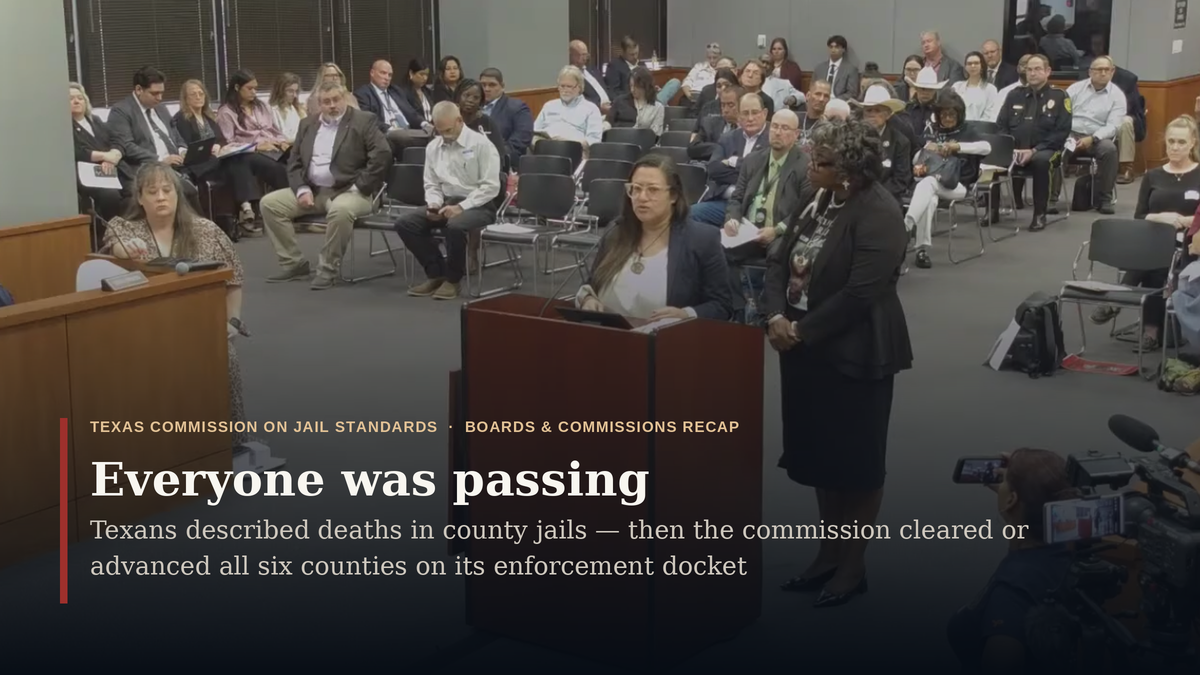
The Texas Commission on Jail Standards spent the first hour and more of its quarterly meeting Thursday listening. Mothers, wives, nieces, a stepfather, a nurse, a Navy veteran and a former state representative came to Room 170 of the Stephen F. Austin Building and described, one after another, people who went into Texas county jails and did not come out.
Across the whole of the recorded testimony, there was no substantive reply from the dais — no question, no answer, no acknowledgement of a single case. What they do preserve is procedural: names read off a list, “Thank you,” a reminder that speakers must be present when called, two warnings that a speaker’s time had run out, one negotiation with a woman who spoke out of turn, and one ruling on decorum — “Order. Want to have order in here. No cross discussions or I’ll have you removed.” The posted recording opens mid-testimony.
Then the chair said: “And on that note, I will close public comment. Move on to item number five, old business.”
What followed was the commission’s actual enforcement docket — six counties under a notice of non-compliance, a remedial order, or both. One by one, every one of them was reported to be improving. One had its remedial order lifted outright. The word the executive director used, county after county, was compliance.
The first county called was Bexar.
At least five of the morning’s speakers had described conditions in the Bexar County Jail. Lydia Leos, whose son Julian died there, told the commission she was not called while he was dying. “I was not notified while my son was fighting for his life,” she said. “I was not notified when he required emergency [medical care]. I was not notified when every minute mattered. Instead, I was notified approximately 10 hours later after my son had already died. Those 10 hours can never be returned.”
Anthony Pastello said he had first entered the same jail in 1994, at seventeen, and described what he says happens when the state’s inspectors are due: “They try to before you guys show up for your visits, the first the whole month before that is a whole team getting ready for you guys… And the minute you guys walk out, it’s all back to normal.”
A woman who gave her name as Rosita said she had been held in the jail three weeks and described the treatment of pregnant women, then alleged that three deputies had phoned her the afternoon her son was arrested demanding $900 by Zelle or Cash App to put him in a diversion program.
And the last person to speak, apparently out of turn, was Victoria Sarca Bara, who said her husband had gone two and a half weeks in the Bexar County Jail without his PTSD medication. “All I’m asking is for you to save my husband before he ends up another statistic,” she said, “because to me he’s Jonas. To everybody else and to [Bexar] county he’s 970126.”
Bexar County Sheriff Javier Salazar was in the room. He had come to Austin for exactly this item. “We are looking very much looking forward to passing hopefully passing our next comprehensive inspection and coming off that list of enhanced supervision,” he told the commission. “I’ll open it to whatever questions you all might have.”
The answer, in full: “I don’t have any questions at this time.” Chairman Lowe went straight on to report that Bexar had passed the first of its two comprehensive inspections in February, and recommended the commission “continue to monitor until that second inspection.” Nothing said that morning about that jail was put, on the record, to the sheriff standing in front of them. He was thanked and he sat down.
The pattern held. Harris County — whose jail has been under a remedial order since 2024, and where a commissioner Porsa recused himself — reported that it had passed an unannounced comprehensive inspection in July, that it had cut its out-of-state population by 100 in July with another 150 planned this calendar year, and that emergency-room transfers were running about 260 a month with zero delays for lack of a transport officer, down from 34 delays in December. The fire panels were fixed. “With that Harris County is currently in compliance,” Armstrong said. “So we no action needed this.”
Leon County’s acting jail administrator described monitoring “every booking, every medical screening, every medical record.” Armstrong: “they are in compliance and waiting to pass hopefully another second inspection. So at this time we have no recommendations.”
A commissioner asked whether the pressure stayed on — “do we still need to do the enhanced enforcement?” — and was told: “Yes.” Earlier that morning Jennifer Belnap had described her son’s death in the Leon County jail, and the passing of blame that followed it: “MHMR blamed the jail. The jail blamed the medical provider. The provider blamed county protocols. All to dodge legal liability.”
Liberty County reported it was finishing the exhaust-fan replacement and would complete training by October 31. San Patricio said its main problem was a roof leak and was told: “See you back here in November.”
Robertson County produced the docket’s only vote. It had passed both comprehensive inspections, the most recent in July, and had written asking that its remedial order be lifted. Its representative told the commission it had “added a lot of policy and procedure that was absent before” and thanked the agency for its help. Armstrong recommended lifting the order. The chair: “I have a motion. Do I have a second? I have a second. Any other discussion? Hearing none, I’ll call for the question. All those in favor signify by saying I.” Then: “Any opposed? Motion carries. Congratulations. Great job.”
Six counties under enforcement. One order lifted, five progress reports, no new finding of non-compliance, and no county-specific question drawn from anything said in the morning.
“Item six, new business. We have none.”
The distance between the two halves of the meeting has a number attached to it. The co-founder of the Texas Jail Project pointed commissioners to a packet — “I think you have a packet in front of you” — and gave them the numbers in it: “As of August 4th, there were 78 reported custody deaths” in Texas jails this year. “79% of the people who died in custody this year… were [pre-]trial legally innocent. The actual number is most likely higher. Between 2021 and 2026, 85% of people who died were pre-trial.”
Several speakers argued the official count is itself the problem. Victoria Rogers said her uncle died in the Tarrant County jail after fourteen days, the fifth person to die there this year and, she said, the seventy-eighth since 2017. Charges were dismissed minutes before he died. “At 4:32 p.m., he was technically released from custody. 9 minutes later, his shackles were removed. 5 minutes after he was pronounced dead,” she said — a sequence that does not add up as the machine rendered it, and which the Dispatch has not reconciled.
Her conclusion: “14 minutes determined whether my uncle’s death would be counted as an in custody death or just disappear from the official record.” The Texas Jail Project described a second case the same way — a man who spent six years pre-trial, was fatally attacked three weeks after a plea that already left him over a thousand days of credit, and whose homicide the commission does not count because the prison system released him as he lay dying. “The commission staff is well aware of this case,” the speaker said. “We’ve had numerous conversations about this.”
Two speakers went directly at the agency. Nan Terry of the Justice Network of Tarrant County read back Armstrong’s own letter transmitting an inspection report to the Tarrant County sheriff — a letter praising “dedication and professionalism in maintaining a safe secure environment” and telling county residents they “should be proud.” “I, for one, as a county resident am appalled,” she said. “Did you miss the 21 deaths that are not investigated as required by the Sandra Bland Act…? Did you forget the two jailers on trial for murder of Anthony Johnson?… I’m appalled. I am not proud, sir.”
Lon Burnam, who told the commission he served eighteen years in the Texas House and had spent twelve hours that week booked into a county jail as an inmate, said he had come about something he had heard attributed to the executive director. “It is alleged that it was said in public that the commission’s job is to quote unquote reduce the liability of the sheriffs,” he said. “If that was said or anything close to this, we need for the assistant AG to explain the job of this commission.” He closed: “If any of you have not had an opportunity to review the law that creates this commission recently, you should cuz you’re not doing your job.”
Neither remark drew a reply.
There was one more place the morning could have landed, and it is the item the Dispatch previewed a week earlier: the public petitions. Three members of the public — named on the agenda as Alirma Davis, Paula Keeth and Leroy Jones — have asked the commission to write a rule against over-detention, holding people past the moment their release is legally due.
Texas jail standards set no deadline for acting on a dismissal, a posted bond or a signed release order, and no state agency tracks how often it happens — a finding from the Dispatch’s July 29 preview, which reviewed every chapter of 37 TAC Part 9, and from the Texas Tribune’s reporting in March.
Armstrong told the commission the petitions had gone to the administrative rules committee, and then explained why nothing had happened to them: “Our administrative rules committee was unable to meet this quarter and so they’ll be talked about more in the next meeting.” His recommendation was “just send this back to let them finish working.”
Lydia Leos’s petition — the one she had come to speak to that morning — did move. Armstrong said staff had drafted language and met with the Sheriffs’ Association of Texas, which supplied wording of its own, and asked that both go to the rules committee for review. The text he read aloud covers notifying next of kin for people “hospitalized for more than seven days,” admitted to an intensive care or cardiac care unit, undergoing general anesthesia, or entering hospice. That is narrower than what Leos asked for from the microphone — notification “without unreasonable delay” whenever a person in custody suffers a life-threatening medical emergency, is transported to a hospital, or dies.
The meeting at a glance
Issue
The commission’s quarterly enforcement docket — six county jails under a notice of non-compliance, a remedial order, or both — taken up immediately after more than an hour of public testimony about deaths and medical neglect in several of the same jails.
When
Thursday, August 6, 2026, 9:00 a.m. CT.
Where
Room 170, Stephen F. Austin Building, 1700 Congress Ave., Austin.
Governing body
Texas Commission on Jail Standards — nine members appointed by the Governor to staggered six-year terms, created under Government Code ch. 511 to set and enforce minimum standards for Texas county jails. Chair: Sheriff Kelly Rowe, Lubbock County. Vice-Chair: Dr. Esmaeil Porsa. Members: Sheriff Richard C. Kirkpatrick; Commissioner Ben Perry; Duane Lock; Ross Garrick Reyes; Monica H. McBride; Patricia M. Anthony; Judge Joseph “Joe” Fauth III. Executive Director: Ricky Armstrong, interim February 5, 2026, confirmed May 7, 2026, succeeding Brandon S. Wood.
Archived video
“TCJS August 6 Quarterly Meeting” (2:01:00), Texas Commission on Jail Standards YouTube channel, streamed live August 6, 2026.