
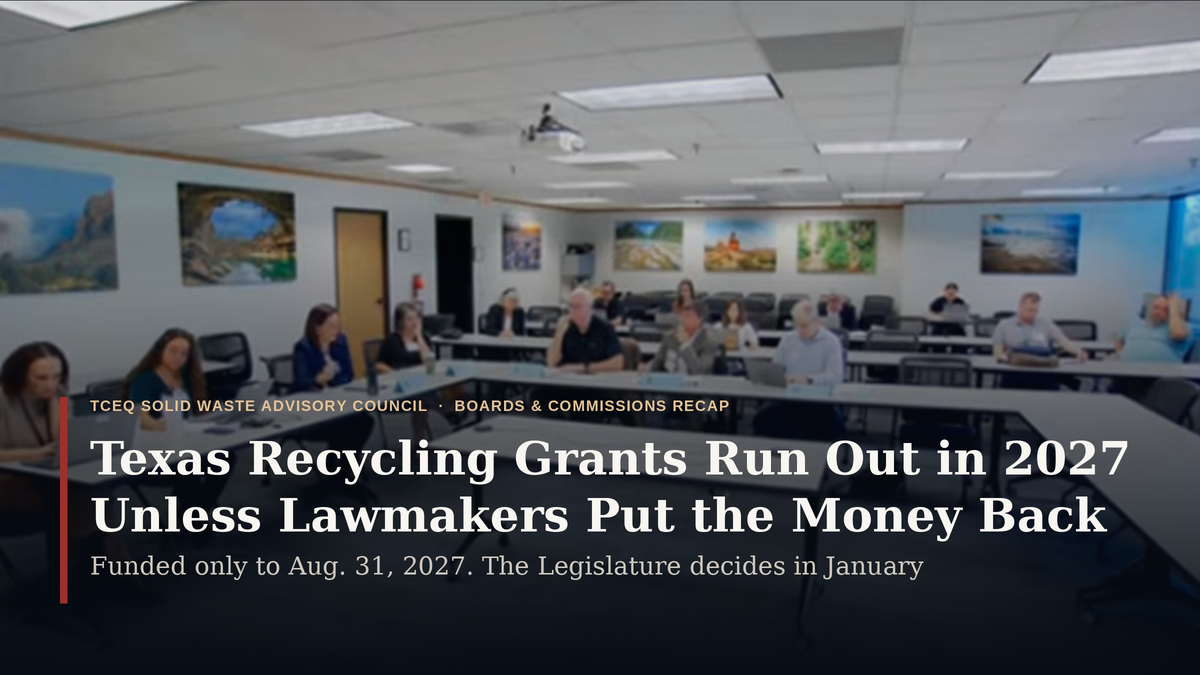
The money that pays for recycling and waste planning across all 24 of Texas’ regional planning areas runs out after Aug. 31, 2027, unless state lawmakers put it back. The Municipal Solid Waste Management and Resource Recovery Advisory Council, which advises the Texas Commission on Environmental Quality on how that money is used, was told Oct. 8 that the agency had taken the entire $5,493,162-a-year line out of its next budget request.
The money is not the agency’s to keep. State law dedicates a third of what Texans pay in solid waste disposal fees to local and regional projects, allotted to planning regions by a formula weighing population, area, fee generation and public health need (§361.014(b)). In practice that means the 24 councils of governments, which the agency says use it for inventories of closed landfills, regional waste plans, and local recycling and diversion work.
The order came from the top. In July the governor, the lieutenant governor and the House speaker jointly told state agencies to build their 2028-29 requests around a 3 percent cut to base funding. The agency met that order out of four programs, Charly Fritz, deputy director of its waste permits division, told the council: cleanups of Superfund sites, leaking petroleum storage tanks and dry-cleaner contamination were cut back, and the solid waste grants were cut entirely. It then asked lawmakers to hand all $20,546,702 of it back as an exceptional item, a request that rides outside the base budget, as the Dispatch reported in August.
“So to meet the cut, we cut those grants and then ask for the money back,” Fritz said. The grants are the largest single piece of what is being asked back. The budget document does not break the request down by program, but the figures reconcile: twice the $5,493,162 grant line is about $11 million, and the $3.4 million, $4.2 million and $1.9 million staff gave the commissioners in August for the three cleanup programs account for nearly all the rest.
The council is no bystander. Its charge, as the commissioners themselves describe it, includes recommending “policies for the use, allocation, or distribution of the planning fund”. A member told Fritz that a scenario in which all of that money goes away was “problematic” for the state, then put the harder question: “is that in violation of state law?” Fritz answered on authority rather than legality. There are, she said, “other tasks and programs in statute that the agency can do. It’s whether or not we have the funding.”
The room got one thing wrong. The same member said he understood state law to send half the fee revenue to the grants, and nobody at the table corrected him. It sends a third; the other 66.7 percent goes to the commission’s own permitting, enforcement and cleanup work. Members recalled a “50-50” arrangement changed in an earlier session.
Where the loss would bite hardest is not where the money is largest. The formula sends the most to the big metropolitan regions, but two members said small communities have the least to fall back on. Steve Shannon, of the State of Texas Alliance for Recycling, who holds the private conservation seat, called the grants “essential in the mechanics of getting solid waste services to rural counties” and said they “need to be preserved and in my view expanded”. Brocke Lively, solid waste superintendent for the city of Plainview, said that in his part of the state, “this is the only way they look into any kind of recycling is through those grant opportunities”. He described a single hauler’s route crossing four counties to reach farm households.
The agency is defending the arithmetic more than the cut. It asked for every dollar back, and no jobs ride on the request: the restoration item carries no new positions, while the agency’s five other exceptional items add 126. Fritz said the grants were picked partly “to keep our headcount”, and that budget board staff asked nothing about the grant. The fees keep arriving either way. Money that is not appropriated, she said, “stays in account 549”.
Nothing is settled. The 90th Legislature convenes Jan. 12, and the request must survive the budget writers before it reaches the agency’s appropriation; Fritz said she did not know whether the House or the Senate would originate the bill. She agreed to give the council a list of lawmakers to press once committees are named. The council meets again Jan. 7. On Nov. 4 the commissioners filled its planning-region seat — empty that day, and the one that speaks for the regions whose money is at stake — appointing Harold Womble of the Brazos Valley Council of Governments to a term ending Aug. 31, 2027, the day the grants would lapse.
A rewrite of the rules for building over closed landfills, five-year-old groundwater reporting going electronic, and a longer grace period for expired licenses. Staff are rewriting Subchapter T, the rules covering use of land over closed municipal landfills, after what a work leader called a significant rise in applications since 2017 — parking lots, trails and soil borings over buried waste, and occasionally enclosed buildings. A draft was promised to the council in November. A separate rulemaking headed for the commissioners Dec. 16 would give lapsed license holders 180 days to renew instead of 30, at a penalty fee, and let them keep working for 90 days while a renewal is pending. One member said she had lost decades of licensure after mail delivery failed and she missed the old deadline. The groundwater e-reporting system, five years in the making, opens to filers in January 2027 and will not be public-facing.