
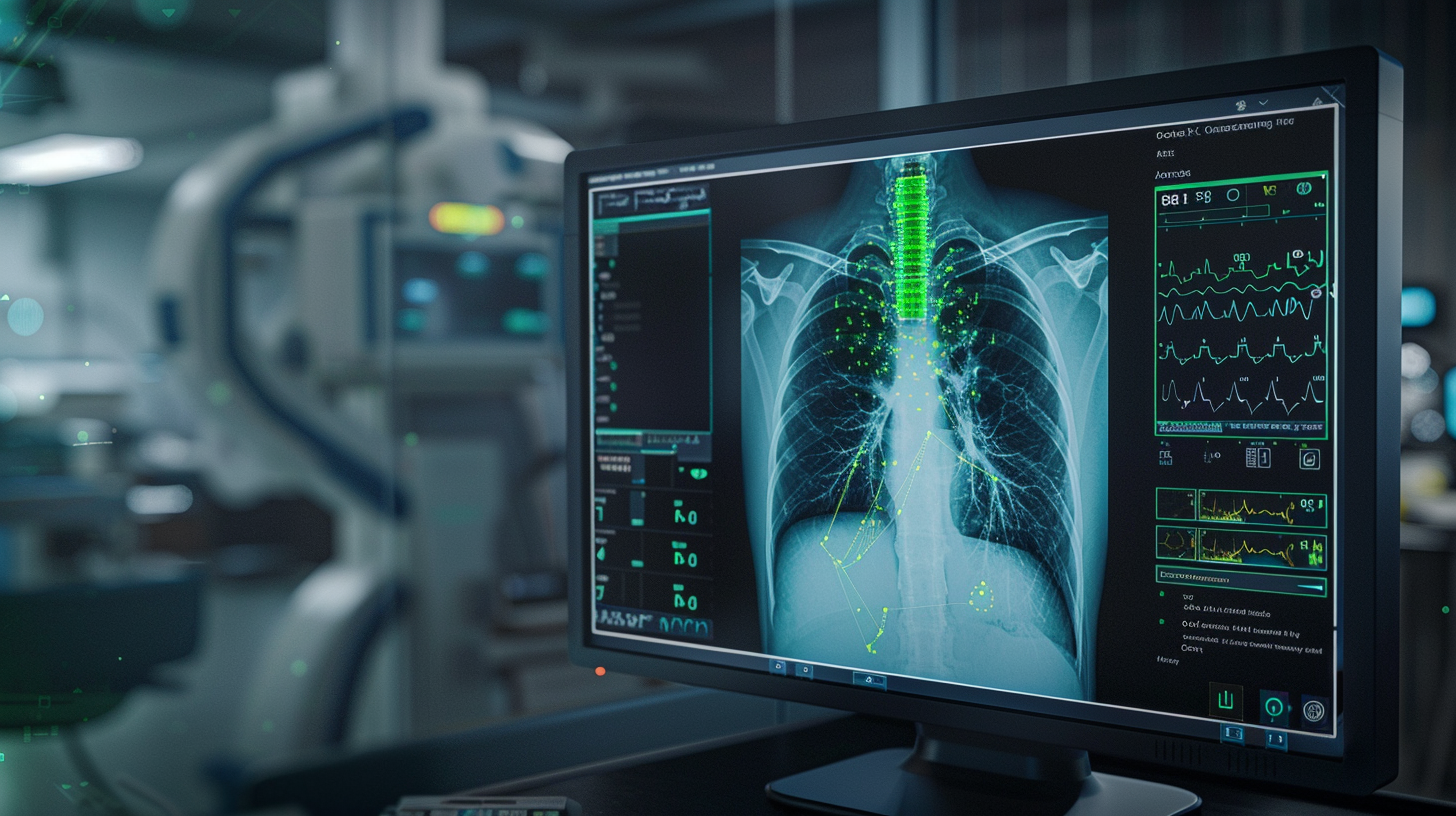
Picture an emergency room a few years from now. You walk in at 2 am – maybe you have a broken foot or are experiencing chest pain; maybe your child needs an X-ray. Whatever the scenario, your scan gets read, and then, automatically, it gets a second look. Every fracture, every shadow, every early-stage cancer is checked again before you ever leave the building. Nobody asks whether you can afford it. It isn’t a perk of some kind of concierge care or a surprise line item on your bill, it’s the minimum standard. And in every downtown trauma center and rural clinic alike.
This isn’t science fiction. The software to deliver that second look exists right now. But that future hasn’t arrived.
In San Antonio, there are two very different experiences of healthcare, and as a practicing radiologist, I see it clearly every night.
After the sun goes down, I sit down to read roughly 200 chest X-rays, CT scans, and MRIs from patients at our community hospital. The best available evidence tells us that about 4% of my interpretations and my colleagues’ will contain an error. That’s roughly eight patients every single shift whose fracture, infection, or cancer might be missed. For those who can afford concierge-level care, their scans often get a second or even third set of expert eyes. But save for a few specific use cases and well-resourced institutions, the majority of patients here in San Antonio, across Texas, and around the world get no second look. No safety net. A missed diagnosis is simply a missed diagnosis.
That reality is what drives my work as a doctor and the mission of my San Antonio-based company, Zauron Labs. We are building artificial intelligence software & services that can drive that 4% error rate down toward zero – at no additional cost to the patients we serve. Our goal is simple: tear down the paywall that currently separates high-quality, low-error healthcare from everyone else.
None of this game-changing technology is possible without cheap, abundant computing power. Most people picture AI development as something abstract involving frontier labs, chatbots, debates about jobs. My experience of it is more mundane. On my screen, next to the patient scans, is a dashboard showing live prices and availability for GPUs, the specialized chips that train our models. I check it the way a driver glances at gas station signs. Too often, it reads like an “out of gas” sign: zero available, or a price no community hospital could ever justify. When that happens, a model that should take days to train takes a month, or never gets built at all. What never slows down, though, is the steady stream of patients who continue to arrive at our hospitals without that extra layer of protection.
Datacenters are the engine that makes this possible. The same infrastructure powering ChatGPT for your workday is the same resource that lets me build life-saving medical AI after hours. Datacenters are not luxuries – they are essential infrastructure for 21st-century medicine.
This is why efforts to slow the pace of AI by blocking or de-incentivizing regional datacenter construction are shortsighted. When compute is scarce, AI development doesn’t stop – it warps. Instead of companies competing fiercely to deliver the most value to patients and doctors, they compete for control of limited resources. The result is higher costs, fewer options, and the rise of “concierge AI” – premium intelligence available only to those who can pay, while the rest of us make do with less.
When compute is plentiful and accessible, the opposite happens: innovation accelerates, prices fall, and the benefits spread broadly. That is the path that can finally extend world-class diagnostic accuracy to every patient who walks through our hospital doors, not just the privileged few.
Datacenters can and should be built and managed responsibly. With smart electricity rate protections and reasonable zoning, we can expand this critical infrastructure without compromising our communities or our grid.
Every month we delay data centers development is another month in which preventable diagnostic errors continue to occur – errors that AI can help us prevent. As some states are pumping the brakes on AI development and its infrastructure, Texas risks following suit and denying Texans the best-possible care at the lowest cost.
The choice before us is clear: we can stop data center construction and succumb to the status quo where healthcare costs continue to rise and quality care is reserved for the few, or build abundant compute infrastructure and give life-saving care at no added cost to every Texan, and every American.
—
Kal Clark, MD is the Vice-Chair of Informatics and an Associate Professor of Radiology at UT Health San Antonio and Cofounder and CEO of Zauron Labs