
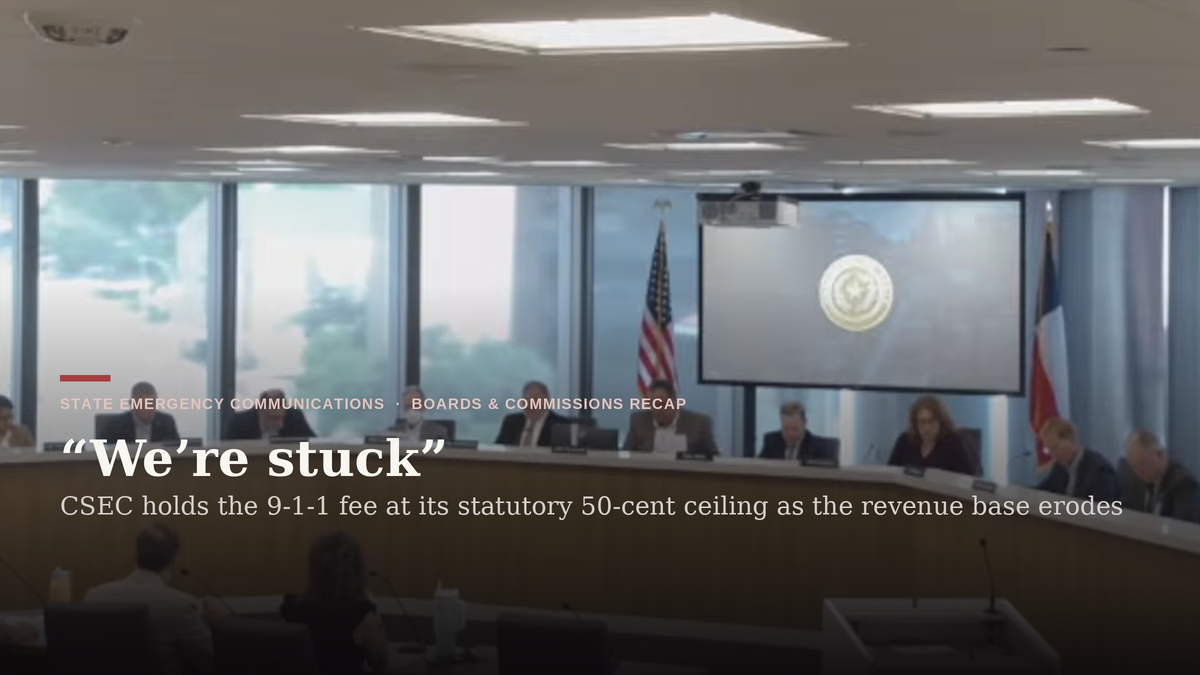
The Commission on State Emergency Communications spent more of Wednesday morning on a vote whose outcome was never in question than on any other item on its agenda. The vote was to leave the 9-1-1 fee exactly where it has been since the day it was created: 50 cents a month, per line, the maximum the Legislature allows.
What made it take so long was that nobody on the commission seemed to think 50 cents was going to be enough.
Chief financial officer Lorrain Meek laid out the arithmetic. Commission rule 255.1 requires the board to review and adopt the regional planning commission 9-1-1 emergency service fee and the statewide equalization surcharge every year. The service fee, she said, “is currently set at the maximum rate of 50 cents per month per non-exempt line. This rate has not changed since its inception.” The equalization surcharge sits at 6 cents against a statutory ceiling of 10.
Together those two charges brought in about $47 million in 2025 and are projected at roughly $48 million for 2027. That projection, Meek told commissioners, “can only fund a portion of what’s needed for to maintain the current level of 911 and… poison program… services appropriations and the remainder will need to come from the fund balance and general revenue.”
On the surcharge she had run the alternatives. Holding at 6 cents leaves the program “in excess of $215,000.” Dropping to 5 cents — the only direction the commission had any legal room to move — “we would be at a deficit of $3.4 million.” Staff recommended no change to either rate.
The board’s Presiding Chair, James Beauchamp’s, reaction was less a question than a summary of the commission’s position in state government. “That was a long exploration Lorrain for the fact that we can’t touch most of this anyway by law,” he said. “So it is what it is.” Commissioner Clint Sawyer tried to confirm it: “Is that why we’re leaving it at 50 is because it’s statute.” Told that 50 cents was the cap, he pressed — “So that needs to change somewhere, right?” — and then answered himself: “it’s not in our… we can’t do something about it here but somewhere somebody can.”
“You’d be a lawbreaker if you try to do something about it here, Clint,” the Beauchamp said. “So, we’re we’re stuck.”
Then a commissioner asked the question the rest of the discussion turned on: “when do we think the fund balance will be depleted?”
The answer was that staff has an estimate running out to 2032, at which point the agency returns to the constrained position it was in several years ago. But the more consequential part of the answer was about what the fund balance does in the meantime. “As long as that fund balance is sitting there,” the reply went, “there’s probably going to be an unlikely chance of seeing increases in that 50 cents.”
Money in the bank is the argument against raising the fee — and CSEC’s balance is not shared by everyone the fee funds. “This is actually hurting our other partners that… rely on fund balance… that don’t… have the benefit of the fund balance if you will and they’re wanting to increase that 50 cents.”
That is the structural problem in one sentence: the reserve that keeps CSEC solvent is the reason the fee stays frozen for the emergency communication districts and regional councils that have no reserve.
“So it goes back to again where does that process start in a legislative session?” Russell asked. “How are we working with our partners on this issue… to make whole our 911 system that obviously cannot support itself… in the current financial status.” Someone in the room observed that this had “opened up [a] can [of] worms.”
Commissioner Cathy Skurow pushed for a schedule rather than a sentiment. “We need to start working on it and we’re saying it needs to be done… at what point, you know, do we have a time? Let’s work on a schedule. Let’s work with all our partners and making sure that we’re on a… path that… that’s going to lead to a… successful and beneficial ending.”
Beauchamp redirected her to sequence. “The first thing you have to do is really look at the structure of the current fee setup today and its ability to maintain current revenues, which doesn’t exist, and you have to… deal with that first to have that broader discussion.”
She agreed, and named the deadline she was worried about. “Somebody that’s representing on this commission a different entity that’s not party to the fund balance… the longer that fund balance sits there… the less likely that… these fee would be increased… for the benefit of the other two entities that don’t receive that… balance. So, that’s what I’m struggling with right now. And I want to make sure that… we’re trying to get this resolved in a timely way instead of having a… showdown at the Texas legislature.”
“Ultimately, that’s where it’s got to occur though,” Beauchamp answered — and then closed the discussion: “question for today though is do we want to approve these rates as presented by Lorrain?”
They did. The fee stays at 50 cents and the surcharge at 6 cents for 2027.
The case for why that matters had already been made an hour earlier, during the commission’s approval of its Strategic Plan for Statewide 9-1-1 Service for fiscal 2027 through 2031. Reviewing the revenue trend lines, the Beauchamp told the room what the composition of the fee base now looks like: “landlines are going down precipitously… particularly on that revenue. Cell phones are going up, but certainly not to the percentage increase that landlines are going down. It’s not an equal phase out there.” VoIP revenue was growing. Prepaid wireless was the anomaly — “every other state in the nation prepaid wireless revenue is going up… Ours is is not,” he said, raising the possibility of a collection problem specific to how Texas rules treat prepaid sales.
His conclusion was the one the rate vote could not act on. “We’ve really got to look at that on the legislative front — not necessarily what the fee is per se but the actual structure of those fees today,” he said, “because left in their current state two years from now we will generate less revenue, two years from then we’ll generate even less revenue, and this program becomes more of a burden onto the state.”
The meeting at a glance
Issue
Annual rate setting under commission rule 255.1 for the regional planning commission 9-1-1 emergency service fee on landline and VoIP lines, and for the statewide equalization surcharge.
What happened
The commission adopted staff’s recommendation without change: the 9-1-1 service fee stays at 50 cents per month per non-exempt line — the statutory maximum, unchanged since the fee was created — and the equalization surcharge stays at 6 cents against a 10-cent cap.
When
Wednesday, July 29, 2026; called to order 10:01 a.m. CT
Where
George H.W. Bush State Office Building, 1801 Congress Ave., 4th Floor, Board Room 4.300, Austin.
Archived video
youtube.com/watch?v=h9dvxyC1m58 — Commission on State Emergency Communications Open Meeting July 29, 2026