
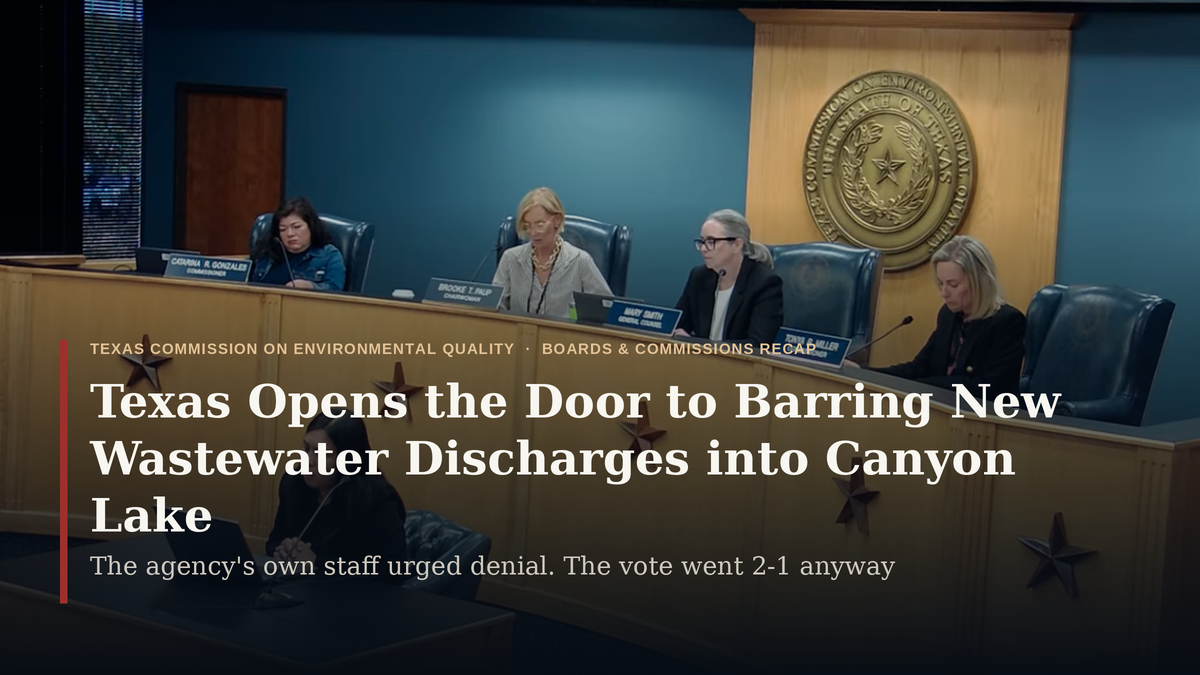
Texas regulators voted Nov. 18 to open an inquiry that could end in rules barring new wastewater discharges into Canyon Lake, overruling their own permitting staff, who had told them the protections already on the books are enough.
The Texas Commission on Environmental Quality granted a residents’ petition on a 2-1 vote and handed it to agency staff to examine. Canyon Lake carries none of the watershed rules that 14 other Texas lakes have, though its water volume “exceeds that of 10 of the 14 lakes already subject to special protections under Chapter 311”, the Office of Public Interest Counsel, which represents the public in agency proceedings, told the commissioners.
The decision reaches the people trying to build around the lake first. Lennar Homes needs a wastewater permit before it can break ground on a 230-acre, 850-home subdivision on the north side of Canyon Lake, My Canyon Lake reported Nov. 16, and the plant it proposes would send up to 600,000 gallons a day of treated effluent down Potters Creek into the reservoir. Whitney Lauderdale, one of several Fischer residents fighting that application, urged neighbors to comment: “This is a chance to let TCEQ know that you are directly affected and concerned by these issues”.
Protect Our Waters of Texas, a group founded by Canyon Lake residents, filed in September with individual petitioners. They ask the state to draw a protection area around the lake, forbid new discharges inside it, require treated water to be put back to use rather than released — beneficial reuse, in the petition’s language — and limit runoff from paving. They also want a freeze on new wastewater permits in the watershed while the state works out how much nutrient pollution the lake can absorb. The model is the Highland Lakes, whose first watershed rules took effect in 1986. The Dispatch previewed the hearing on Nov. 17.
Canyon Lake is “a sitting body of water, not a moving river”, the petitioners’ presenter told the commissioners. A resident who drinks water drawn from the lake said it “needs the same protections as the Highland Lake area”. No member of the public spoke against the petition, and no builder, utility or trade association has taken a public position on it that the Dispatch could find.
The executive director’s water quality staff recommended turning it down. Texas already screens new discharges against the condition of the water receiving them, staff told the commissioners, and the demands for mandatory reuse and for weighing future growth are “outside of our jurisdiction to consider when developing a wastewater permit”. The conclusion was flat: “staff respectfully recommend denying this petition to amend chapter 311”.
The public interest counsel went the other way, urging the commissioners to “grant the petition and initiate rulemaking” but refuse the permit freeze, so pending applications could keep moving. Doing so, the office said, “would not adopt any particular rule language or prejudge the outcome”. Most subchapters added to these rules over the years began as public petitions, it added.
Commissioner Tonya Miller, who the presiding officer said had led on the question earlier in the year, said she was “in favor of granting the petitions” and asked staff to “develop cost estimates”, because such work can cost enough to change what the agency asks lawmakers for. A colleague then asked for a recess, saying she had questions for counsel. It was announced as 10 minutes and ran about 13.
Commissioner Catarina Gonzales came back and said she would deny the petition. A rulemaking of this kind “takes a lot of staff time and resources”, she said, “particularly one without state direction or appropriations”; if lawmakers told the agency to do it and paid for it, “that’s a different story”. The Highland Lakes precedent being pressed on her “occurred in 1986, 40 years ago”, and she did not know what drove it. Existing permitting, she concluded, “is sufficient”.
Chairwoman Brooke Paup disagreed. Given the “high population growth and the extensive recreational use in the area”, she said, staff should “take a closer look at stronger water quality protections”, and “I would approve the petition”. A motion followed to “direct the executive director to initiate rulemaking to examine the issues raised”, a second, and a voice vote.
Granting a petition bans nothing, as all three commissioners said. The commission is only instructing staff “to determine whether rulemaking may be appropriate”, Miller said. The freeze the residents wanted was not in the motion. The work now falls to Steven Schar, confirmed as executive director later the same day. No deadline was set, and the cost estimate could reach the agency’s budget request before lawmakers convene Jan. 12.
A new executive director confirmed, a second petition denied, and two air rule packages sent out for comment. Returning from closed session the commissioners appointed Steven Schar executive director, effective that day, dropping the interim tag he had carried since Oct. 2, when he succeeded Kelly Keel. They also made Eli Martinez public interest counsel, a post he had held on an interim basis. Earlier they turned down a petition from El Paso County vehicle emissions inspection stations seeking to lift the cap on what each may charge drivers from $11.50 to at least $18.50; the chair said she was “still in the same place that I was when this petition came before us earlier this year”, and all three agreed. Two air rule packages went out for publication and comment, one that would adopt federal hazardous air pollutant standards by reference and one clearing obsolete emissions trading provisions. Twenty-one enforcement orders and four contested permits were also listed.