
Every Texas peace officer has to pass a shooting test once a year to keep working. The state does not say how big the target has to be, does not require the person running the test to hold any firearms certification, and never finds out who failed.
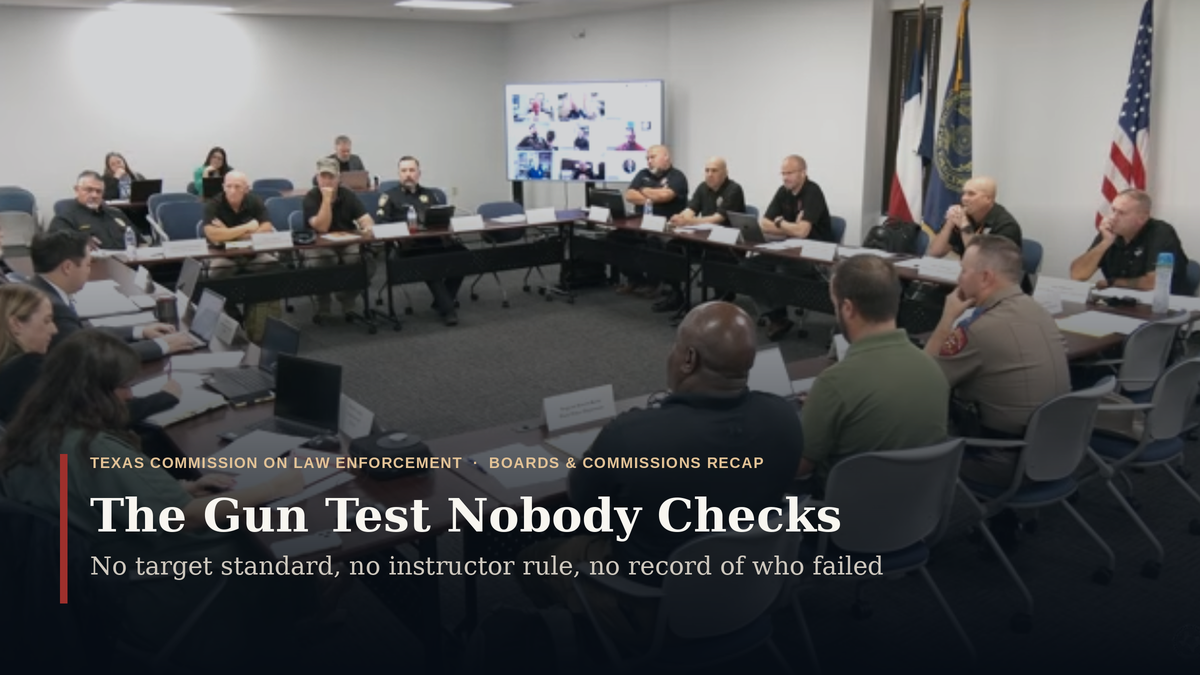
A state advisory committee began rewriting that rule Oct. 13, splitting into three subcommittees to do it. Two of the sharper ideas raised that morning — making departments report failed qualifications to the state, and extending the requirement to licensed officers who hold no job — were floated and abandoned within the hour.
The rule reaches 83,825 currently appointed peace officers and more than 26,000 licensed jailers across 2,773 law enforcement agencies, by the undated counts the Texas Commission on Law Enforcement publishes, read Oct. 15. That is more agencies than any other state has, and one sentence must work for the Department of Public Safety and for a one-man constable’s office. It asks for 50 rounds with a handgun, from point-blank out to at least 15 yards, at least 20 of them from 7 yards or farther, and one timed reload. “The minimum passing percentage shall be 70 for each firearm,” it reads.
That silence is what the committee’s chair, Lewisville police chief Brook Rollins, ran into when he asked members to send in the courses of fire — the sequence of shots an officer must make to pass — their departments use. What came back showed “a significant difference in target design, scoring methods, and passing requirements,” he told the meeting, with handgun passing standards running “from 70 to 100%”, and he warned that the percentages alone “do not establish how difficult a qualification is”. Seventy percent on a silhouette the size of a door and 70 percent inside a six-inch box are not the same test.
The version that stuck came from a sergeant, repeated back by the chair: with no target specified, a department could tack butcher paper to the side of a barn and satisfy Texas. “That gave me a lot of chills when whoever it was said that,” Rollins said.
Writing a tighter rule is harder than it sounds. A chief from a small South Texas department said he drives his officers 40 miles to borrow a range long enough for the patrol rifle course, and that federal agencies keep the valley’s ranges booked. A commission staff member warned that the more precisely the state specifies, the more departments will ask out under the hardship waiver the executive director may grant: “Everybody finds a hardship.” Staff would rather leave room for Fort Worth and El Paso to write courses fitting what they do. The committee leaned toward capping the size of a target’s main scoring zone instead of naming an approved target, leaving small departments free to buy whatever they can get.
Qualifying is an obligation on the employer, not on the license holder. An officer who misses the 12-month deadline “literally could get the agency in trouble” at its next state inspection, the staff member said, but “that human being” is not. Nothing requires that results reach the state at all; the reporting slot in the training database is optional and, staff said, mostly ignored. A member asked the committee to recommend mandatory reporting of passes and failures alike; staff said they would be resistant to managing another report, and he withdrew it minutes later. “That’s still a good recommendation,” Rollins told him. “We just hear a good dialogue on it.”
Texas also does not require anyone who teaches police to shoot to be certified for it. The rule contemplates a departmental record keeper it calls a firearms proficiency officer, whose job a staff member described as knowing how the test is given, how it is scored and how the paperwork is kept. He added that “no one in the state of Texas has to have a firearms instructor certificate”. A member had just argued that an instructor who last shot the course 15 years ago should not be certifying anyone.
Both of the state’s large police employee organizations are inside the process, not outside it. John Wilkerson of the Texas Municipal Police Association chairs the subcommittee on definitions, a representative of the Combined Law Enforcement Associations of Texas sits on it, and the chair remarked on it: “we have TMPA and Cleat sitting in one place”. No outside organization has taken a public position on the rewrite. The subcommittees report progress when the committee meets again Nov. 10 in Austin, drafts are wanted in December, and the recommendations are due in May — to the nine-member commission, which decides what becomes a rule.
A second idea died in the room. The chief of a West Texas department asked whether the rule could be reopened so that people who hold a peace officer license but are not appointed by any department would also have to qualify. Staff explained that unappointed license holders carry no continuing-education burden either and simply go inactive, and the chair told him it “might be a fool’s errand”. He dropped it. A calendar-year loophole survives. Because the rule counts by calendar year rather than from the last qualification, an officer can shoot on Dec. 31 and not shoot again until Dec. 31 of the following year. The chair said the gap “had me nervous” and handed it to the definitions subcommittee. Night and shoot-don’t-shoot were turned away. A captain asked for nighttime, moving-target and decision-making elements in the minimum standard. Members answered that a qualification is a test with an objective score and that adding judgment calls would import subjectivity; the idea was redirected toward recruit training.